Smile4LifeADVANCED DENTAL AESTHETICS & IMPLANTOLOGY

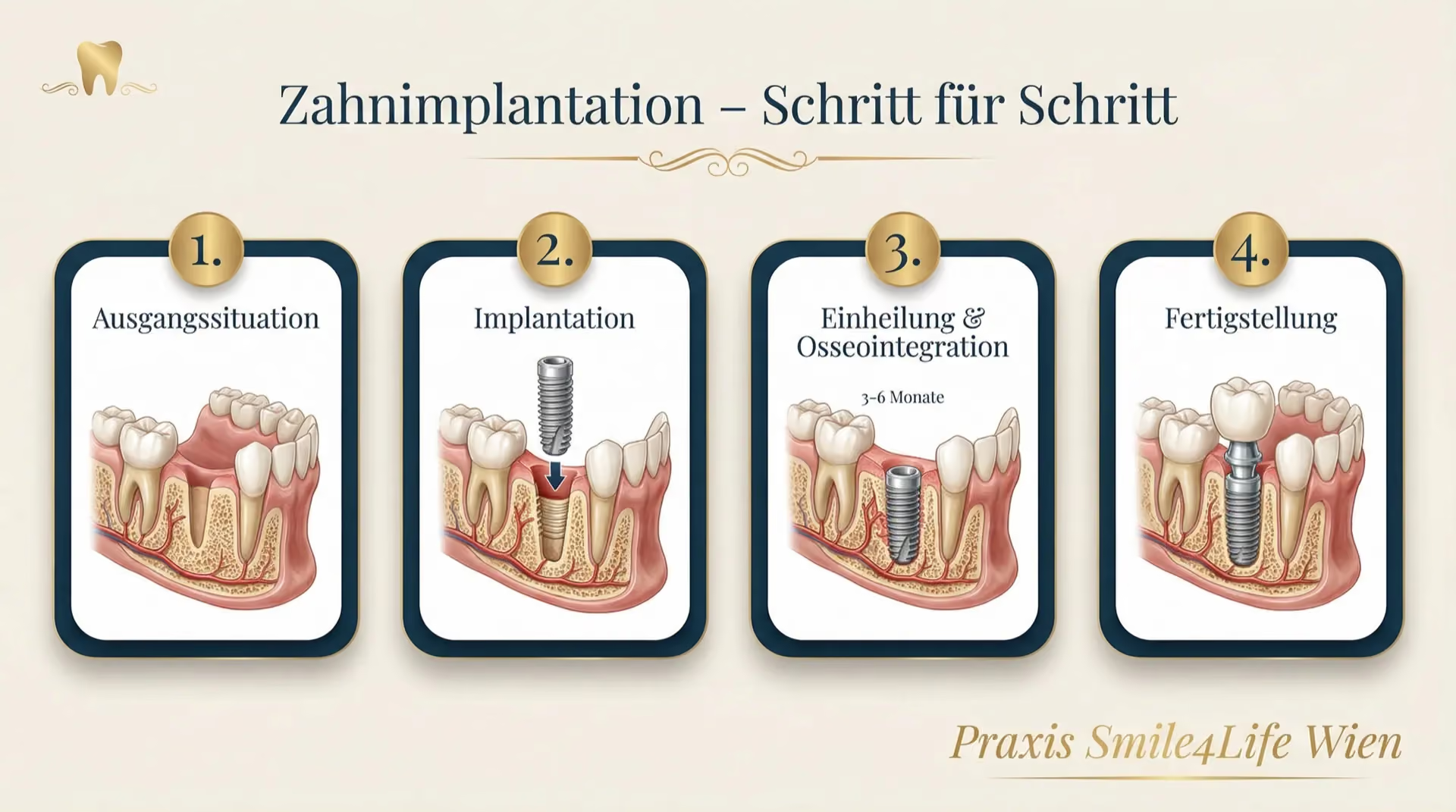
Infographic showing four steps in dental implant treatment, from the initial situation to the crown.
Implantologie

Dental implant treatment in Vienna: from planning to crown

There are several steps between the first examination and the completed restoration. Your treatment plan brings together the appointments, healing and a suitable restoration for the intervening period.

Examination and planning

Support healing

Discuss the interim period

Plan for aftercare

Book an appointment

Dental Implant Treatment Vienna

zahnimplantat-ablauf

4.9★

Doctify rating

25+

Years of experience

Personal

In-practice consultation

1010 Vienna

Kärntner Straße 9

  • How many appointments are needed for a dental implant?

    Usually several: examination and planning, placement, a wound check with stitch removal after 7 to 14 days, and appointments for an impression and crown.* Bone augmentation or uncovering a healed implant adds further appointments.

    3D X-rays for planning →

  • How long does healing take after a dental implant?

    The stitches are removed after about one to two weeks; integration with the bone takes longer. Healing and the timing of the restoration depend on stability, findings, progress and the planned loading protocol. An early temporary restoration is only possible under suitable conditions; it does not mean unrestricted loading is allowed. Bone augmentation can make the process longer.*

  • Is a dental implant worse in the upper or lower jaw?

    Neither is inherently worse. In the upper jaw, proximity to the sinus and often softer bone play a role; in the lower jaw, the course of the mandibular nerve matters. If height is lacking in the upper jaw, a sinus lift may be needed first.

    Sinus lift in the upper jaw →

  • How painful is implant placement?

    The procedure is often performed under local anaesthesia. Discuss questions or previous experiences with anaesthesia with the treatment team beforehand. Wound pain and swelling for a few days afterwards are common. Guided procedures without raising a gum flap caused less pain in five randomised studies, with low certainty of evidence.*

Indicative prices & costs →

The treatment process at a glance

From examination and shared planning through surgery and healing to a suitable restoration and aftercare.

Infographic showing four steps in dental implant treatment, from the initial situation to the crown.

1. Dental implant treatment: examination and shared planning

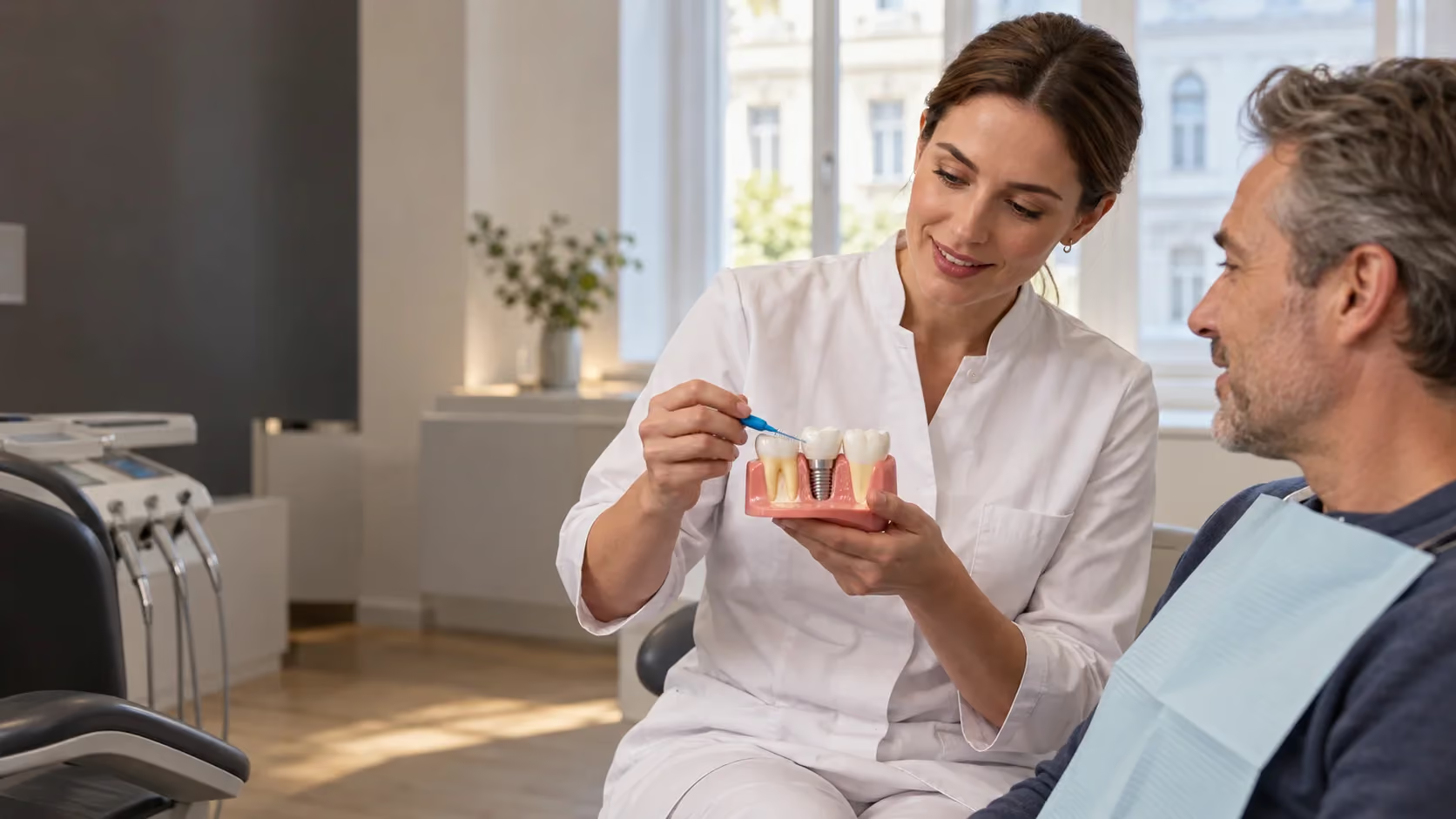
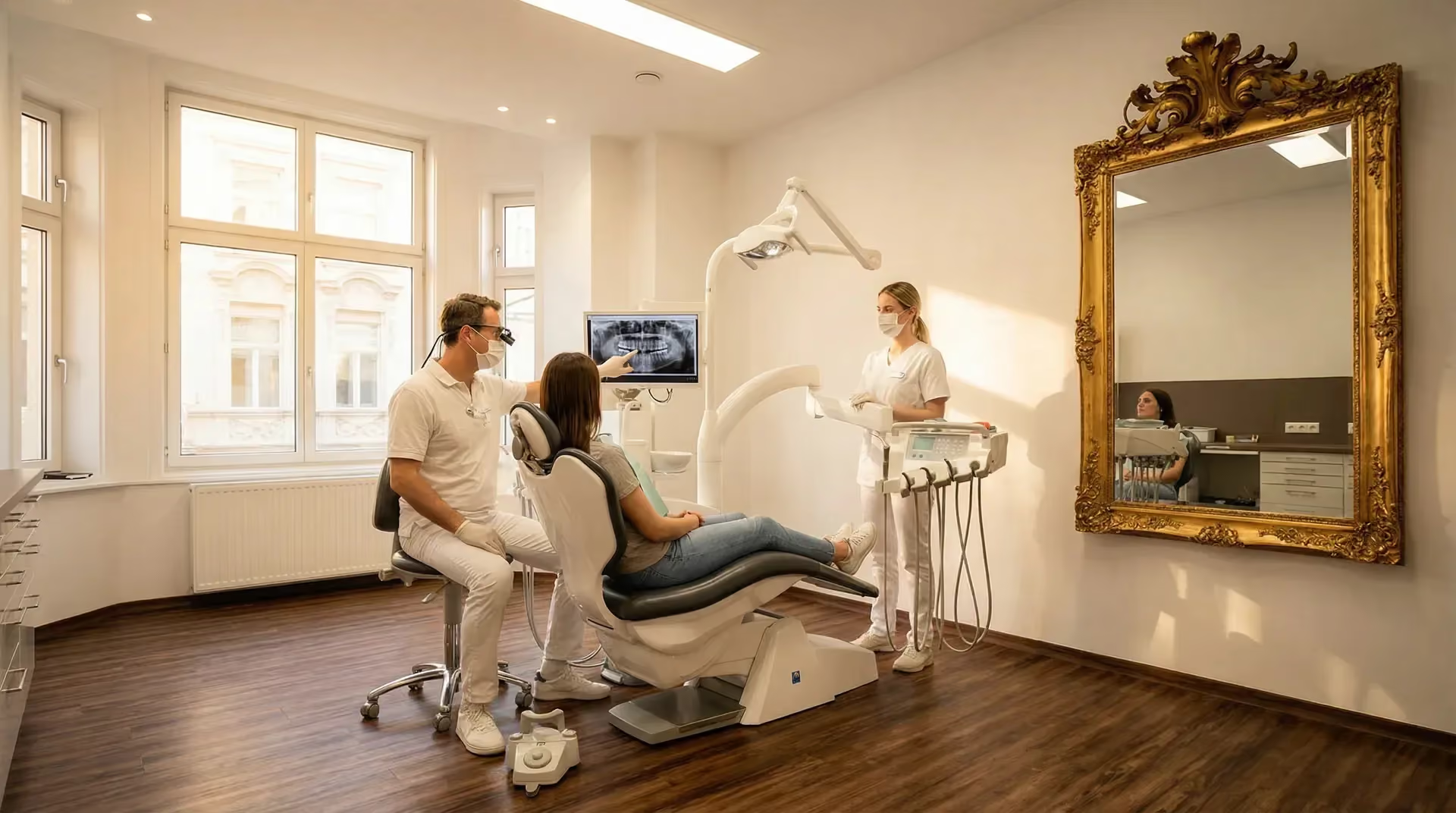
We start by assessing your gap, remaining teeth, gums and general health. Bring your medication list and relevant examination records or reports. Any additional imaging depends on the questions that remain after the examination.

The consultation also covers alternatives, the likely extent of treatment and a possible temporary restoration. Ask which appointments can be anticipated and which decisions can only be made after preparatory treatment. The timetable should suit your examination findings, rather than a blanket number of weeks.

2. Preparation and implant placement

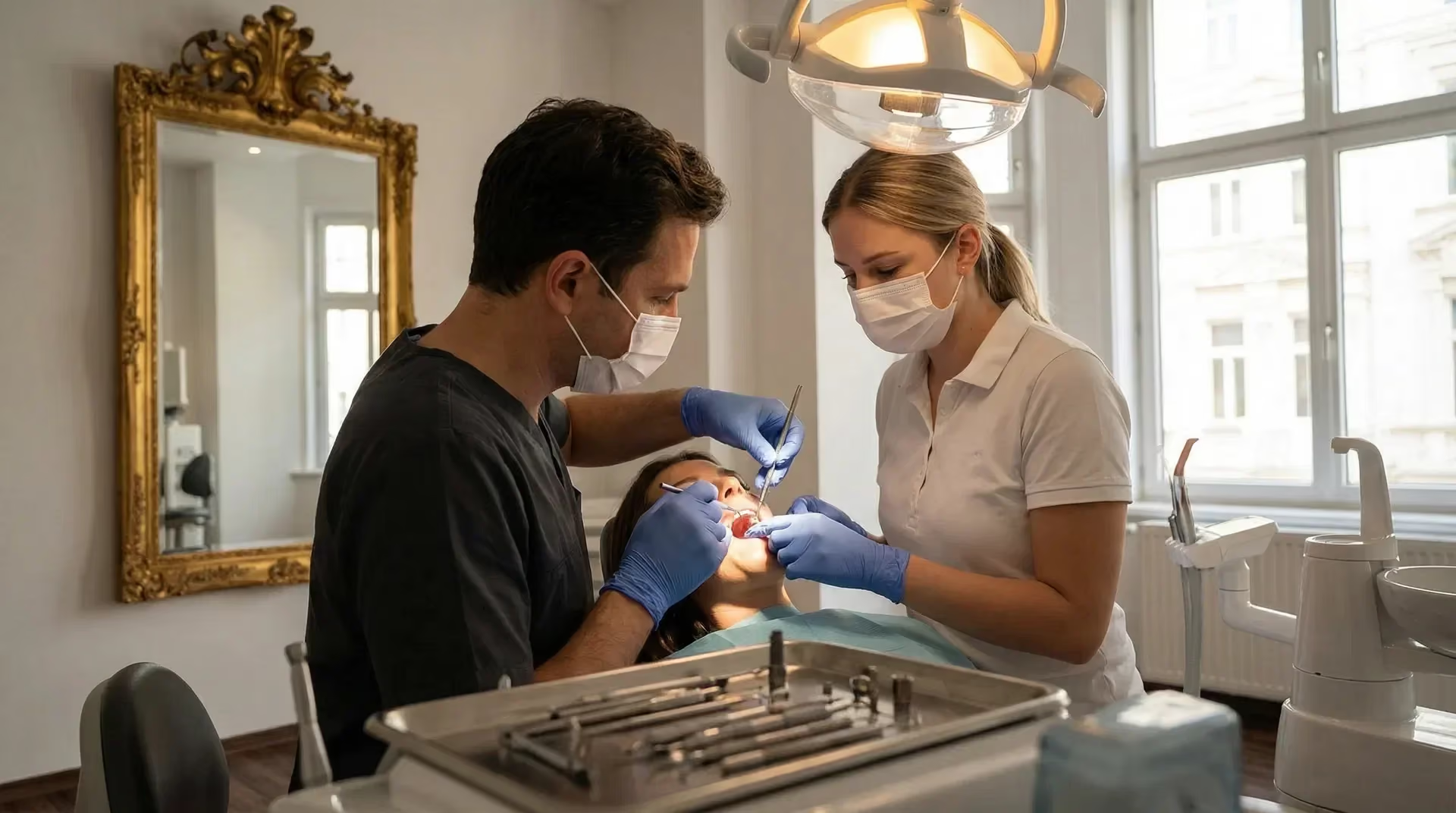
If inflammation or other findings need treating first, this takes place before or as part of the planned implant restoration. Depending on the situation, tooth extraction and implant placement may be separate appointments. Immediate placement is a separate decision.

The procedure is often performed under local anaesthesia. Discuss anxiety, previous experiences and questions about anaesthesia with the treatment team beforehand. The duration depends on the extent of surgery. A general time estimate cannot determine your personal appointment schedule.

What happens during surgery?

To place the implant, the jawbone is accessed and the planned implant site is prepared. The implant is inserted; depending on the approach, the wound area is then closed or managed for open healing. Whether the implant needs to be uncovered later depends on how the gum heals over it.

For the restoration, an impression or digital scan is taken later. This forms the basis for making the crown. The method used is part of the individual plan.

A fully guided static “flapless” approach, without raising a gum flap, showed less postoperative pain than conventional surgery in five randomised studies, with low certainty of evidence; a reduction in swelling was not conclusively demonstrated. Differences in accuracy and operating time concern the technique studied and are not a promise for an individual procedure (Romandini et al., 2022). Whether this approach suits your findings is decided during planning.

3. Supporting wound healing and integration

After surgery, you receive instructions on wound care, eating and prescribed medication. The fresh surgical site is checked. Contact the team if discomfort increases significantly, you develop a fever or bleeding does not settle.

During healing, the implant bonds with the bone. Whether this has happened cannot be judged by whether you have pain — so check-ups at the practice determine when the implant may bear load. Include these appointments in your plans from the outset. The YERIT guide Dental implant treatment process explains in more detail what happens in the bone and what affects healing.

Will I have to live with a gap in the meantime?

Depending on your findings, a temporary restoration may be planned for the intervening period. Before surgery, ask what it will look like, how to clean it and how much load is allowed. A temporary crown and a final replacement tooth that can bear full load are not the same thing.

Healing remains important even when a temporary restoration is provided quickly. Whether this approach is possible is assessed for your situation. Details of immediate treatment concepts belong in a separate consultation and are not assumed for every implant procedure.

How long does the entire dental implant treatment take?

The duration of surgery and the total treatment time are different things. Total time includes preparation, the healing phase and making the restoration. Bone augmentation or necessary treatment of inflammation may add further steps. Ask for an expected timeframe until the final crown and what might change it.

4. Fitting and checking the restoration

Once the requirements are met, the final restoration is fitted. This includes checking its fit, contacts when biting and access for cleaning. Ask to be shown how to reach the junctions and spaces between teeth.

After the restoration is fitted, check-ups follow at individually agreed intervals. The dental implant care page explains daily care afterwards. You can discuss the financial scope using the cost components. All starting points are available under dental implants in Vienna.
Sources and context

The extent of treatment, appointments and aftercare are discussed based on your examination findings.

YOUR OPTIONS

TREATMENT OPTIONS COMPARED

We will discuss payment terms with you prior to treatment.

Advanced Dental Aesthetics & Implantology

Priv.Doz.Dr.Dr. K. Yerit

“Aesthetics is not a coincidence, but the result of precise planning and deep passion.”

Every step of implant treatment at our practice is carefully planned, never rushed — scientifically precise and explained in a way you can understand.

View profile →

Scientific references

Institute for Implantology and Digital Dentistry Vienna

Österreichische Gesellschaft für Implantologie (ÖGI)

European Association for Osseointegration (EAO)

Deutsche Gesellschaft für Implantologie (DGI)

International Team for Implantology (ITI)

Yerit Practice – Dentist Vienna

Frequently asked questions

Frequently asked questions

Am I suitable for dental implants?
How long do dental implants last?
When can I eat normally again after implant surgery?
How long will I need to take off work after implant surgery?
How much does implant treatment cost, and does insurance cover it?

Do you have a specific question about your diagnosis? Book a consultation appointment directly →

Questions about your treatment?

Discuss what matters to you and what the next steps look like with us.

Book your appointment now

SCIENTIFIC STUDIES

Evidence-based medicine

The sources help to classify the possibilities and limitations of the treatment. Their results are not a guarantee for any individual case.

Pandey C et al. (2022). Contemporary Concepts in Osseointegration of Dental Implants: A Review

Healing of the implant into the bone (osseointegration) is the biological basis for success. Implant design, bone quality and loading instructions have a substantial influence on the healing process (BioMed Research International, 2022).

35747499

Lupi SM et al. (2026). Dental implant survival and marginal bone loss after a minimum of 20 years: systematic review and meta-analysis of prospective studies

This systematic review examines the survival of titanium implants over at least 20 years. The findings describe implant retention under different study conditions, not a personal guarantee, the lifespan of the crown or freedom from complications.

42173763

Prevention and treatment of peri-implant diseases—The EFP S3 level clinical practice guideline

Inflammation around implants requires its own diagnosis and treatment. Cleaning, risk control and aftercare are part of this. No procedure guarantees implant preservation or complete tissue regeneration. These outcomes must not be equated with treatment outcomes for natural teeth.

37271498

Krennmair S et al. (2022). Immediately loaded implants placed in fresh extraction and healed sites supporting four-implant fixed mandibular prostheses using the All-on-4 concept: A 5-year prospective study

In a prospective study of the lower jaw, 22 of 24 people with 88 implants were followed for five years. No implant was lost in this group; inflammation nevertheless occurred. The result is not a general guarantee of success.

34800325

Galarraga-Vinueza ME et al. (2025). Prevalence, incidence, systemic, behavioral, and patient-related risk factors and indicators for peri-implant diseases: An AO/AAP systematic review and meta-analysis

An AO/AAP review of 102 studies and 13,030 people reports a person-level prevalence of 46 percent for peri-implant mucositis and 21 percent for peri-implantitis. Periodontitis, smoking, diabetes, alcohol consumption and excess weight were identified as risk indicators; the review did not measure a protective effect of follow-up care or oral hygiene (Journal of Periodontology, 2025).

40489307

Moraschini V et al. (2024). Long-term survival and success rate of dental implants placed in reconstructed areas with extraoral autogenous bone grafts: A systematic review and meta-analysis

The review examined implants in areas reconstructed with the patient’s own bone harvested from outside the mouth. It reports long-term survival rates for these grafting procedures. The results cannot be applied generally to every type of bone grafting or substitute material, and they are not an individual guarantee of success.

38450931

Diaz P et al. (2022). What is the prevalence of peri-implantitis? A systematic review and meta-analysis

Peri-implantitis occurs in around 19.5% of patients and 12.5% of implants, making regular check-ups an integral part of follow-up care (BMC Oral Health, 2022).

36261829

Tekpınar L, Yiğit V (2024). Cost-Effectiveness Analysis of Implant-Supported Single Crown and Tooth-Supported Fixed Dental Prostheses in Turkey

A Markov model from Türkiye compared implant-supported single crowns with tooth-supported bridges over 20 years. In the model, single crowns provided greater quality-adjusted benefit from the restoration, but also involved higher costs. The study examined single-tooth replacement, not restoration of an entire jaw. The results are not a price forecast for treatment in Vienna.

38340673

Romandini M et al. (2022). Minimal invasiveness at dental implant placement: A systematic review with meta-analyses on flapless fully guided surgery

The review of five randomised studies compared statically fully guided implant placement without raising a gum flap with conventional procedures. Less postoperative pain was reported, with low certainty of evidence; a reduction in swelling was not reliably demonstrated. Differences in accuracy and procedure duration relate to this specific technique and are not a promise for an individual procedure.

35906928

After having a dental implant (Patient information, Resource 2846/VER4)

The patient information from Guy’s and St Thomas’ describes possible wound pain, swelling and bruising after the procedure. For the treatment pathway described there, it mentions usual painkillers, discomfort lasting up to one week and removal of stitches after 7 to 14 days (guysandstthomas.nhs.uk, accessed 03.11.2026).

Having a dental implant (Patient information, Resource 2846/VER4)

For the treatment pathway described, the patient information from Guy’s and St Thomas’ generally states a healing period of at least three months before an implant can support a dental restoration; where bone grafting is performed beforehand, it mentions around four to six additional months (guysandstthomas.nhs.uk, accessed 03.11.2026).

Research findings help inform treatment decisions; they do not guarantee an individual outcome. We discuss suitable options with you based on your clinical findings and the planned treatment.

Evidence-based dentistry

ESCD
DGÄZ
AACD
AAED
Bright waiting area with large windows, chairs and a gold-framed wall mirror.

Kärntner Straße 9

100 meters from Stephansplatz, Innere Stadt.

Personal Consultation

Priv.Doz.Dr.Dr. K. Yerit

During a personal consultation, we will discuss your goals and the appropriate treatment options. The information on this page does not replace such an examination.

Partnerships & Memberships & References