Immediate implant treatment in Vienna: step by step to replacement teeth
Whether an implant can be placed directly after extraction depends on the findings. Any same-day crown is temporary. The final crown follows healing. Discomfort is possible after surgery.
Examination and planning
Clarify the interim solution
Support healing
Plan a suitable crown
Immediate Implant Treatment Vienna
sofortimplantate-ablauf-wien
4.9★
Doctify rating
25+
Years of experience
Personal
In-practice consultation
1010 Vienna
Kärntner Straße 9
At a glance
What happens during immediate implant placement?
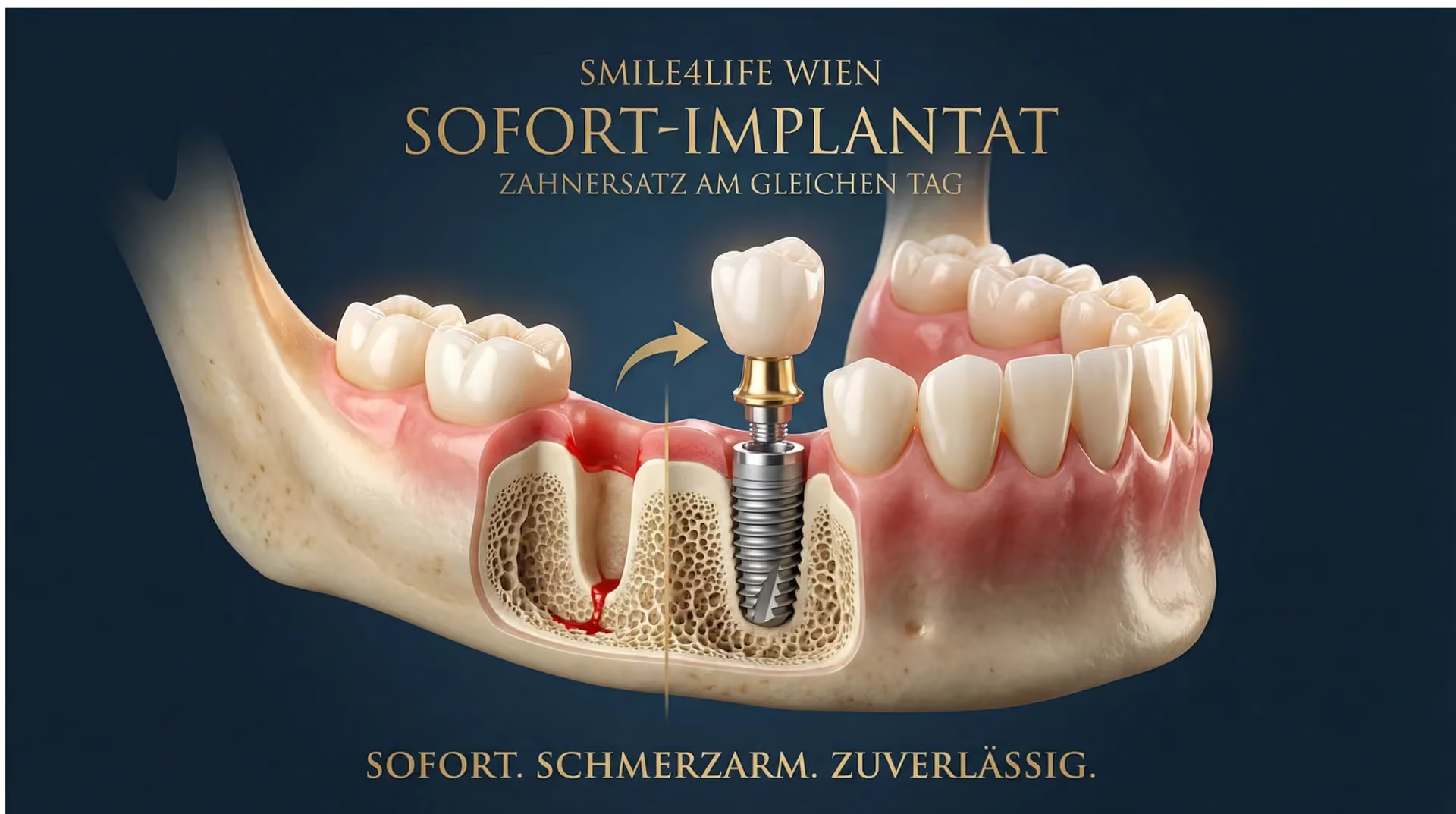
After examination and planning, the tooth is removed and the socket assessed. The implant is placed directly only if conditions and stability are suitable.
The implant is placed at the same appointment as extraction; it then usually needs several months of healing before the final crown. In one study, immediate placement shortened the path to the finished restoration by about five to seven months.*
Is immediate implant placement painful?
Anaesthesia and symptom management are discussed before surgery. Wound pain, swelling or bruising are possible afterwards; the treatment team explains appropriate aftercare.*
Do you get a fixed tooth straight away with an immediate implant?
Sometimes: if the implant is stable enough in the bone, a temporary crown may be attached on the same day and protected when chewing. If a temporary crown on the implant is not possible, another appropriate interim solution is planned; the final crown follows healing.
How does healing after an immediate implant work?
The implant bonds with bone while the gum and socket remodel. Healing and restoration timing depend on stability, findings, progress and the planned loading protocol. An early temporary restoration is only possible under suitable conditions; it does not mean unrestricted loading is allowed. Checks assess the wound, stability and cleaning.*
The treatment process at a glance
From examination and extraction through the implant decision and interim solution to healing, crown and aftercare.

Immediate implant treatment: 1. Examination and planning
The process starts with whether the tooth can be preserved. If extraction is necessary, replacement options are discussed. An immediate implant needs a suitable anchoring site and a clear plan for the eventual crown. At our practice in Kärntner Straße in the 1st district, we first assess during examination whether immediate placement may be possible — the definitive decision is only made on extraction day. YERIT explains the general pathway in the guide Immediate implant placement: treatment process.
Gums, bone and signs of inflammation are assessed. Existing imaging, medical conditions, medication and smoking also belong in planning. The risk is real: a review finds roughly twice the risk of early implant loss in smokers, and an even greater increase in the upper jaw. In the EAO position paper on immediate placement in front teeth and premolars, three-dimensional imaging forms part of preparation. Which examinations your case needs is determined individually.
Discuss now what happens if the implant cannot be placed safely after extraction after all. Source: EAO position paper.
2. Extraction: immediate placement if stability is suitable
The tooth is removed and the socket assessed. This reveals whether the previously planned position provides sufficient stability. The implant is placed directly only when the requirements are met. This is the step described by immediate implant placement.
If stability is insufficient or the findings are unfavourable, placement may be postponed. A retrospective cohort study found a pathway five to seven months shorter with careful selection for immediate placement, but recorded early losses that occurred exclusively in immediate-placement groups in that cohort. Depending on the starting situation, healing or preparatory measures may come first. Later placement is a normal treatment pathway, not failed planning. A review of immediate placement in the aesthetic zone supports this context: the available studies do not methodologically establish superiority over later placement.
3. Restoring the gap during healing
An immediately placed implant screw and an immediately visible tooth are not the same. Whether a temporary crown can be placed directly on the implant also depends on its stability, the bite and the chosen restoration concept. If not possible, another interim solution is discussed.
Ask explicitly whether the temporary restoration only closes the visible gap or may already bear load. Even a fixed temporary restoration is not general permission to bite. The final crown and functional loading remain separate decisions.
4. Healing and aftercare
After placement, the implant must integrate with the bone. Progress, additional measures and the restoration concept determine when the next step is possible. A blanket operating time or fixed date for the final crown would be too imprecise.
Ask for a personal aftercare plan: how do you clean the site? What applies to eating and physical activity? When is the next check-up? Follow these instructions rather than applying general online timescales to your situation. Their importance is illustrated by a study of peri-implantitis prevalence, which found affected sites in around 19.5 per cent of patients and 12.5 per cent of implants — a reason why agreed checks remain part of aftercare.
Contact the treatment team promptly for increasing symptoms, persistent bleeding, fever or a mobile restoration. Please do not tighten a mobile crown or implant yourself. Aftercare and contact advice for problems.
5. The final crown on the implant
When healing and stability allow, the final restoration is prepared. Shape, fit and contact with opposing teeth are among the factors assessed. Whether the crown is screwed in or attached otherwise forms part of individual planning; there is no single attachment method for all cases.
Thorough care and agreed checks remain important after the restoration is complete. Smoking is associated with an increased risk of implant loss. Immediate placement does not remove those risks. Review of risk factors.
Pain, time off and questions for your appointment
Anaesthesia and symptom management are discussed before surgery. Pressure, wound pain and swelling are distinct from whether an implant integrates well. The term immediate implant does not establish a firm promise of freedom from pain or return to work.
- Which anaesthesia is planned?
- Which alternative pathway is prepared?
- How will the gap be restored and how may I chew?
- Which check-ups and contact options are planned?
- What costs arise up to the final crown?
Return to the immediate implants in Vienna overview or continue to costs and the cost plan.
Examination, extraction and possible implant placement, healing and the final crown are planned as a connected course of treatment.
YOUR OPTIONS
TREATMENT OPTIONS COMPARED
We will discuss payment terms with you prior to treatment.
The indicative market prices in our price overview provide an initial guide. We will discuss which services are planned for you and the costs involved based on your examination findings and individual cost plan.
Advanced Dental Aesthetics & Implantology
Priv.Doz.Dr.Dr. K. Yerit
“Aesthetics is not a coincidence, but the result of precise planning and deep passion.”
The key to success lies in precise planning rather than the speed of implant placement.
View profile →Scientific references
Institute for Implantology and Digital Dentistry Vienna
Österreichische Gesellschaft für Implantologie (ÖGI)
International Team for Implantology (ITI)
European Association for Osseointegration (EAO)
Deutsche Gesellschaft für Implantologie (DGI)
Yerit Practice – Dentist Vienna
Frequently asked questions
Frequently asked questions
Do you have a specific question about your diagnosis? Book a consultation appointment directly →
Questions about your treatment?
Discuss what matters to you and what the next steps look like with us.
Book your appointment nowYour orientation
Each step has a purpose: a well-planned path from the diseased tooth to a suitable restoration.
Understanding what’s involved
The timetable depends on initial findings, necessary preparation and healing. Ask for each next step to be explained.
In everyday life
The interim solution should fit your everyday life. Before treatment, clarify what you may eat with it and what protection is recommended for your situation.
Who this information is for
Important limitations
Our approach
SCIENTIFIC STUDIES
Chen R et al. (2025; online 2024). Effectiveness of immediate implant placement into defective sockets in the esthetic zone: A systematic review and meta-analysis
The review examines selected defective extraction sockets in the aesthetic zone. Its single-arm design cannot establish superiority over later implant placement. Print 2025, online 2024; PMID 38493065.
38493065
Shi JY et al. (2022). Bone preservation or augmentation simultaneous with or prior to dental implant placement: A systematic review of outcomes and outcome measures
How many implants remain in place (implant survival) and how much bone gain is seen on X-rays are the most frequently studied success criteria for bone augmentation procedures around dental implants (Clinical Oral Implants Research, 2022).
35817421
Meier M et al. (2026). Immediate vs. Delayed Implant Placement Following Alveolar Ridge Procedures with Xeno-Hybrid Bovine Bone Graft: A Retrospective Cohort with Operator-Level Comparison
With careful case selection, immediate implant placement shortens the treatment pathway by five to seven months compared with delayed placement. However, in this retrospective cohort of 158 procedures, early implant losses occurred only in the immediate groups (6.3 and 6.5 percent compared with no losses in the delayed group); within their cohort, the authors do not see this as a clear increase in risk (Diagnostics, 2026).
42072856
Giok KC et al. (2026; online 2025). Factors leading to implant failure: An umbrella review of meta-analyses of observational studies and trials
The review reports an association between smoking and implant loss. For immediate compared with delayed implant placement, pooled randomized studies provide moderate evidence of a higher risk of failure. This is not an individual risk estimate; print 2026, online 2025; PMID 40425441.
40425441
After having a dental implant (Patient information, Resource 2846/VER4)
The patient information from Guy’s and St Thomas’ describes possible wound pain, swelling and bruising after the procedure. For the treatment pathway described there, it mentions usual painkillers, discomfort lasting up to one week and removal of stitches after 7 to 14 days (guysandstthomas.nhs.uk, accessed 03.11.2026).
Having a dental implant (Patient information, Resource 2846/VER4)
For the treatment pathway described, the patient information from Guy’s and St Thomas’ generally states a healing period of at least three months before an implant can support a dental restoration; where bone grafting is performed beforehand, it mentions around four to six additional months (guysandstthomas.nhs.uk, accessed 03.11.2026).
More topics in this area
Deepen your knowledge – find all information regarding the treatment process, costs, and results.


Kärntner Straße 9
100 meters from Stephansplatz, Innere Stadt.

Partnerships & Memberships & References