
Immediate implants in Vienna: placement directly after extraction
Does a tooth need removing? Find out whether an implant could be placed directly afterwards and how the gap can be closed until the final restoration.
Understand suitability
See the treatment steps
Weigh up alternatives
Discuss your cost plan
Immediate Implants Vienna
sofortimplantate-wien
4.9★
Doctify rating
25+
Years of experience
Personal
In-practice consultation
1010 Vienna
Kärntner Straße 9
At a glance
What is an immediate implant and when is it possible?
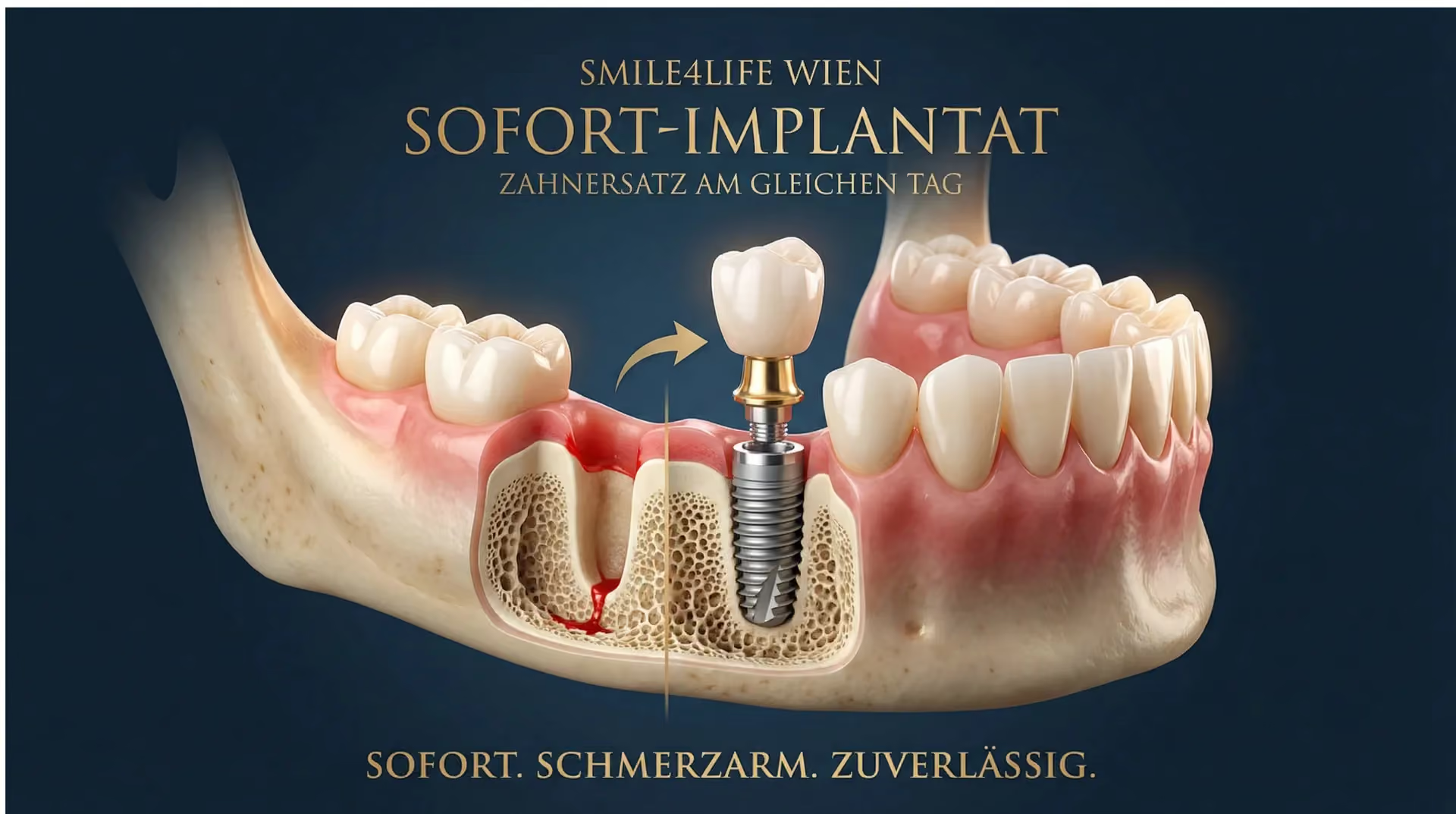
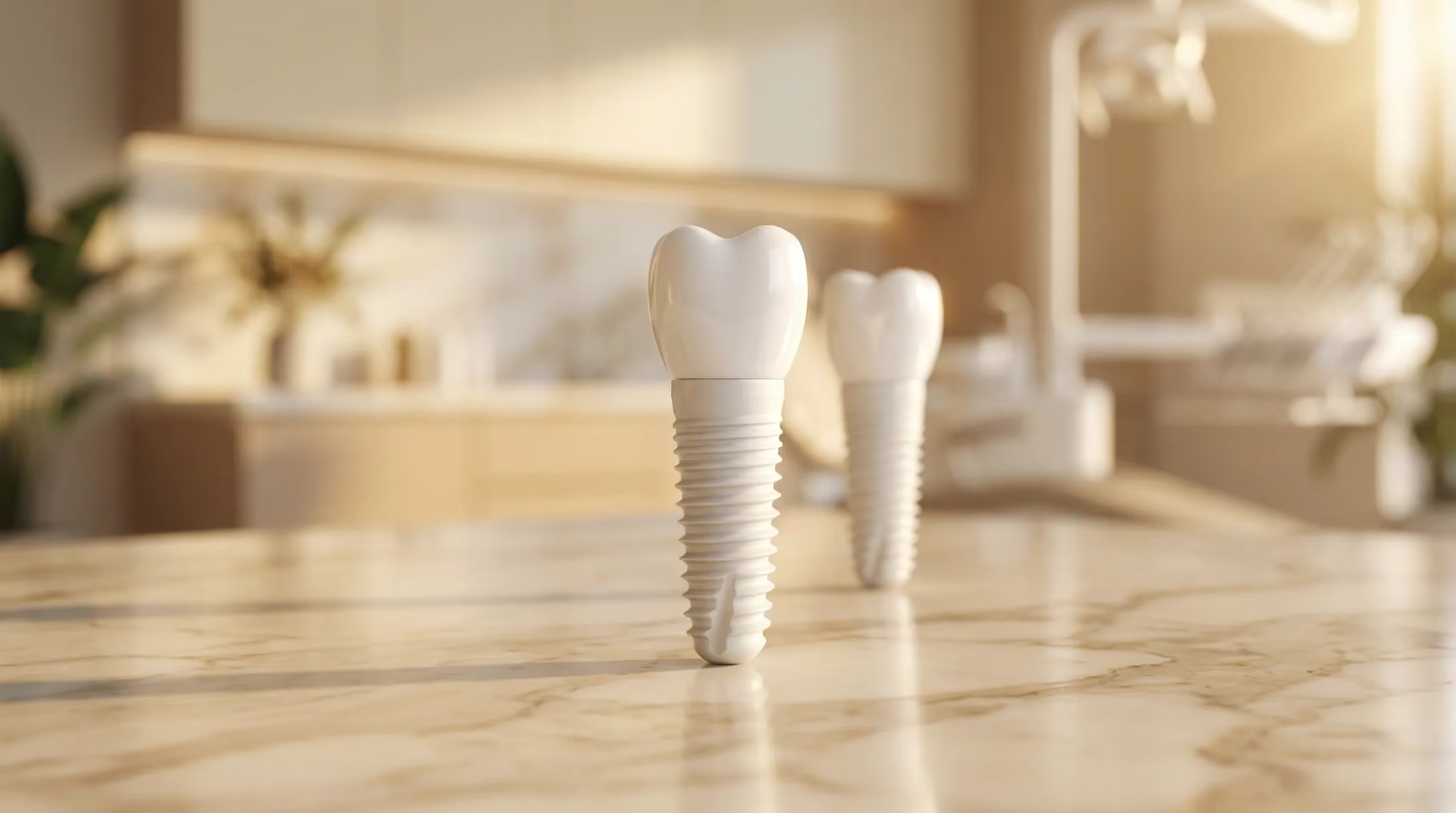
An immediate implant is placed in the socket directly after tooth extraction.
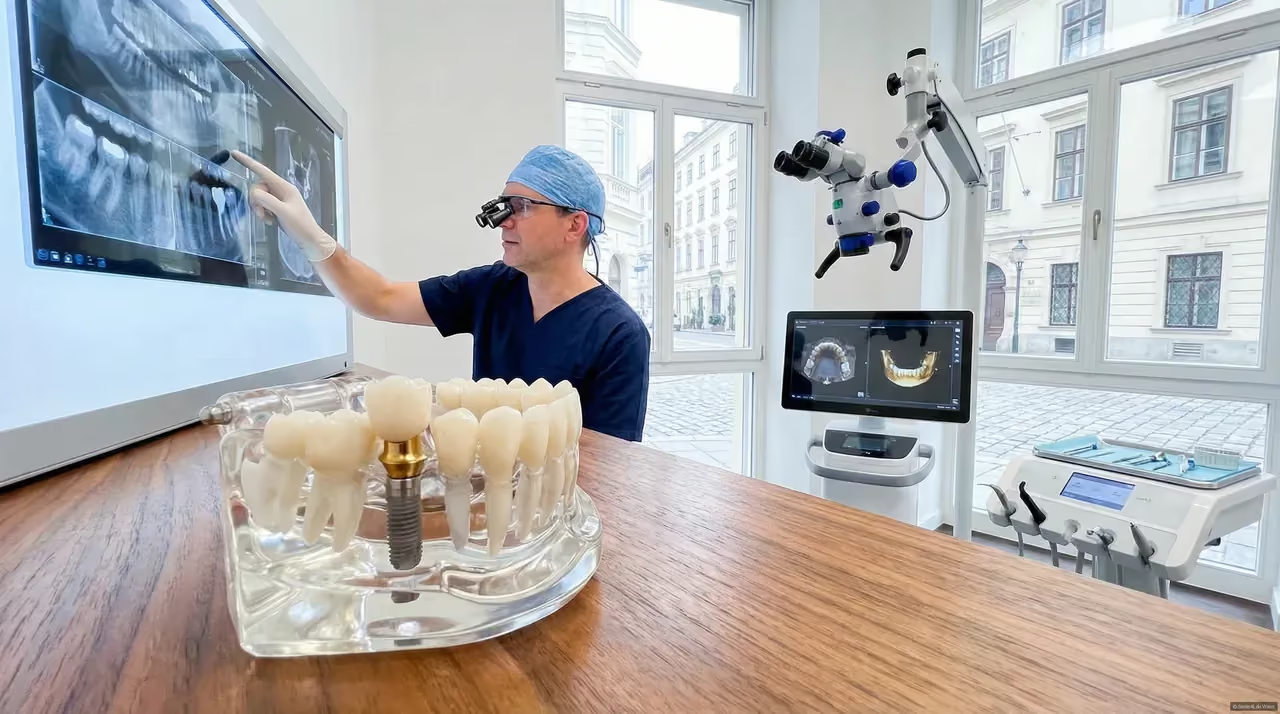
This may be an option when the tooth can be removed without acute inflammation, the socket’s bone walls are largely intact and the implant is firmly anchored in the remaining bone. Examination and appropriate X-rays enable planning. Whether the implant can actually be placed immediately is only established definitively after extraction.
Why is an immediate implant sometimes not recommended?
For example, where there is acute inflammation, a missing or very thin bone wall, or insufficient implant stability. Healing is then allowed first and bone preserved or augmented if necessary; the implant follows after several weeks to months.
What are the disadvantages of an immediate implant?
The risk of early implant loss may be higher than with later placement. In a cohort of 158 procedures, 4.4 % of implants were lost early, exclusively following immediate placement; the path to a crown was several months shorter.*
How long does an immediate implant last?
An individual lifespan cannot be predicted. A review of 630 immediate implants in damaged sockets in the visible area found survival of 98.1 %, but only over short- to medium-term observation. The single-arm analysis has no comparison with later-placed implants.*
What does immediate implant placement mean?
Immediate implants are placed directly after tooth extraction in the same appointment — hence the name. This can avoid part of the waiting time between these two steps. Whether it is possible depends on the socket, bone and other findings.
A placed implant is not yet a finished crown. The temporary restoration and when you may chew on it are planned separately.
Could an immediate implant suit you?
The first question is whether your natural tooth can be preserved. If it must be removed and an implant is planned, immediate placement may be an option. This needs particularly careful planning because socket condition and implant stability must be suitable immediately after extraction.
- How much load-bearing bone is available?
- What are the bone walls and gums like?
- Is there an acute infection or another finding needing treatment?
- Which conditions, medicines or habits affect planning?
Findings and appropriate X-rays are assessed for planning. The EAO position paper on immediate placement in the anterior and premolar region identifies three-dimensional imaging as an important planning requirement. However, imaging alone cannot predict with certainty whether immediate placement will be possible during surgery. Clinical basis for case selection.
What happens on the day of extraction?
After extraction, the socket can be assessed directly. If the implant has enough stability in its intended position, it can be placed. If this requirement is not met, delayed treatment may be more appropriate. A plan B discussed beforehand helps make this decision understandable.
Even after placement, restoring the visible gap remains a separate question. A temporary crown on the implant is only possible under suitable conditions. Otherwise, another interim solution may be used. A visible tooth therefore does not automatically mean you may bite normally straight away.
The individual steps are explained under Immediate implant: treatment and healing.
When is another approach more suitable?
An acute infection, unfavourable bone conditions or insufficient stability may argue against immediate placement. A previous change at the root tip, however, is not the same as every acute infection. Whether and when an implant can be placed must be decided from the individual findings. A retrospective cohort study describes a treatment pathway five to seven months shorter than delayed placement with careful case selection, but recorded early implant losses in that cohort exclusively in the immediate-placement groups.
Possible alternatives include later placement after healing, preparatory bone treatment or another restoration. A review of alveolar ridge preservation describes positive effects on soft-tissue contour and ridge width after extraction, which may facilitate later implant placement. Immediate placement guarantees neither preservation of all bone walls nor avoiding bone augmentation. A review of immediate placement in the aesthetic zone also notes that the available studies do not methodologically establish superiority over later placement. Smoking is associated with a higher risk of implant loss and belongs in the consultation.
The medical context is explained by YERIT: immediate implants, requirements and limitations.
What should you clarify before treatment?
- Which findings favour or argue against immediate placement in my case?
- Which interim solution is planned if the direct approach is not possible?
- What would a temporary restoration rest on, and how much load may it bear?
- How are healing, check-ups and the final crown planned?
- Which services does my cost plan include?
Bring existing examination records or reports and an up-to-date medication list. Discuss smoking, previous wound-healing problems and your expectations for appearance and daily life too. Please do not change medication on your own.
Which costs need considering?
Alongside the implant, the restoration may involve extraction, planning, a temporary restoration, the implant abutment and the final crown. Additional measures change the work involved. The scope of your personal cost plan is therefore decisive.
Further guidance on the cost components of an immediate implant. The prices page provides non-binding general market guidance and does not replace a personal cost plan.
YOUR CONCERNS
What is on your mind?

A tooth needs extracting
When extraction is necessary, an implant may be placed directly afterwards if conditions are suitable.
Plan the intervening period
How the gap will be restored and what the temporary solution can do belong in planning before surgery.
A visible front tooth is affected
For a visible tooth, the temporary restoration and eventual gum shape are particularly important.
SUITABILITY CHECK
Is this treatment right for you?
YOUR JOURNEY
Your treatment process
Individual initial consultation
Getting to know your goals and your teeth
We will discuss your goals and examine which treatment is best suited for your teeth.


Individual treatment planning
Defining the next steps together
You will learn which steps are planned and which questions should be clarified in advance.
Precise execution
Guiding you through your treatment step by step
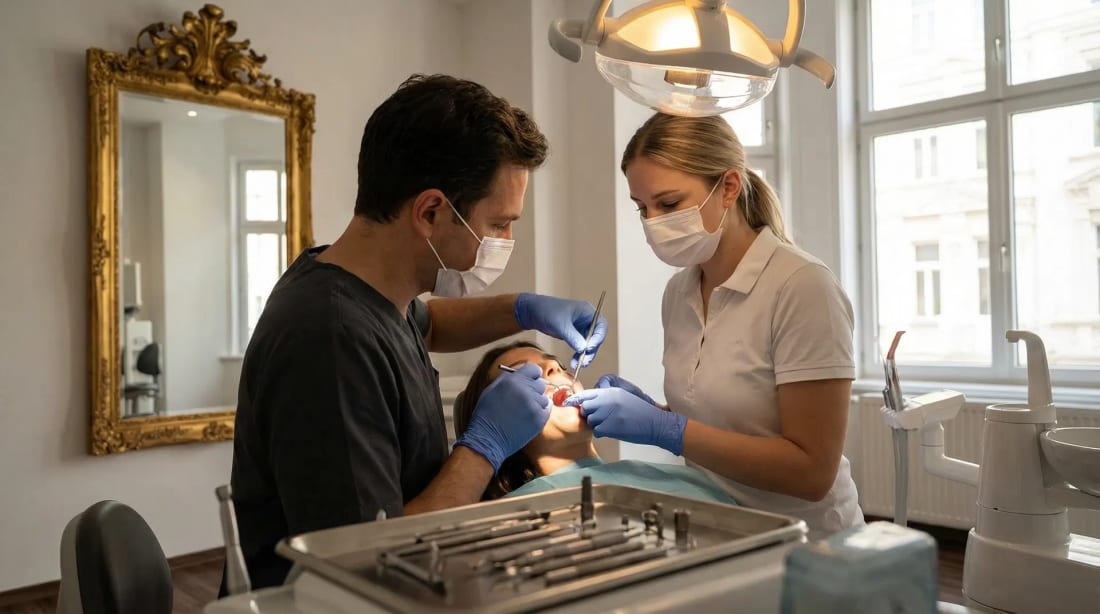
Your treatment follows your personal plan. Please ask questions and tell us about any discomfort at any time.

Aftercare and check-ups
Discuss care and follow-up appointments
Finally, we will discuss ongoing care and the follow-up appointments that are right for you.
In everyday life
Discuss in advance how the gap will be restored during healing. The type and loading limits of the temporary restoration determine what is possible when eating and in daily life.
YOUR OPTIONS
TREATMENT OPTIONS COMPARED
◆ With suitable clinical findings
Immediate implant
Extraction and implant placement in one session, if bone and inflammation findings allow.
Flexible
Conventional implant
An established delayed protocol, also possible with bone loss.
Budget-friendly
Removable denture
A reversible option without surgery for a limited budget.
We will discuss payment terms with you prior to treatment.
The indicative market prices in our price overview provide an initial guide. We will discuss which services are planned for you and the costs involved based on your examination findings and individual cost plan.
Advanced Dental Aesthetics & Implantology
Priv.Doz.Dr.Dr. K. Yerit
“Aesthetics is not a coincidence, but the result of precise planning and deep passion.”
Immediate implants show high survival rates in clinical studies. With careful patient selection and precise planning, they are a dependable option, although the risk of early implant loss may be higher than with later placement.
View profile →Scientific references
Institute for Implantology and Digital Dentistry Vienna
Österreichische Gesellschaft für Implantologie (ÖGI)
International Team for Implantology (ITI)
European Association for Osseointegration (EAO)
Deutsche Gesellschaft für Implantologie (DGI)
Yerit Practice – Dentist Vienna
Excellence
Why Smile4Life
Clarify the restoration early
A possible temporary crown and how much load it may bear are planned separately.
Combine steps
Extraction and implant placement may take place in one appointment where the findings are suitable.
Consider the tissues
Bone and gums are carefully assessed. Additional measures may still be needed.
Know the alternatives
An agreed plan B provides guidance if later placement is more suitable.
Digital planning
Findings and appropriate imaging help plan the implant position and eventual crown.
Understand the decision
The decision is guided by your starting situation and the aim of the restoration.
Frequently asked questions
Frequently asked questions
Do you have a specific question about your diagnosis? Book a consultation appointment directly →
Questions about your treatment?
Discuss what matters to you and what the next steps look like with us.
Book your appointment nowYour orientation
The right path to your restoration starts with careful planning.
Understanding what’s involved
Examination, extraction and possible implant placement, healing and the final crown are planned as a connected course of treatment.
In everyday life
Discuss in advance how the gap will be restored during healing. The type and loading limits of the temporary restoration determine what is possible when eating and in daily life.
Who this information is for
If a tooth needs removing and sufficient suitable bone is available for stable anchorage, immediate implant placement may be an option. Gums, the socket and individual risks are assessed as well.
Important limitations
Acute infection, insufficient stability or unfavourable tissues may favour later treatment. The final decision may only be possible after extraction.
Our approach
Timing depends on the conditions needed for a stable restoration. Earlier placement is no reason to overlook unfavourable findings or a necessary preparatory step.
SCIENTIFIC STUDIES
Timing depends on the conditions needed for a stable restoration. Earlier placement is no reason to overlook unfavourable findings or a necessary preparatory step.
Krennmair S et al. (2022). Immediately loaded implants placed in fresh extraction and healed sites supporting four-implant fixed mandibular prostheses using the All-on-4 concept: A 5-year prospective study
In a prospective study of the lower jaw, 22 of 24 people with 88 implants were followed for five years. No implant was lost in this group; inflammation nevertheless occurred. The result is not a general guarantee of success.
34800325
Atieh MA et al. (2024). Alveolar ridge preservation versus early implant placement in single non-molar sites: A systematic review and meta-analysis
After tooth extraction, measures to preserve the jaw ridge can favourably influence soft-tissue shape and ridge width, potentially simplifying later implant treatment (Clinical Oral Implants Research, 2024).
38850092
Chen R et al. (2025; online 2024). Effectiveness of immediate implant placement into defective sockets in the esthetic zone: A systematic review and meta-analysis
The review examines selected defective extraction sockets in the aesthetic zone. Its single-arm design cannot establish superiority over later implant placement. Print 2025, online 2024; PMID 38493065.
38493065
Shi JY et al. (2022). Bone preservation or augmentation simultaneous with or prior to dental implant placement: A systematic review of outcomes and outcome measures
How many implants remain in place (implant survival) and how much bone gain is seen on X-rays are the most frequently studied success criteria for bone augmentation procedures around dental implants (Clinical Oral Implants Research, 2022).
35817421
Afrashtehfar KI et al. (2024). Guided bone regeneration improves defect fill and reconstructive outcomes in 3-wall peri-implantitis defects
In a randomized study over 36 months, guided bone regeneration produced greater filling of bone defects around implants than cleaning alone (2.13 versus 1.64 millimetres). The difference did not reach statistical significance (p = 0.18), nor did treatment success of 46.2 versus 20 percent (p = 0.053) (Evidence-Based Dentistry, 2024).
39397174
Meier M et al. (2026). Immediate vs. Delayed Implant Placement Following Alveolar Ridge Procedures with Xeno-Hybrid Bovine Bone Graft: A Retrospective Cohort with Operator-Level Comparison
With careful case selection, immediate implant placement shortens the treatment pathway by five to seven months compared with delayed placement. However, in this retrospective cohort of 158 procedures, early implant losses occurred only in the immediate groups (6.3 and 6.5 percent compared with no losses in the delayed group); within their cohort, the authors do not see this as a clear increase in risk (Diagnostics, 2026).
42072856
More topics in this area
Deepen your knowledge – find all information regarding the treatment process, costs, and results.


Kärntner Straße 9
100 meters from Stephansplatz, Innere Stadt.

Partnerships & Memberships & References




