Bone augmentation before dental implants in Vienna
We assess from your examination findings whether an implant needs additional bone. Here you will find the main options and next steps.
Assess the need
Compare procedures
Allow for healing
Discuss alternatives
Bone Augmentation Vienna
knochenaufbau-implantate-wien
4.9★
Doctify rating
25+
Years of experience
Personal
In-practice consultation
1010 Vienna
Kärntner Straße 9
At a glance
What is bone augmentation before an implant?
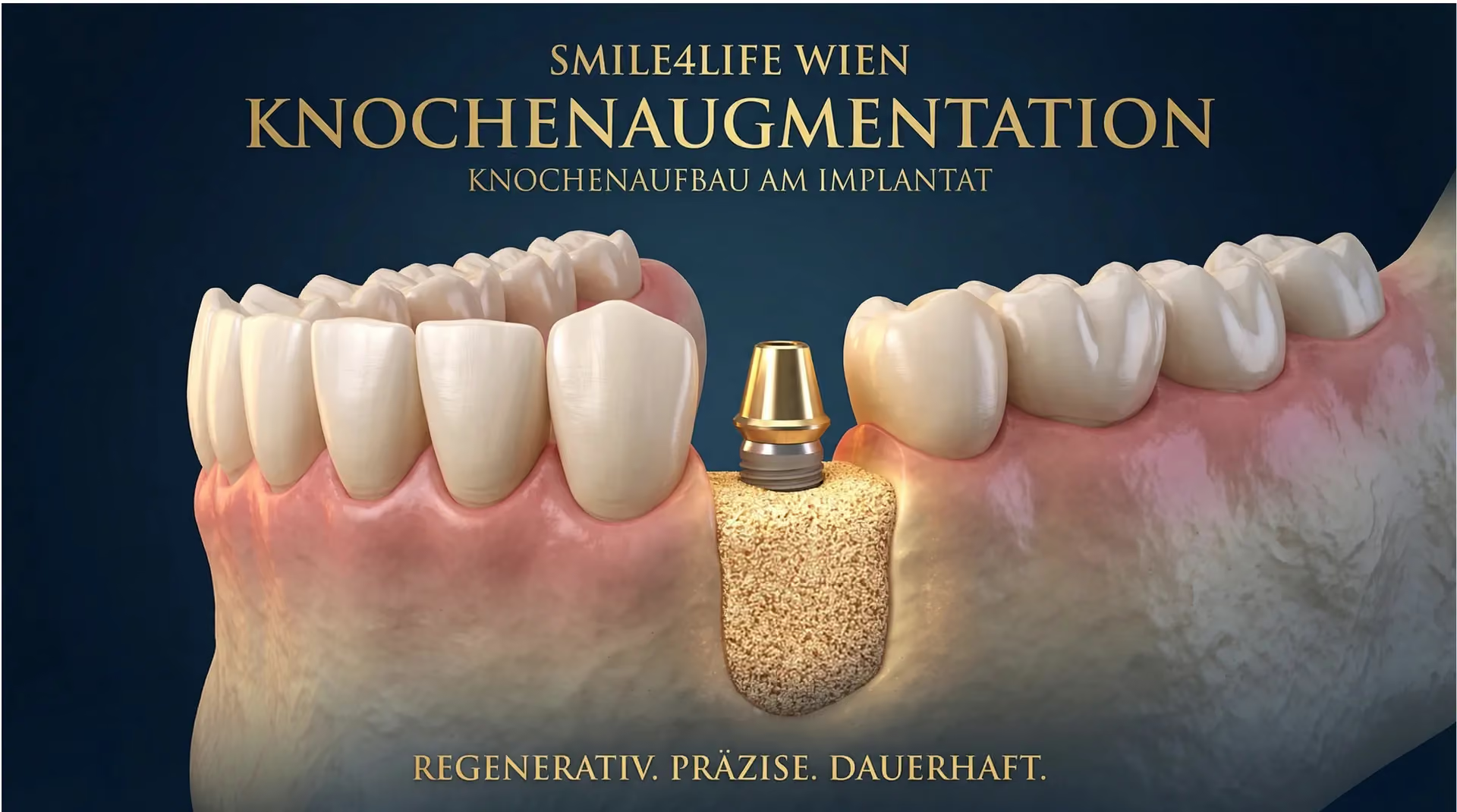
Bone augmentation adds missing bone to the jaw. It may create the conditions needed for an implant where there is insufficient bone at the planned site.
Procedures include guided bone regeneration with a membrane, blocks of your own or donor bone, ridge splitting and, in the upper jaw, a sinus lift. Which method fits depends on defect size and shape.*
How long does dental bone augmentation take?
Smaller augmentation may be combined with implant placement. Whether this shortens total time depends on progress and the restoration plan. Bone healing is still needed. For larger augmentation, healing and placement timing are planned according to findings and progress; further restoration follows.*
How painful is dental bone augmentation?
The procedure is performed under local anaesthesia. Afterwards, pain can usually be treated with simple painkillers; swelling is strongest around the second day, and after seven to ten days, once stitches are removed, most people feel better.*
How long does an implant with bone augmentation last?
A review of 31 studies examined implants in areas reconstructed using the patient’s own bone harvested from outside the mouth. Over an average observation of 92 months, survival rates of 92.3 to 96.5 % were reported depending on graft group. This is not a general durability prediction for every type of bone augmentation.*
Limited bone may make an implant restoration more involved. The first question is which restoration suits your findings and whether additional augmentation would support it.
When is bone augmentation appropriate for dental treatment?
Bone augmentation adds missing bone to the jaw. It does not replace the tooth but may create the conditions needed for the later restoration.
A dental implant needs sufficient bone where it is to support the eventual restoration. The jaw ridge may change after tooth loss. Inflammation or injury can also cause bone loss. Jawbone recovers on its own only to a limited extent: after extraction, the socket fills with new bone, but the ridge becomes narrower and lower. Volume already lost does not regrow without treatment. However, a long-standing gap does not automatically mean augmentation is necessary. YERIT explains the basics in its guide What is bone augmentation?
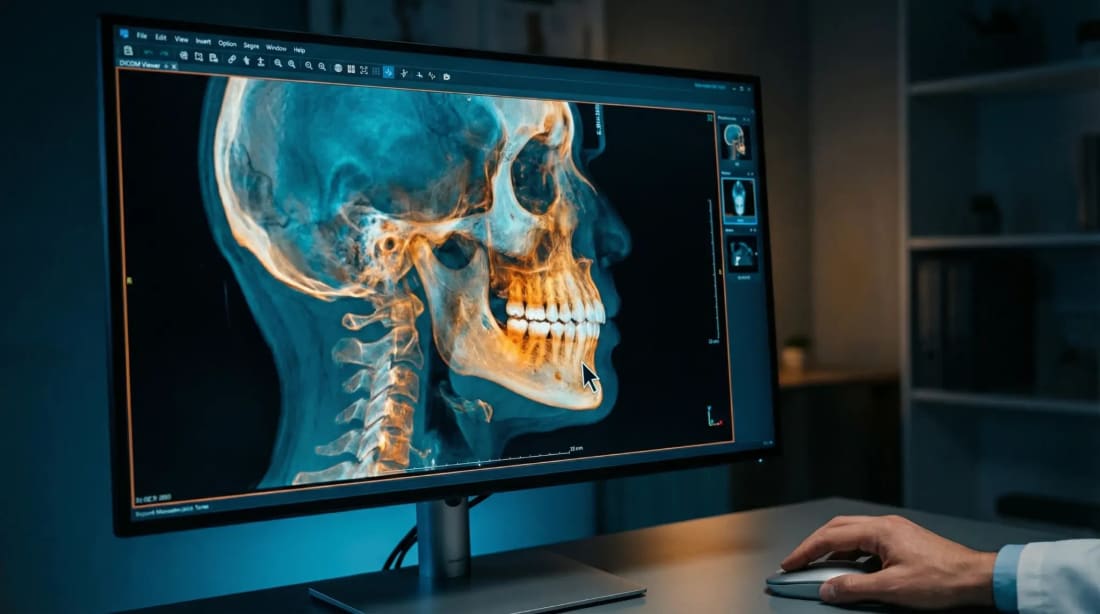
Discussing your findings involves more than whether a screw fits into the jaw. Surrounding bone walls, gums and the planned crown also count. Examination and appropriate X-rays help with assessment. If additional spatial information is needed, three-dimensional imaging may be useful. A single millimetre figure does not decide treatment alone. An international consensus report on bone walls around implants also emphasises that one millimetre value is insufficient for this decision (Jensen et al., 2023).
Which options may be considered?
For a narrow ridge, guided bone regeneration, or GBR, may combine bone material and a protective membrane. The membrane separates the area from faster-growing soft tissue. It is not an implant or an artificial tooth. A clinical review describes how bone material and membrane work together and which approach suits a particular defect (Buser et al., 2023). Larger defects may need other forms of augmentation, such as a firmly secured bone block. A systematic review with limited evidence assesses GBR as a stable and effective augmentation procedure compared with block grafting and distraction osteogenesis. Neither general superiority nor an individual success claim follows from this (Chandrasekaran et al., 2024). Material differences are discussed below under Your own bone or substitute material?
Increasing width has different requirements from increasing height. For width in the lower jaw, a review of eight studies with 276 augmentations found an average gain of 4.8 millimetres and a failure rate of 4.4 per cent (Smeets et al., 2022). For three-dimensional augmentation using titanium mesh, a meta-analysis of 22 studies found gains of 3.36 millimetres in height and 3.26 millimetres in width, with 10.8 per cent complications, mostly mesh exposure (Sabri et al., 2024). The method therefore cannot be determined from gap size alone.
Bone augmentation with a sinus lift in the upper jaw
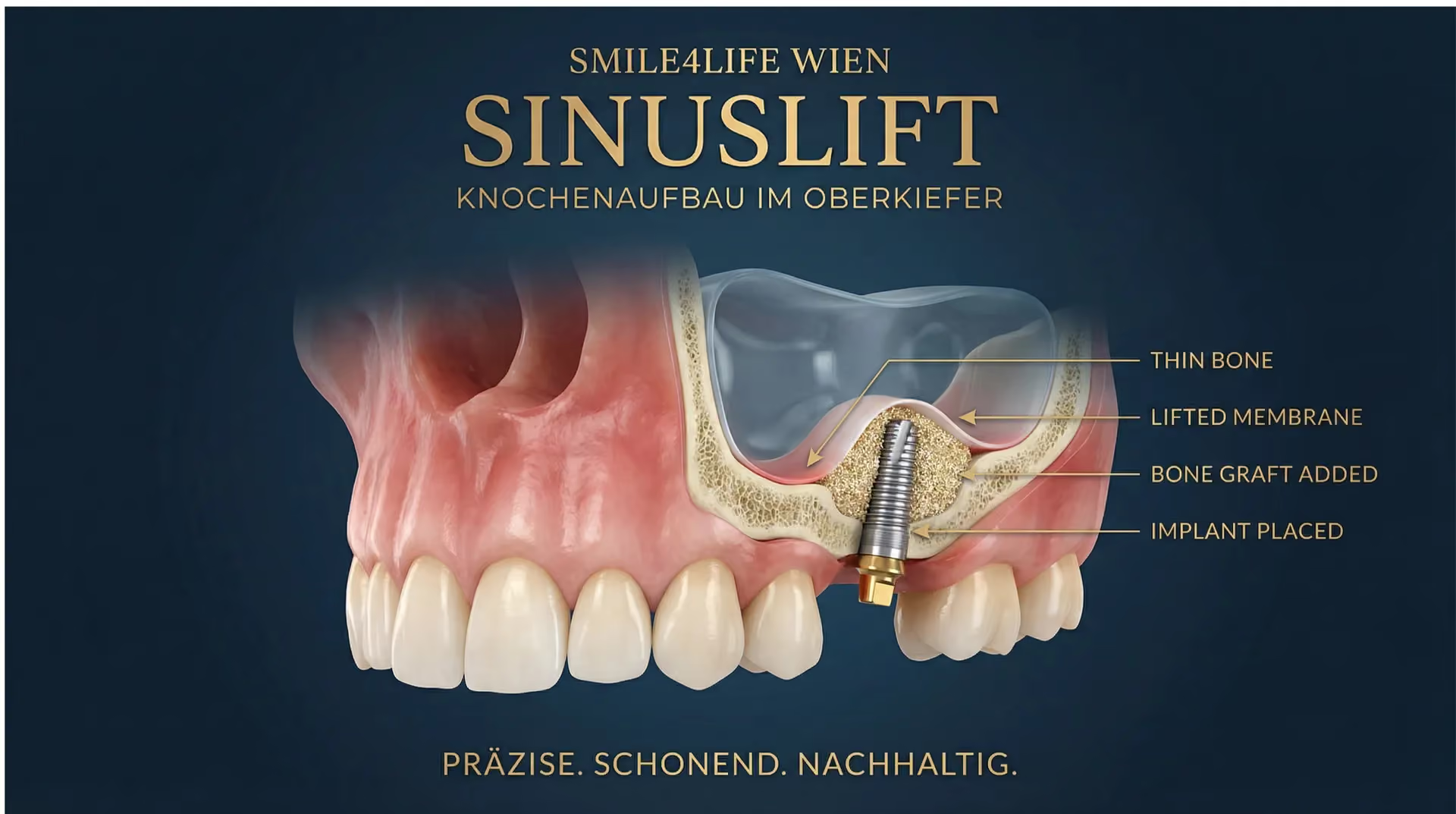
In the back of the upper jaw, the sinus may limit available height. A sinus lift creates space for bone beneath the raised membrane there. A review with a decision model puts the combined sinus factors — remaining bone, shape, condition and membrane — in context (Lyu et al., 2023). It therefore addresses a different problem from widening a narrow ridge. Both situations may occur together. In the upper back-tooth region, the sinus may expand downwards after tooth loss while the ridge shrinks; this relationship is described in the review of sinus lift procedures (Alsharekh et al., 2024). A sinus lift is not performed in the lower jaw.
In selected cases, a shorter or narrower implant may avoid extensive augmentation. A systematic review of five randomised studies with at least five years of follow-up supports short implants as a possible alternative in the back of the upper jaw — but this cannot be applied to every jaw (Mester et al., 2023). It depends on the region, planned loading and restoration. A different implant shape is not automatically better. A bridge or removable replacement teeth may also be alternatives.
How much treatment and healing are needed?
For smaller defects, augmentation and implant placement may be possible in the same procedure. British hospital information also confirms that augmentation may take place before or alongside placement — material origin, healing and risks must always form part of individual counselling (Cambridge University Hospitals, 2024). One requirement is sufficient implant stability in the existing bone. For larger augmentation, bone may be added first and the implant placed later.
Placed material is not yet load-bearing new bone. It acts as a scaffold into which your own bone grows, and healing requires a suitable environment, sufficient stability and time. Planned checks assess how far remodelling has progressed. Gums that look normal alone do not prove completed bone healing. Further information from Guy’s and St Thomas’ on healing and subsequent treatment: Open patient information.
Initial wound healing is not the same as bone integration. Even if the mouth soon feels normal again, further bone formation may take several months. Whether and when the implant may bear load is assessed separately. The bone augmentation treatment process explains these stages.
Possible complications include infection, wound opening or insufficient bone gain. An exposed membrane may impair healing. Certain procedures have additional region-specific risks. Planning therefore also considers which alternative is acceptable for your findings and how aftercare is organised.
Pain, medication and reliable context
Anaesthesia is discussed before surgery and should adequately control pain during treatment. Wound pain and swelling may follow. Use medication according to the agreed plan and do not stop prescribed medicines such as ASS/ASA on your own. Increasing or unusual symptoms should be assessed.
Bone augmentation has been studied for different defects. How well it works individually depends on factors including procedure, defect, health and healing progress. Bone gain, complications and later implant survival are different outcomes; a single success rate does not adequately describe them. The review of the outcomes studied in bone augmentation explains the limits of such figures (Shi JY et al., 2022).
Your own bone or substitute material?
Your own bone comes from your body; depending on the amount needed, an additional harvesting site may be required. Human donor material is processed. Animal-derived substitute material is also processed; synthetic material is manufactured. A product’s origin should be explained clearly before treatment. Substitute material avoids this harvesting. The two are often mixed. Materials differ in how they support new bone formation and how quickly the body remodels them. “Synthetic” therefore does not automatically mean worse, and “your own” does not mean there are no additional risks.
If origin matters to you for personal or religious reasons, raise this early. Selection concerns more than the bone material: a membrane used may also have a particular origin. Whether a preferred alternative suits the defect belongs in shared planning.
What helps with the decision?
Bring existing imaging, a medication list and your questions to the consultation. Do not stop regularly prescribed low-dose aspirin on your own without medical advice (NHS, 2026). Three specific answers help: what is lacking at the planned implant site? What options exist with and without augmentation? Which steps are planned for the chosen restoration?
Also ask which material is planned and whether an additional harvesting site would be needed. The individual plan should clearly distinguish augmentation, implant, restoration and aftercare. For financial preparation, see cost factors for bone augmentation and the prices page with non-binding guidance; a binding estimate requires examination findings and the scope of services.
YOUR CONCERNS
What is on your mind?
Not enough bone?
Ask to be shown whether height, width or both are lacking.
A long-standing gap
Current findings matter; duration alone does not decide.
Upper back teeth
A sinus lift may be an option when height is lacking beneath the sinus.
SUITABILITY CHECK
Is this treatment right for you?
YOUR JOURNEY
Your treatment process
Individual initial consultation
Getting to know your goals and your teeth
We will discuss your goals and examine which treatment is best suited for your teeth.

Individual treatment planning
Defining the next steps together
You will learn which steps are planned and which questions should be clarified in advance.
Precise execution
Guiding you through your treatment step by step
Your treatment follows your personal plan. Please ask questions and tell us about any discomfort at any time.
Aftercare and check-ups
Discuss care and follow-up appointments
Finally, we will discuss ongoing care and the follow-up appointments that are right for you.
In everyday life
YOUR OPTIONS
TREATMENT OPTIONS COMPARED
We will discuss payment terms with you prior to treatment.
The indicative market prices in our price overview provide an initial guide. We will discuss which services are planned for you and the costs involved based on your examination findings and individual cost plan.
Advanced Dental Aesthetics & Implantology
Priv.Doz.Dr.Dr. K. Yerit
“Aesthetics is not a coincidence, but the result of precise planning and deep passion.”
In the back of the upper jaw, shorter implants may be an alternative to augmentation in selected cases. The right solution depends on all the findings and the planned restoration.
View profile →Scientific references
Institute for Implantology and Digital Dentistry Vienna
Medizinische Universität Wien
Österreichische Gesellschaft für Mund-, Kiefer- und Gesichtschirurgie (ÖGMKG)
International Team for Implantology (ITI)
Österreichische Gesellschaft für Implantologie
Yerit Practice – Dentist Vienna
Excellence
Why Smile4Life
Understand the findings
Examination and appropriate imaging explain the available bone.
Weigh up the options
Augmentation and alternatives are considered in relation to the planned restoration.
Know the steps
A clear plan distinguishes surgery, healing and replacement teeth.
Frequently asked questions
Frequently asked questions
Do you have a specific question about your diagnosis? Book a consultation appointment directly →
Questions about your treatment?
Discuss what matters to you and what the next steps look like with us.
Book your appointment nowYour orientation
Healing and next steps are assessed according to your progress.
Understanding what’s involved
The extent of treatment and appointments depend on the procedure and augmentation needed.
In everyday life
Who this information is for
Discussing the findings is useful if insufficient bone is suspected before an implant restoration or if different treatment proposals have been made.
Important limitations
Active inflammation, medical conditions, medication and smoking may affect planning. Bone augmentation guarantees neither an implant nor its long-term survival.
Our approach
Bone augmentation is appropriate when it supports the planned restoration. We discuss your findings, possible alternatives and treatment limitations. A single millimetre measurement or general success rate does not replace this assessment.
SCIENTIFIC STUDIES
Bone augmentation is appropriate when it supports the planned restoration. We discuss your findings, possible alternatives and treatment limitations. A single millimetre measurement or general success rate does not replace this assessment.
Maxillary sinus floor augmentation: a review of current evidence on anatomical factors and a decision tree
For a sinus lift, the remaining bone, shape and condition of the maxillary sinus and its lining need to be considered together. A review with a decision model, not an individual treatment instruction.
37714889
Short Implants versus Standard Implants and Sinus Floor Elevation in Atrophic Posterior Maxilla: A Systematic Review and Meta-Analysis of Randomized Clinical Trials with ≥5 Years' Follow-Up
In selected cases, short implants may be an alternative to a sinus lift in the back of the upper jaw. Five randomized studies with at least five years of follow-up. The findings cannot be applied to every jaw or restoration.
36836403
Jensen SS et al. (2023). Group 1 ITI Consensus Report: The role of bone dimensions and soft tissue augmentation procedures on the stability of clinical, radiographic, and patient-reported outcomes of implant treatment
The bone wall around an implant is important for assessment. A single millimetre figure does not determine whether grafting is needed. The 1.5-mm finding concerns the outer (buccal) bone wall after implant placement at healed sites, not a general minimum width before surgery.
37750519
Bone grafting for dental implants
Bone grafting may be performed before or at the same time as implant placement. Material origin, healing and risks are part of the consultation. Hospital-specific patient information, version 3. Its timings and aftercare do not constitute a fixed protocol for Smile4Life.
Moraschini V et al. (2024). Long-term survival and success rate of dental implants placed in reconstructed areas with extraoral autogenous bone grafts: A systematic review and meta-analysis
The review examined implants in areas reconstructed with the patient’s own bone harvested from outside the mouth. It reports long-term survival rates for these grafting procedures. The results cannot be applied generally to every type of bone grafting or substitute material, and they are not an individual guarantee of success.
38450931
Chandrasekaran D et al. (2024). Treatment Outcome of Using Guided Bone Regeneration for Bone Augmentation for the Placement of Dental Implants - A Systematic Review
This systematic review compares guided bone regeneration (GBR) with block grafting and distraction osteogenesis for bone augmentation before implant placement. The authors consider GBR a stable and effective procedure but emphasize the limited evidence. This establishes neither general superiority nor an individual guarantee of success (Chandrasekaran et al., 2024).
39926965
Smeets R et al. (2022). Horizontal augmentation techniques in the mandible: a systematic review
This systematic review evaluates eight clinical studies with a total of 276 bone augmentation procedures in the lower jaw, in which bone width was increased using animal-derived, autogenous or donor material, as granules or blocks. Seven of the eight papers reported a mean width gain of 4.8 mm, and the mean graft failure rate was 4.4 percent. The authors also note that randomized comparative studies are largely lacking and that combinations of donor bone blocks and resorbable membranes need reassessment (International Journal of Implant Dentistry, 2022).
35532820
Sabri H et al. (2024). Bone augmentation using titanium mesh: A systematic review and meta-analysis
This meta-analysis of 22 controlled clinical studies quantifies bone gain using titanium mesh as a shaping framework: 3.36 mm in height and 3.26 mm in width. Mesh exposure was the most common complication, and the pooled complication rate was 10.8 percent. Direct comparison with collagen membranes found no significant difference in width gain. Titanium mesh is therefore particularly suitable for defects requiring three-dimensional augmentation of around 4 mm (International Journal of Oral Implantology, 2024).
39283219
More topics in this area
Deepen your knowledge – find all information regarding the treatment process, costs, and results.


Kärntner Straße 9
100 meters from Stephansplatz, Innere Stadt.

Partnerships & Memberships & References