

Bone augmentation costs in Vienna: compare procedure and scope
The cost of your bone augmentation depends on your findings and the planned steps. A clear quotation helps with comparison.
Scope determines the cost
Break down the services
View the prices page
Clarify reimbursement
Bone Augmentation Costs Vienna
knochenaufbau-kosten-wien
500
3000
4.9★
Doctify rating
25+
Years of experience
Personal
In-practice consultation
1010 Vienna
Kärntner Straße 9
At a glance
How much does bone augmentation at the dentist cost?
For bone augmentation, the prices page gives 500 to 3,000 euros as non-binding market guidance. These are not our practice’s prices. The specific amount depends on the defect: size, procedure and material determine the work involved. These ranges provide guidance; your personal cost plan follows examination, necessary imaging and discussion of the intended treatment.
Does health insurance pay for bone augmentation?
Usually not: implant restorations are not an ÖGK benefit, and augmentation for them is generally paid privately too. A contribution may be possible in medically justified exceptional cases, but only with prior approval from the Dental Service.*
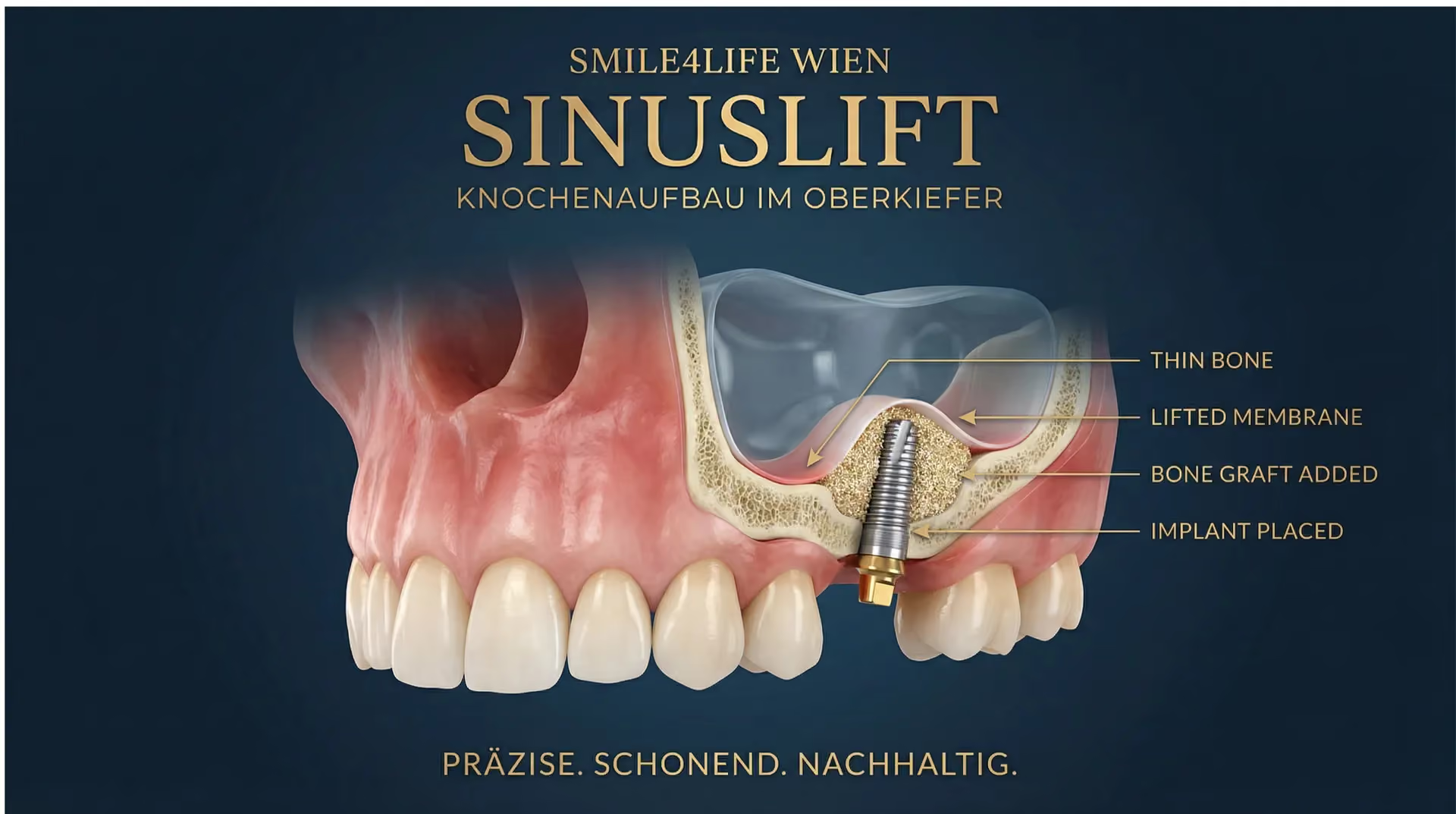
What does a sinus lift cost?
Internal and external access may require different steps. Material quantity and costs depend on the specific augmentation and planned stages. Which approach may be considered is discussed using the examination, initial anatomy and necessary imaging. The cost plan then describes the intended treatment.
What does bone augmentation cost in the upper and lower jaw?
The jaw alone does not determine the work involved; defect size, procedure and material do. In the upper back-tooth area, a sinus lift is often added; the lower jaw usually needs lateral augmentation, where a review found an average width gain of 4.8 mm.*
Dental bone augmentation: finding initial cost guidance
The prices page provides initial guidance. The amounts shown there are non-binding, typical market ranges — a firm figure can only be established after examination. An individual quotation is decisive for your own case. Small augmentation at one implant site cannot be compared directly with extensive augmentation or a bilateral sinus lift. British hospital information also confirms that material origin, healing and risks enter counselling differently according to scope (Cambridge University Hospitals, 2024). YERIT provides general context for cost factors in the guide Bone augmentation: costs.
Always ask what a quoted price relates to: one site, one procedure, one side of the jaw or the entire restoration. Whether it includes only augmentation or also the implant and replacement teeth is equally important. Only this context makes an amount meaningful.
Bone augmentation in the upper and lower jaw: what costs depend on
Defect shape helps determine which procedure is possible. Does the ridge need widening, is height lacking or is the sinus in the way? The bone augmentation overview explains procedures and limitations. When height is lacking in the upper back-tooth area, two processes usually coincide — the sinus expands downwards while the ridge shrinks (Alsharekh et al., 2024). These situations may require different materials, access routes and steps. Choosing a method solely for a lower individual price would overlook the clinical task.
Which other factors affect costs?
Material quantity and a possible additional bone-harvesting procedure also affect the work involved. In guided bone regeneration, bone material and protective membrane jointly determine the work involved (Buser et al., 2023). A membrane, its stabilisation and necessary checks may also form part of the plan. Ask which items are planned and which would only be added in a particular course of treatment.
For a sinus lift, distinguish whether one or both sides will be treated and whether internal or external access is planned. The sinus lift overview explains procedure selection. A larger access route does not, however, automatically mean the implant must always be placed in a later operation.
What should the quotation make clear?
A useful comparison separates the steps of the complete restoration. Depending on the case, these include diagnostics, bone augmentation, placement, temporary and final replacement teeth and aftercare. An international consensus report discusses the bone wall needed around the eventual implant — a single millimetre measurement alone does not determine augmentation scope (Jensen et al., 2023). Clarify which of these items are included in the quotation.
Also ask whether additional appointments or procedures are planned. With a two-stage approach, bone is added first and the implant placed later. Combining augmentation and placement may avoid a separate surgical stage; without the specific plan, however, no fixed saving can be inferred.
How unexpected healing progress will be managed should also be discussed. A price comparison is meaningful only when quotations cover comparable restorations and services. Material names or an individual package price are insufficient.
How do you clarify reimbursement and payment?
Using the specific quotation, obtain written confirmation before treatment starts of whether your insurer covers the planned procedure. A general online statement cannot replace your policy terms or an assessment of your case.
Ask which documents are needed and whether prior approval is required. A submitted enquiry is not a promise of reimbursement. Initially plan with amounts that have been firmly confirmed.
Payment terms also need clarifying before treatment. We offer payment in instalments for larger treatments such as bone augmentation; we discuss due dates and terms at the consultation. An insurance benefit applies only once your insurer confirms it for your case.
Three documents help for the consultation: your existing findings, available imaging and, where applicable, the insurer’s response. The bone augmentation before dental implants overview and treatment process put the clinical steps in context.
YOUR OPTIONS
TREATMENT OPTIONS COMPARED
We will discuss payment terms with you prior to treatment.
The indicative market prices in our price overview provide an initial guide. We will discuss which services are planned for you and the costs involved based on your examination findings and individual cost plan.
Scientific references
Institute for Implantology and Digital Dentistry Vienna
Österreichische Zahnärztekammer
Österreichische Gesundheitskasse (ÖGK)
International Team for Implantology (ITI)
Medizinische Universität Wien
Yerit Practice – Dentist Vienna
Frequently asked questions
Frequently asked questions
Do you have a specific question about your diagnosis? Book a consultation appointment directly →
Questions about your treatment?
Discuss what matters to you and what the next steps look like with us.
Book your appointment nowYour orientation
Healing and next steps are assessed according to your progress.
Understanding what’s involved
The extent of treatment and appointments depend on the procedure and augmentation needed.
In everyday life
Who this information is for
If you want to compare quotations or plan the total cost of an implant restoration.
Important limitations
Price guidance does not replace a personal quotation. Insurance benefits and payment terms must be clarified for the individual case.
Our approach
Bone augmentation is appropriate when it supports the planned restoration. We discuss your findings, possible alternatives and treatment limitations. A single millimetre measurement or general success rate does not replace this assessment.
SCIENTIFIC STUDIES
Bone augmentation is appropriate when it supports the planned restoration. We discuss your findings, possible alternatives and treatment limitations. A single millimetre measurement or general success rate does not replace this assessment.
Maxillary sinus floor augmentation: a review of current evidence on anatomical factors and a decision tree
For a sinus lift, the remaining bone, shape and condition of the maxillary sinus and its lining need to be considered together. A review with a decision model, not an individual treatment instruction.
37714889
Bone grafting for dental implants
Bone grafting may be performed before or at the same time as implant placement. Material origin, healing and risks are part of the consultation. Hospital-specific patient information, version 3. Its timings and aftercare do not constitute a fixed protocol for Smile4Life.
Chandrasekaran D et al. (2024). Treatment Outcome of Using Guided Bone Regeneration for Bone Augmentation for the Placement of Dental Implants - A Systematic Review
This systematic review compares guided bone regeneration (GBR) with block grafting and distraction osteogenesis for bone augmentation before implant placement. The authors consider GBR a stable and effective procedure but emphasize the limited evidence. This establishes neither general superiority nor an individual guarantee of success (Chandrasekaran et al., 2024).
39926965
Smeets R et al. (2022). Horizontal augmentation techniques in the mandible: a systematic review
This systematic review evaluates eight clinical studies with a total of 276 bone augmentation procedures in the lower jaw, in which bone width was increased using animal-derived, autogenous or donor material, as granules or blocks. Seven of the eight papers reported a mean width gain of 4.8 mm, and the mean graft failure rate was 4.4 percent. The authors also note that randomized comparative studies are largely lacking and that combinations of donor bone blocks and resorbable membranes need reassessment (International Journal of Implant Dentistry, 2022).
35532820
Sabri H et al. (2024). Bone augmentation using titanium mesh: A systematic review and meta-analysis
This meta-analysis of 22 controlled clinical studies quantifies bone gain using titanium mesh as a shaping framework: 3.36 mm in height and 3.26 mm in width. Mesh exposure was the most common complication, and the pooled complication rate was 10.8 percent. Direct comparison with collagen membranes found no significant difference in width gain. Titanium mesh is therefore particularly suitable for defects requiring three-dimensional augmentation of around 4 mm (International Journal of Oral Implantology, 2024).
39283219
Shah D et al. (2022). Survival rate of dental implant placed using various maxillary sinus floor elevation techniques: A systematic review and meta-analysis
The meta-analysis of 17 studies compared direct lateral and indirect approaches to maxillary sinus floor elevation. There was no statistically significant difference in implant survival. This does not prove equivalence in every individual situation. The access route is selected according to the complete clinical findings and the restoration plan.
36511050
Alsharekh MS et al. (2024). Evolving Techniques and Trends in Maxillary Sinus Lift Procedures in Implant Dentistry: A Review of Contemporary Advances
This review describes the two approaches to maxillary sinus floor elevation and their respective requirements and limitations. The initial problem in the back of the upper jaw involves two simultaneous processes: downward expansion of the maxillary sinus and resorption of the remaining jaw ridge. The authors emphasize preoperative imaging and careful elevation of the sinus lining; complications at this site directly affect implant survival (Cureus, 2024).
39544602
Jensen SS et al. (2023). Group 1 ITI Consensus Report: The role of bone dimensions and soft tissue augmentation procedures on the stability of clinical, radiographic, and patient-reported outcomes of implant treatment
The bone wall around an implant is important for assessment. A single millimetre figure does not determine whether grafting is needed. The 1.5-mm finding concerns the outer (buccal) bone wall after implant placement at healed sites, not a general minimum width before surgery.
37750519
Die ÖGK im Überblick – Leistungen und Services 2026
Fixed dental restorations such as crowns, bridges and implants are not covered by the ÖGK; a contribution is available in medically justified exceptional cases if approval from its Dental Service has been obtained before treatment (gesundheitskasse.at, accessed 03.11.2026).
More topics in this area
Deepen your knowledge – find all information regarding the treatment process, costs, and results.
Kärntner Straße 9
100 meters from Stephansplatz, Innere Stadt.

Partnerships & Memberships & References




