Sinus Lift in Vienna: Internal or External Access
When bone height is lacking in the posterior upper jaw, a sinus lift can create space for augmentation. The appropriate approach depends on your anatomy.
Posterior upper jaw
Internal or external
Assess stability
Allow time for healing
Sinus Lift Vienna
sinuslift-wien
4.9★
Doctify rating
25+
Years of experience
Personal
In-practice consultation
1010 Vienna
Kärntner Straße 9
At a glance
What is a sinus lift, and when is it needed?
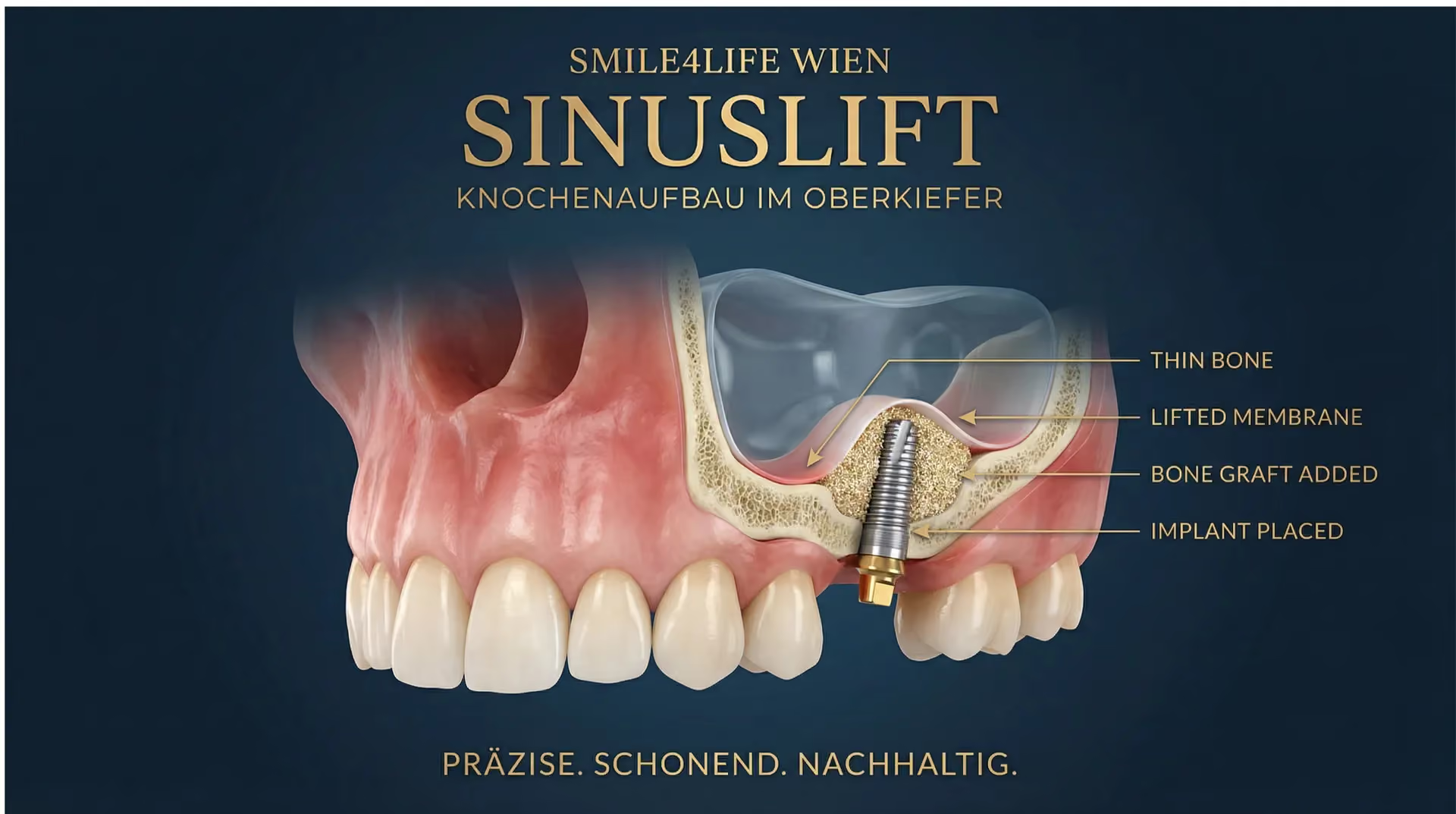
A sinus lift is bone augmentation in the posterior upper jaw. The lining of the sinus floor is raised to create space for bone beneath it. Whether an implant needs it and which approach is appropriate depend on the clinical findings.
The procedure is usually performed under local anaesthetic; discuss the approach and any questions about anaesthesia with the treatment team beforehand. Pressure and swelling are common afterwards; swelling is usually greatest on the second day, and pain can generally be managed with simple pain relief.*
How long will I need off work after sinus lift surgery?
This depends on the extent of surgery and your job and is determined by the clinician. Swelling usually peaks after two days; many people feel better when the stitches are removed after seven to ten days. Physical work often requires more rest.*
How long does an external sinus lift take?
The process through to the final restoration may take several months. Whether augmentation and implant placement take place together or separately, and when treatment continues, depend on the clinical findings.*
What are the disadvantages of a sinus lift?
It is an additional procedure involving swelling and usually several months of healing before the tooth is complete. In selected cases, short implants can replace augmentation: five randomised studies with at least five years of follow-up found no statistically significant difference in implant survival between the approaches.*
When can a sinus lift be useful for dental implants?
The maxillary sinus lies above the back teeth in the upper jaw. After tooth loss, there may be too little bone height for a planned implant. Two processes often occur together in this area: the sinus expands downwards while the jaw ridge loses bone (Alsharekh et al., 2024). A sinus lift raises the lining of the sinus floor to create space for bone beneath it. YERIT explains the basic principles in its guide to the sinus lift.
A sinus lift is therefore a specific form of bone augmentation. It does not automatically widen a narrow jaw ridge and is not a treatment for the lower jaw. Guided bone regeneration is more likely to be considered for widening the ridge. A systematic review with limited evidence describes it as a stable and effective method compared with block grafting and distraction osteogenesis. This does not establish general superiority or predict individual success (Chandrasekaran et al., 2024). Whether a sinus lift is needed also depends on the planned implant and restoration.
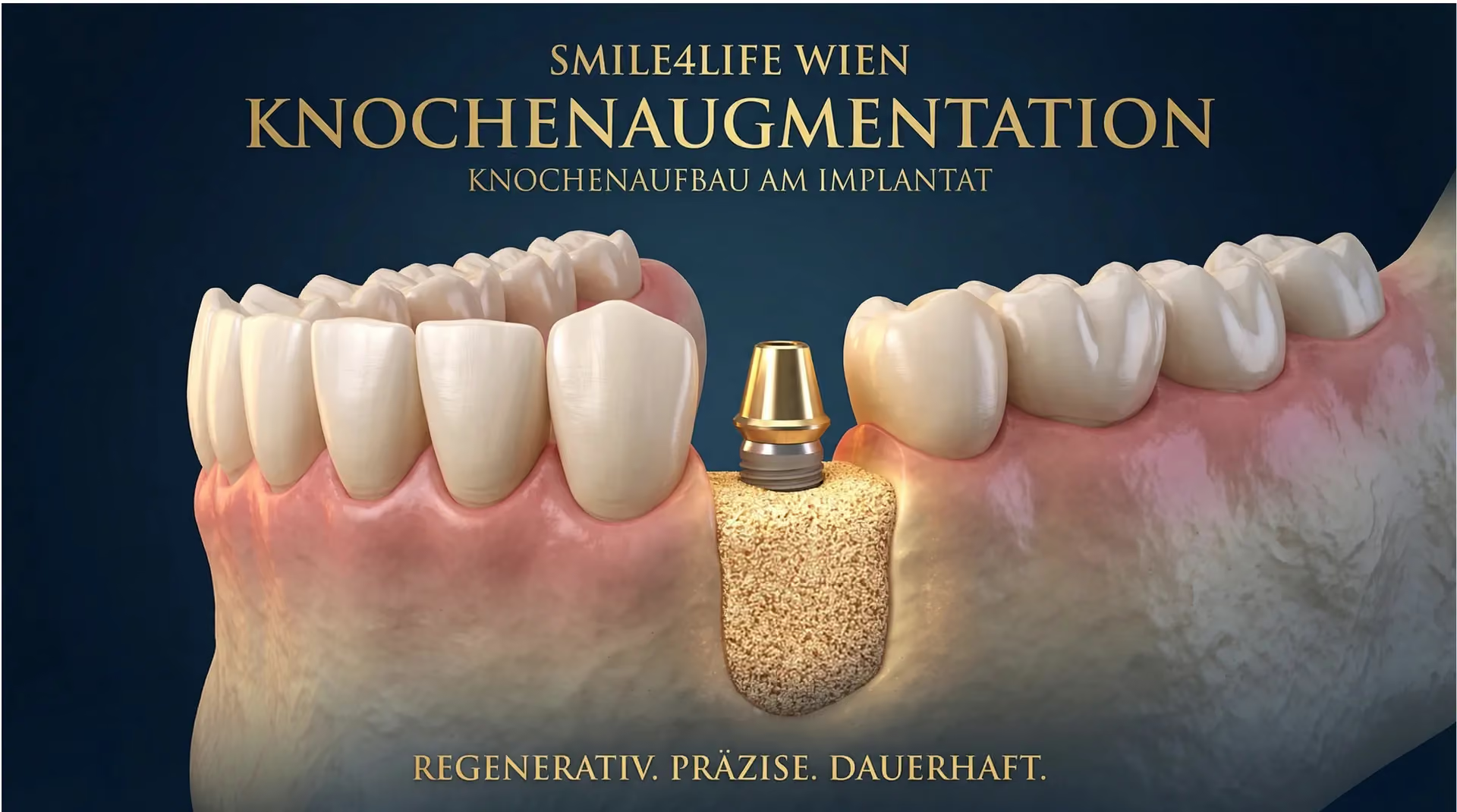
Depending on the procedure, the bone substitute placed supports the formation of bone tissue. Your own bone or combinations of different materials may also be considered. Ask about the origin and purpose of the planned material; the sinus lining remains a separate anatomical structure.
Internal and external sinus lifts compared
| Access route | What matters when choosing |
|---|---|
| Internal | Through the prepared implant site in the jaw ridge, without a lateral window. The required augmentation must be achievable through this access. |
| External | Through a lateral bone window. This may provide better visibility and more working space for more extensive augmentation or particular anatomical conditions. |
| For both | Residual bone, sinus width, shape and internal bony partitions, as well as the lining, are assessed together; a measurement in millimetres alone does not determine the choice. |
| Implant timing | Simultaneous or later implant placement depends on the clinical findings. The access route alone determines neither the timing nor whether immediate loading is possible. |
Internal sinus lift: access through the implant site
An internal, or transcrestal, sinus lift approaches the sinus from the jaw ridge. The sinus floor is reached through the prepared implant site, and the lining above it is carefully raised. This creates space for bone underneath. This approach does not involve a lateral window. The instruments and materials used depend on the particular technique.
The clinical term sinus floor elevation describes raising the lining in the area of the sinus floor. Whether a bone substitute is used, and which one, depends on the chosen technique. The material is intended to support bone regeneration; it does not replace the implant’s necessary anchorage in existing bone.
Remaining bone height is important, but it is not the only selection criterion. Bone width and quality, the shape of the sinus and the condition of its lining also matter. A review with a decision model brings these anatomical factors together without replacing an individual treatment decision (Lyu et al., 2023). Internal bony partitions or disease may affect access.
A blanket rule that an internal approach is always used above five millimetres would therefore be too simplistic. Clinical studies also investigate transcrestal access at lower residual heights. A systematic review of seven direct randomised comparisons specifically examined this approach at residual heights of up to six millimetres. Given the increased risk of bias in the included studies, it does not establish general equivalence or a rigid five-millimetre threshold (Shi et al., 2023). Nor does it recommend choosing this procedure for every such clinical situation.
External sinus lift: access through the lateral jaw wall
An external, or lateral, sinus lift creates access to the sinus through the lateral bone wall of the upper jaw. The lining of the sinus floor is raised, creating space underneath for the planned bone augmentation.
The lateral bone window opens the working area. After the lining has been raised, a bone substitute, your own bone or a combination is placed, depending on the technique. The choice is adapted to the space required and the healing process. The sinus lining is also called the Schneiderian membrane; it is not the same as an additional covering membrane used during treatment.
A lateral approach may be considered when the existing height is low or the required augmentation cannot be appropriately achieved through an internal approach. The decision also takes account of width, sinus shape, internal bony partitions and the lining.
The statement that an external approach is always required below five millimetres would be equally simplistic. A meta-analysis of 17 studies found no statistically significant difference in implant survival between internal and external approaches (Shah et al., 2022). This does not prove equivalence for every individual situation. The choice depends on the starting conditions and planned restoration; an X-ray measurement alone determines neither the access route nor whether treatment should have one or two surgical stages. Examination, imaging and the requirements of the eventual restoration are considered together.
When can the implant be placed?
When conditions are suitable, the implant can be placed at the same time as the sinus lift. Among other requirements, it must be possible to anchor it sufficiently firmly in the existing bone. The bone wall around the implant also matters for later assessment, as an international consensus report notes; here too, a single measurement in millimetres does not determine augmentation on its own (Jensen et al., 2023). If this foundation is insufficient, augmentation may be carried out first, with implant placement planned after it has healed.
An implant placed at the same time still needs an appropriate healing phase. “In one appointment” does not mean that the restoration can immediately take chewing forces. The schedule therefore distinguishes surgery, wound healing, bone healing and the subsequent restoration.
A two-stage plan involves at least two surgical stages: augmentation first, followed by implant placement after healing. Several months are often needed for the augmentation to heal. The next step depends on progress and follow-up examinations. In a two-stage plan, healing after the later implant placement is additional; with simultaneous treatment, parts of the healing phases may overlap.
The number of appointments and the time required are discussed based on your clinical findings. General time estimates from other patients cannot reliably be applied to your case.
When arranging appointments, consider the entire process through to the restoration. A wound that settles early does not mean that bone healing is complete. The page on bone augmentation treatment and healing explains the individual stages.
Pain, swelling and recovery after sinus lift surgery
The procedure is usually performed under local anaesthetic. Swelling, pressure and wound pain are common during the first few days afterwards and can usually be managed well with the recommended pain relief and cooling. The lateral approach is the more extensive procedure; internal access through the implant site is considered less burdensome (Farina et al., 2022).
How long you should rest and whether time off work is appropriate depend on the extent of surgery and the physical demands of your work; we discuss this beforehand. Forceful nose blowing, pressure changes during diving and flying, and strenuous sport are common aftercare topics during the first weeks. Increasing pain, fever, pus from the nose or bleeding require prompt assessment.
Which risks should you know about before a sinus lift?
The sinus lining can also be injured through the small internal access. The term “minimally invasive” does not promise painless healing or a procedure without risk. A review of 15 controlled studies considers the internal approach a minimally invasive and effective option for the posterior upper jaw with bone loss (Farina et al., 2022). This does not rule out injury to the lining in an individual case.
Injury to the sinus lining is a recognised risk. Its management depends in part on the size and location. The procedure may need to be modified or stopped. Good implant outcomes after treated injuries do not mean that such an injury is unimportant. A meta-analysis specifically examining the lateral, external approach included seven papers with 1,598 external sinus lift procedures and 3,604 implants and reported a perforation rate of 30.6 percent. Implant survival rates in this analysis were 97.68 versus 98.88 percent, without a statistically established difference. This does not mean that an injury has no consequences: the size and location of the tear matter for subsequent management (Díaz-Olivares et al., 2021). These findings are not a personal prognosis for an internal sinus lift.
Other possible problems include infection, impaired wound healing, sinus symptoms or less augmentation than expected. Existing sinus symptoms should therefore be discussed beforehand. Smoking and general health also belong in the risk discussion.
If you smoke, mention it openly at the consultation. A systematic review of eight studies found more implant losses in smokers after sinus floor augmentation; in the three prospective studies alone, the difference was not statistically established (Chambrone et al., 2014). We agree with you how long you should refrain before surgery and during healing, and include smoking in the decision about the sinus lift.
What alternatives may be considered?
In selected cases in the posterior upper jaw, a shorter implant may be an alternative. A systematic review of five randomised studies with at least five years of follow-up supports this, but the findings cannot be applied to every jaw or restoration (Mester et al., 2023). The implant must suit the bone shape, loading and planned restoration. Other forms of tooth replacement can also be discussed.
If internal access does not provide sufficient visibility or working space, an external approach may be an option. The comparison of the two approaches helps explain the selection questions. Widening the jaw ridge serves a different purpose from augmentation beneath the sinus; the bone augmentation overview explains other procedures.
What should you clarify before the appointment and for aftercare?
Existing images, medication, sinus symptoms and planned travel belong in the preliminary discussion. Ask how to care for yourself at home and how to contact the practice if problems occur. Advice about care, nose blowing, flying, diving, sport and other pressure-related activities is adapted to your procedure. A follow-up examination helps determine when the next treatment step can take place.
Which cost factors belong in your plan?
The treatment requirements depend on the augmentation needed, the material and the chosen approach. Treatment on one or both sides and any additional procedures also matter. The specific plan must make clear whether augmentation and implant placement will take place together or separately. Compare the same scope of services. The bone augmentation cost overview helps with financial planning.
YOUR OPTIONS
TREATMENT OPTIONS COMPARED
We will discuss payment terms with you prior to treatment.
The indicative market prices in our price overview provide an initial guide. We will discuss which services are planned for you and the costs involved based on your examination findings and individual cost plan.
Advanced Dental Aesthetics & Implantology
Priv.Doz.Dr.Dr. K. Yerit
“Aesthetics is not a coincidence, but the result of precise planning and deep passion.”
When choosing internal or external access, we consider more than the remaining bone height. The sinus, soft tissue and planned restoration also form part of the decision.
View profile →Scientific references
Institute for Implantology and Digital Dentistry Vienna
Medizinische Universität Wien
Österreichische Gesellschaft für Mund-, Kiefer- und Gesichtschirurgie (ÖGMKG)
International Team for Implantology (ITI)
Österreichische Gesellschaft für Implantologie
Yerit Practice – Dentist Vienna
Frequently asked questions
Frequently asked questions
Do you have a specific question about your diagnosis? Book a consultation appointment directly →
Questions about your treatment?
Discuss what matters to you and what the next steps look like with us.
Book your appointment nowYour orientation
Healing and the next steps are assessed based on your progress.
Understanding what’s involved
The extent of treatment and number of appointments depend on the procedure and augmentation needed.
In everyday life
Who this information is for
When there is insufficient bone height beneath the sinus before a restoration in the posterior upper jaw.
Important limitations
A sinus lift is not required for every bone deficiency. Sinus disease and individual risks must be considered.
Our approach
Bone augmentation is useful when it supports the planned restoration. We discuss your findings, possible alternatives and treatment limitations with you. A single measurement in millimetres or a general success rate does not replace this assessment.
SCIENTIFIC STUDIES
Bone augmentation is useful when it supports the planned restoration. We discuss your findings, possible alternatives and treatment limitations with you. A single measurement in millimetres or a general success rate does not replace this assessment.
Alsharekh MS et al. (2024). Evolving Techniques and Trends in Maxillary Sinus Lift Procedures in Implant Dentistry: A Review of Contemporary Advances
This review describes the two approaches to maxillary sinus floor elevation and their respective requirements and limitations. The initial problem in the back of the upper jaw involves two simultaneous processes: downward expansion of the maxillary sinus and resorption of the remaining jaw ridge. The authors emphasize preoperative imaging and careful elevation of the sinus lining; complications at this site directly affect implant survival (Cureus, 2024).
39544602
Shah D et al. (2022). Survival rate of dental implant placed using various maxillary sinus floor elevation techniques: A systematic review and meta-analysis
The meta-analysis of 17 studies compared direct lateral and indirect approaches to maxillary sinus floor elevation. There was no statistically significant difference in implant survival. This does not prove equivalence in every individual situation. The access route is selected according to the complete clinical findings and the restoration plan.
36511050
Farina R et al. (2022). Minimal invasiveness in the transcrestal elevation of the maxillary sinus floor: A systematic review
This systematic review evaluates 15 controlled studies of internal sinus lifts, in which the lining of the sinus floor is raised through the implant site. It concludes that the procedure is a minimally invasive, effective option for the back of the upper jaw with bone loss. Motor-driven instruments instead of a hand mallet and osteotome further reduce the burden on patients without reducing clinical effectiveness. A standardized sequence of instruments adapted to the remaining bone height, together with control of pressure and penetration depth, is essential (Periodontology 2000, 2022).
35913076
Díaz-Olivares LA et al. (2021). Management of Schneiderian membrane perforations during maxillary sinus floor augmentation with lateral approach in relation to subsequent implant survival rates: a systematic review and meta-analysis
This meta-analysis of seven papers includes 1,598 sinus lift procedures with a total of 3,604 implants and examines what happens if the sinus lining tears during an external sinus lift. The perforation rate was 30.6 percent. Implant survival was 97.68 percent under repaired, previously perforated membranes and 98.88 percent under intact membranes, with no statistically significant difference. The non-significant difference in implant retention does not mean that a tear has no other risks or consequences. The size of the tear and treatment adapted to it are crucial (International Journal of Implant Dentistry, 2021).
34250560
Jensen SS et al. (2023). Group 1 ITI Consensus Report: The role of bone dimensions and soft tissue augmentation procedures on the stability of clinical, radiographic, and patient-reported outcomes of implant treatment
The bone wall around an implant is important for assessment. A single millimetre figure does not determine whether grafting is needed. The 1.5-mm finding concerns the outer (buccal) bone wall after implant placement at healed sites, not a general minimum width before surgery.
37750519
Chandrasekaran D et al. (2024). Treatment Outcome of Using Guided Bone Regeneration for Bone Augmentation for the Placement of Dental Implants - A Systematic Review
This systematic review compares guided bone regeneration (GBR) with block grafting and distraction osteogenesis for bone augmentation before implant placement. The authors consider GBR a stable and effective procedure but emphasize the limited evidence. This establishes neither general superiority nor an individual guarantee of success (Chandrasekaran et al., 2024).
39926965
Clinical efficacy of transcrestal sinus floor augmentation, in comparison with lateral approach, in sites with residual bone height ≤6 mm: A systematic review and meta-analysis
Internal and external sinus lift were also compared where residual bone height was limited. The choice of procedure depends on the full clinical findings. Seven direct randomised comparisons; the studies had an elevated risk of biased results. No general equivalence or fixed 5-mm threshold.
37548090
Maxillary sinus floor augmentation: a review of current evidence on anatomical factors and a decision tree
For a sinus lift, the remaining bone, shape and condition of the maxillary sinus and its lining need to be considered together. A review with a decision model, not an individual treatment instruction.
37714889
Short Implants versus Standard Implants and Sinus Floor Elevation in Atrophic Posterior Maxilla: A Systematic Review and Meta-Analysis of Randomized Clinical Trials with ≥5 Years' Follow-Up
In selected cases, short implants may be an alternative to a sinus lift in the back of the upper jaw. Five randomized studies with at least five years of follow-up. The findings cannot be applied to every jaw or restoration.
36836403
Bone grafting for dental implants
Bone grafting may be performed before or at the same time as implant placement. Material origin, healing and risks are part of the consultation. Hospital-specific patient information, version 3. Its timings and aftercare do not constitute a fixed protocol for Smile4Life.
Chambrone L et al. (2014). Effects of tobacco smoking on the survival rate of dental implants placed in areas of maxillary sinus floor augmentation: a systematic review
The systematic review of eight studies found an increased risk of implant loss among smokers after sinus floor augmentation in the overall analysis (relative risk 1.87); in the subgroup of three prospective studies, the difference was not statistically established (Clinical Oral Implants Research, 2014).
23651315
More topics in this area
Deepen your knowledge – find all information regarding the treatment process, costs, and results.


Kärntner Straße 9
100 meters from Stephansplatz, Innere Stadt.
Partnerships & Memberships & References