Tooth extraction in Vienna: removal and alternatives
When a tooth can no longer be saved — gentle removal and a clear plan for the gap, with Priv.Doz.Dr.Dr. K. Yerit
5–60 minutes
Local anaesthesia
Plan individual aftercare
Tooth preservation comes first
Tooth Extraction Vienna
zahnextraktion-wien
4.9★
Doctify rating
25+
Years of experience
Personal
In-practice consultation
1010 Vienna
Kärntner Straße 9
At a glance
When may tooth removal be appropriate, and how is it anaesthetised?
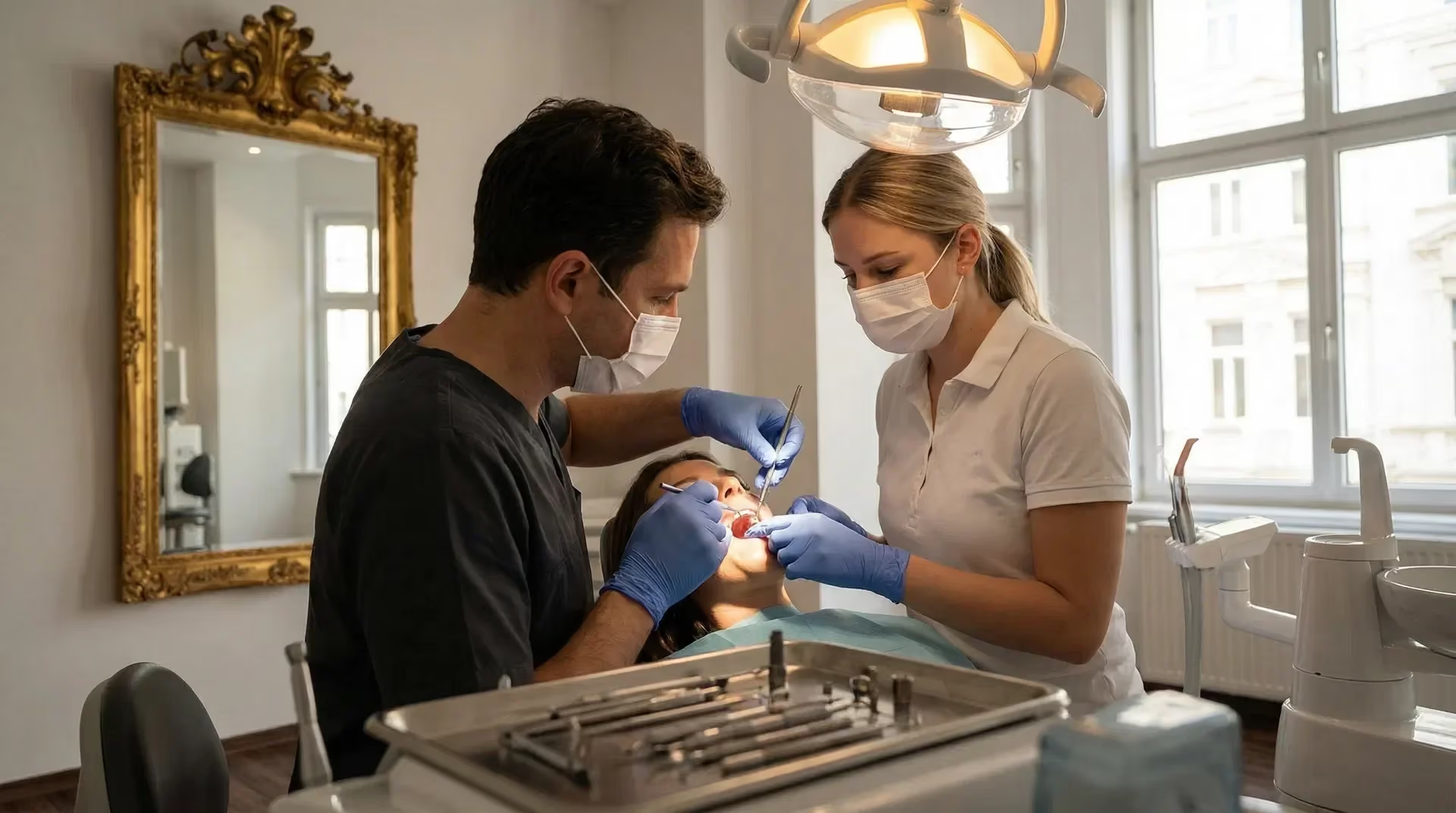
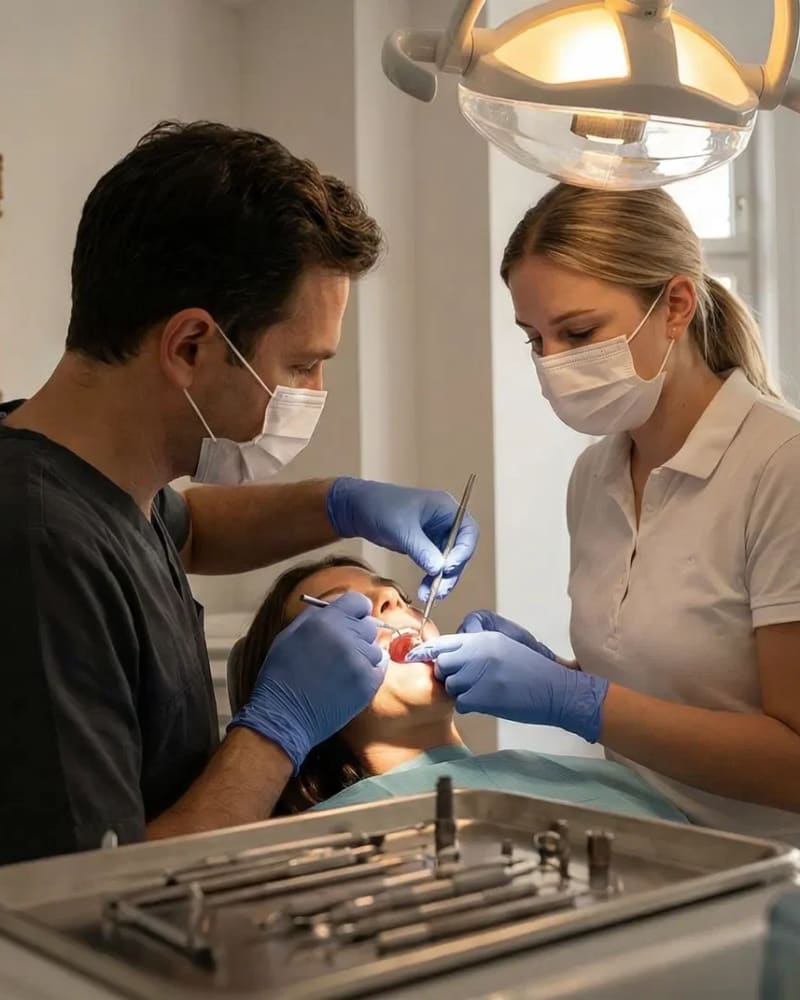
A tooth extraction removes a tooth. For a diseased tooth, we first assess whether root canal treatment, root-end surgery or periodontal therapy can preserve it. A justified orthodontic treatment plan may also provide for extraction.
Under local anaesthesia you feel pressure and pulling during surgery, but no sharp pain; tell the team immediately if you do. Pain and swelling may occur afterwards and, according to the Health Portal, decrease after a few days.*
When is the worst day after extraction?
Usually the first one to two days, after which pain and swelling should ease. If they become significantly worse again two to three days after surgery, contact us: this is the typical timing of a dry socket.*
Which tooth is hardest to extract?
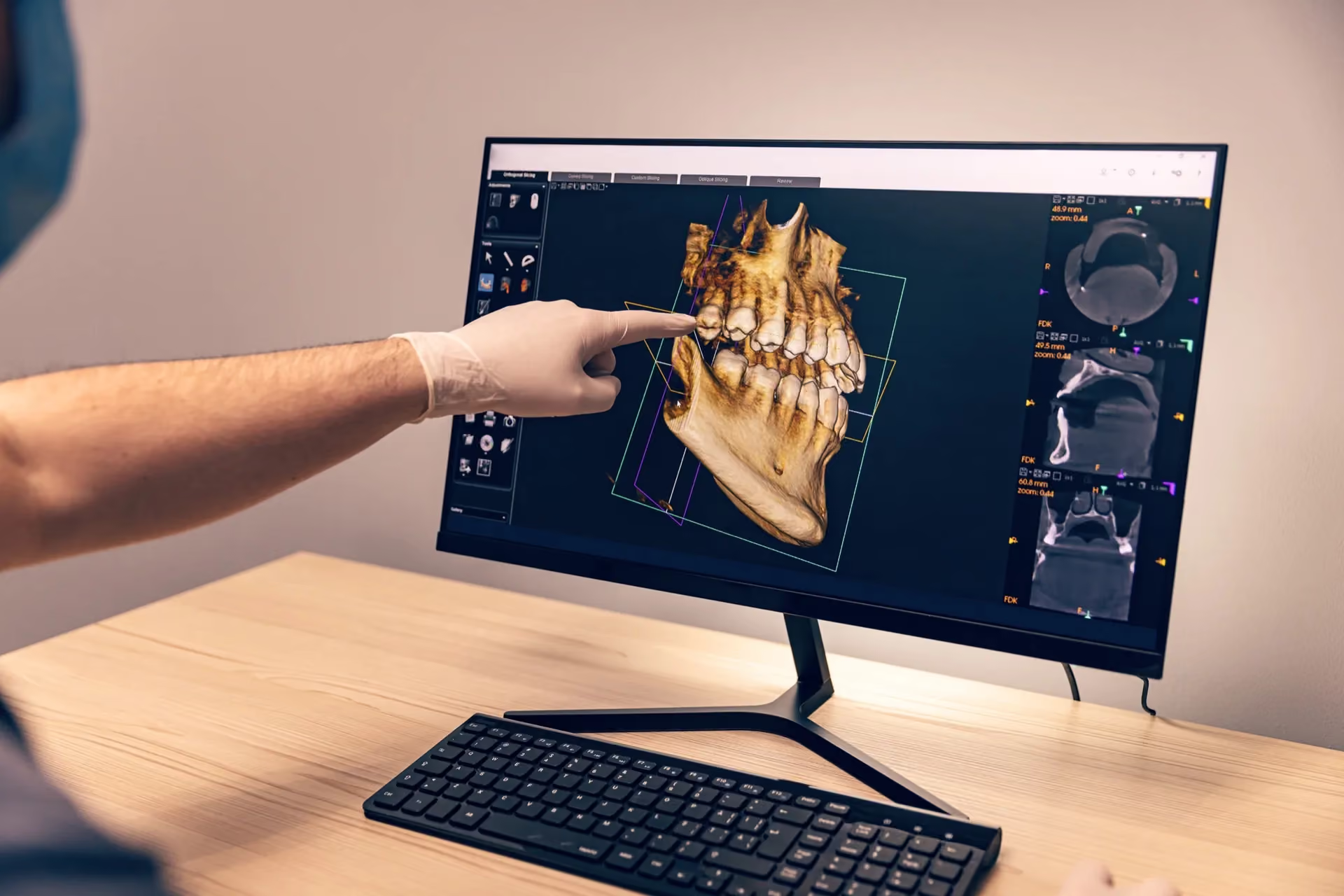
No tooth is always hardest; wisdom teeth lying sideways or deep in the jaw are often more involved. Examination and suitable imaging help assess difficulty and access. Imaging shows factors including root shape and position and surrounding bone; it does not determine the approach alone.*
Tooth removal needs a clear reason.
First we assess whether it can stay
For a diseased tooth, we consider root canal treatment, root-end surgery and periodontal therapy before recommending extraction. Removal may also be needed under a separately justified orthodontic treatment plan. We discuss which reason applies to your tooth.
What follows belongs in the decision
Jawbone shrinks after tooth loss — by more than three millimetres in width at molars. We therefore discuss filling the socket before surgery, rather than afterwards.

Millimetres of mean width reduction
The review estimated mean width reduction of 3.61 mm on X-rays after undisturbed healing at molar sites (Couso-Queiruga et al., 2021). This is a study average for that tooth region and measurement method, not a fixed prediction for every tooth. We discuss whether socket preservation is appropriate based on the clinical findings and planned restoration.
How is tooth removal planned?
For a diseased tooth, we first assess whether it can be preserved. If extraction is planned, access and the work involved depend on examination, tooth position and suitable imaging. An easily accessible removal differs from a surgical approach; the course of tooth extraction explains the individual steps.
After surgery you receive advice on rest, oral hygiene and checks. Have the wound checked for severe or increasing symptoms, persistent bleeding or fever; breathing or swallowing difficulties require immediate medical help. Later gap restoration and bone are separate planning questions.
Further detail
What happens to the bone after extraction
The procedure itself is usually straightforward. What matters for your planning is what happens to the bone afterwards — this determines when and how the gap can be closed.
Without a tooth, the jaw ridge may shrink. A systematic review of undisturbed healing after extraction estimated average radiographic width reduction in molar regions at 3.61 mm (95% confidence interval: 3.24–3.98 mm; Couso-Queiruga et al., 2021). Estimates vary by tooth region and starting situation. Loss may be greater with a thin outer bone wall (Couso-Queiruga et al., 2023). Its thickness can be assessed before surgery.
If an implant is planned, filling the socket during surgery may reduce shrinkage (Canullo et al., 2022). Where neither an implant is planned nor the bone wall thin, we advise against it. We therefore discuss replacement before extraction, not afterwards — and decide in the same conversation when an implant or bridge is appropriate. The YERIT guide Simple or surgical tooth extraction provides background. Other procedures performed at our practice are shown on the oral and maxillofacial surgery in Vienna page.
Dry socket: the complication you should know about
If the blood clot is lost from the wound, bone is exposed — a dry socket, or alveolitis sicca. Typically, pain is delayed until two to three days later and then increases. Frequency depends strongly on the procedure: 1 to 5 per cent for routine extractions and up to 30 per cent for surgically removed wisdom teeth (Daly et al., 2022). A large observational study of 1,357 routine procedures found it in 1 per cent of cases and identified smoking and longer surgery as risk factors (Cardoso et al., 2024). Chlorhexidine can help prevent it — rinses or gel significantly reduced risk in the Cochrane review.
Wound healing after extraction: what actually helps
The 2024 guideline on medication for acute dental pain is clear: NSAID anti-inflammatory medicines, alone or with paracetamol, are likely to work better than opioids after extraction, with a more favourable safety profile. Opioids remain reserved for cases where this is insufficient (Green et al., 2024). For the procedure in detail, read Tooth extraction process in Vienna; indicative prices are on Tooth extraction costs in Vienna and our price overview; we discuss your personal cost plan after examination.
YOUR CONCERNS
What is on your mind?
Acute pain or swelling
A tooth throbs, your cheek swells, chewing is no longer possible. Call us — we arrange a prompt assessment before discussing removal.
Extraction — or is there another option?
Extraction has been suggested and you would like a second opinion. We take time to assess whether the tooth can be retained — and tell you honestly if it cannot.
What comes after the tooth?
You know the tooth needs removing and wonder how the gap will be closed. This question belongs before surgery — it changes how we carry it out.
SUITABILITY CHECK
Is this treatment right for you?
YOUR JOURNEY
Your treatment process
Individual initial consultation
Getting to know your goals and your teeth
We will discuss your goals and examine which treatment is best suited for your teeth.


Individual treatment planning
Defining the next steps together
You will learn which steps are planned and which questions should be clarified in advance.
Precise execution
Guiding you through your treatment step by step
Your treatment follows your personal plan. Please ask questions and tell us about any discomfort at any time.
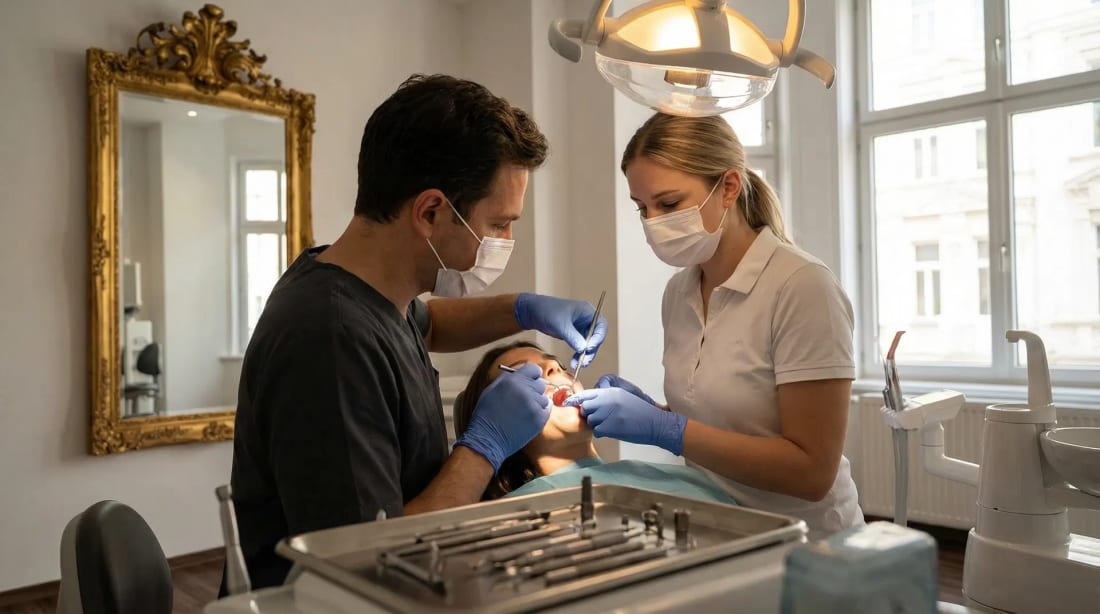

Aftercare and check-ups
Discuss care and follow-up appointments
Finally, we will discuss ongoing care and the follow-up appointments that are right for you.
In everyday life
Plan surgery for a day when you can rest afterwards. Discomfort and swelling are most pronounced on the first and second days; cooling externally helps. Avoid sport, saunas, alcohol and smoking in the first days, as well as straws and vigorous rinsing — these can dislodge the blood clot protecting the wound. Eat soft, lukewarm food and chew on the other side.
YOUR OPTIONS
TREATMENT OPTIONS COMPARED
We will discuss payment terms with you prior to treatment.
The indicative market prices in our price overview provide an initial guide. We will discuss which services are planned for you and the costs involved based on your examination findings and individual cost plan.
Advanced Dental Aesthetics & Implantology
Priv.Doz.Dr.Dr. K. Yerit
“Aesthetics is not a coincidence, but the result of precise planning and deep passion.”
Removing a tooth is the last option, not the fastest. When it is unavoidable, technique determines how much bone remains for what comes next.
View profile →Scientific references
Institute for Implantology and Digital Dentistry Vienna
Medizinische Universität Wien
Österreichische Gesellschaft für Mund-, Kiefer- und Gesichtschirurgie (ÖGMKG)
Österreichische Gesellschaft für Zahn-, Mund- und Kieferheilkunde (ÖGZMK)
Österreichische Zahnärztekammer
Yerit Practice – Dentist Vienna
Excellence
Why Smile4Life
Tooth preservation is assessed first
For a diseased tooth, we consider root canal treatment, root-end surgery and periodontal therapy before recommending extraction. Not every tooth given up on would need to be.
Bone-preserving technique
The tooth is loosened and, where necessary, divided and removed in sections so that the bone walls remain. This determines how much bone is left for later replacement.
The oral and maxillofacial surgeon operates personally
Priv.Doz.Dr.Dr. K. Yerit is a specialist in oral and maxillofacial surgery. Findings and general health determine whether outpatient treatment at the practice is suitable. Necessary further specialist or hospital treatment is not excluded.
Frequently asked questions
Frequently asked questions
Do you have a specific question about your diagnosis? Book a consultation appointment directly →
Questions about your treatment?
Discuss what matters to you and what the next steps look like with us.
Book your appointment nowYour orientation
As a rough guide, a simple extraction takes about 5 to 15 minutes and a surgical one about 20 to 60 minutes. Wound closure, stitch removal and bone remodelling are different steps. Commonly quoted wound timescales of 3 to 7 or 7 to 14 days, and several months for bone, may differ in an individual case. Your check-ups follow your progress.
Understanding what’s involved
An examination appointment with an X-ray, the procedure itself and — after a surgical approach — stitch removal after 7 to 10 days. If replacement is planned, a planning appointment is added.
In everyday life
Plan surgery for a day when you can rest afterwards. Discomfort and swelling are most pronounced on the first and second days; cooling externally helps. Avoid sport, saunas, alcohol and smoking in the first days, as well as straws and vigorous rinsing — these can dislodge the blood clot protecting the wound. Eat soft, lukewarm food and chew on the other side.
Who this information is for
For patients whose tooth is no longer worth preserving — for example, decay so advanced that no restoration can hold, severe bone loss from periodontitis with marked mobility, a longitudinal root fracture or deep root remnants. Also for displaced wisdom teeth causing recurrent inflammation and orthodontically justified crowding.
Important limitations
If the tooth can still be retained with root canal treatment, root-end surgery or periodontal therapy, preservation takes priority — removal is then not indicated. Acute extensive inflammation is treated first. Blood-thinning medicines, bisphosphonate or antibody therapy for bone loss, radiotherapy in the jaw region and poorly controlled diabetes require special planning and sometimes coordination with your treating doctor. Never stop blood-thinning medicines on your own.
Our approach
At our practice, tooth extraction is the conclusion of an assessment rather than a routine decision. Advanced decay, bone loss from periodontitis or a root fracture do not automatically mean a tooth must come out — in many cases, root canal treatment or root-end surgery still offers support. We recommend removal only when these approaches no longer offer a sound prospect. If a tooth really cannot be retained, we also say so clearly rather than starting a futile preservation attempt that costs time and money.
We speak equally openly about what follows. Jawbone measurably shrinks after tooth loss — 2.73 mm in width at front teeth and premolars, 3.61 mm at molars (Couso-Queiruga et al., 2021), and as much as 4.57 mm with a thin bone wall (Couso-Queiruga et al., 2023). Finding this out only years later when planning an implant can mean a larger procedure than necessary. For us, the replacement question therefore belongs before extraction rather than after. Whether filling the socket is appropriate follows from the findings, not a blanket rule: it is effective (Canullo et al., 2022), but not always necessary.
SCIENTIFIC STUDIES
At our practice, tooth extraction is the conclusion of an assessment rather than a routine decision. Advanced decay, bone loss from periodontitis or a root fracture do not automatically mean a tooth must come out — in many cases, root canal treatment or root-end surgery still offers support. We recommend removal only when these approaches no longer offer a sound prospect. If a tooth really cannot be retained, we also say so clearly rather than starting a futile preservation attempt that costs time and money.
We speak equally openly about what follows. Jawbone measurably shrinks after tooth loss — 2.73 mm in width at front teeth and premolars, 3.61 mm at molars (Couso-Queiruga et al., 2021), and as much as 4.57 mm with a thin bone wall (Couso-Queiruga et al., 2023). Finding this out only years later when planning an implant can mean a larger procedure than necessary. For us, the replacement question therefore belongs before extraction rather than after. Whether filling the socket is appropriate follows from the findings, not a blanket rule: it is effective (Canullo et al., 2022), but not always necessary.
Couso-Queiruga E et al. (2021). Post-extraction dimensional changes: A systematic review and meta-analysis
This systematic review and meta-analysis of 28 papers quantifies how much the jaw ridge shrinks after extraction without additional measures. In non-molars, clinically measured horizontal loss was 2.73 mm and outer vertical reduction 1.71 mm. In molars, X-rays suggested mean horizontal loss of 3.61 mm. As both tooth region and measurement method differ, these values do not provide a simple ranking by tooth type. Bone loss varies with the initial situation, an important basis for deciding whether to fill the socket after extraction (Journal of Clinical Periodontology, 2021).
33067890
Couso-Queiruga E et al. (2023). Effect of periodontal phenotype characteristics on post-extraction dimensional changes of the alveolar ridge: A prospective case series
This prospective case series followed 42 patients for 14 weeks after extraction of an upper-jaw non-molar and examined which initial anatomical conditions determine bone loss. The thickness of the outer bone wall was crucial: where it was at most 1 mm thick, horizontal loss of 4.57 mm was more than twice that seen with a thicker wall, at 2.17 mm. Volume loss was also markedly greater. Bone wall thickness can be assessed before surgery, explaining why we discuss socket preservation particularly in these cases (Journal of Clinical Periodontology, 2023).
36644815
Canullo L et al. (2022). Dimensional and histomorphometric evaluation of biomaterials used for alveolar ridge preservation: a systematic review and network meta-analysis
This network meta-analysis of 88 randomized studies with 2,805 patients and 3,073 sockets examines whether and with which materials bone loss after extraction can be limited. All tested materials significantly reduced horizontal and vertical loss compared with untreated sockets left to heal spontaneously. Xenografts and allografts combined with bioactive additives performed most reliably; platelet concentrates ranked highest for new bone formation (Clinical Oral Investigations, 2022).
34826029
Daly BJM et al. (2022). Local interventions for the management of alveolar osteitis (dry socket)
This updated Cochrane review evaluates 49 randomized studies with 6,771 participants on preventing and treating dry socket. The authors estimate its frequency at 1 to 5 percent after routine extraction, compared with up to 30 percent after surgical wisdom tooth removal. Chlorhexidine rinses before and 24 hours after the procedure markedly reduced risk (odds ratio 0.38), as did chlorhexidine gel placed in the socket (odds ratio 0.44), both with moderate certainty of evidence (Cochrane Database of Systematic Reviews, 2022).
36156769
Cardoso RB et al. (2024). Prevalence and factors associated with dry socket following routine dental extractions
This prospective multicentre observational study of 1,357 patients after routine tooth extraction found dry socket in 1 percent of cases. Factors favouring it were age under 50, a longer procedure and incidents during extraction, although the latter association was mediated by surgical complexity. Smoking was linked to the complication particularly with complex procedures. The authors identify moderate to severe pain lasting longer than two days as a practical warning sign (Medicina Oral, Patología Oral y Cirugía Bucal, 2024).
38288852
Green VG et al. (2025). Evidence-based clinical practice guidelines for the management of acute dental pain
This summary of the guideline published in 2024 on drug treatment for acute dental pain, developed with the American Dental Association and others using GRADE methodology, expressly includes pain after extraction. The benefit-risk assessment clearly favours non-opioid medicines: NSAID anti-inflammatory drugs, alone or with paracetamol, are likely to relieve pain better than opioids and are also safer. Opioids are reserved for cases where first-line treatment is insufficient or cannot be used (The American Journal of Emergency Medicine, 2025).
39764906
Zahnentfernung – Öffentliches Gesundheitsportal Österreichs
The Austrian patient information describes pain and swelling after tooth extraction and advises against acetylsalicylic acid as an additional painkiller. This is not an instruction to stop medically prescribed aspirin or other blood-thinning treatment yourself. Individual pain relief is agreed with the treatment team. This does not establish that removing symptom-free wisdom teeth is beneficial for every clinical situation.
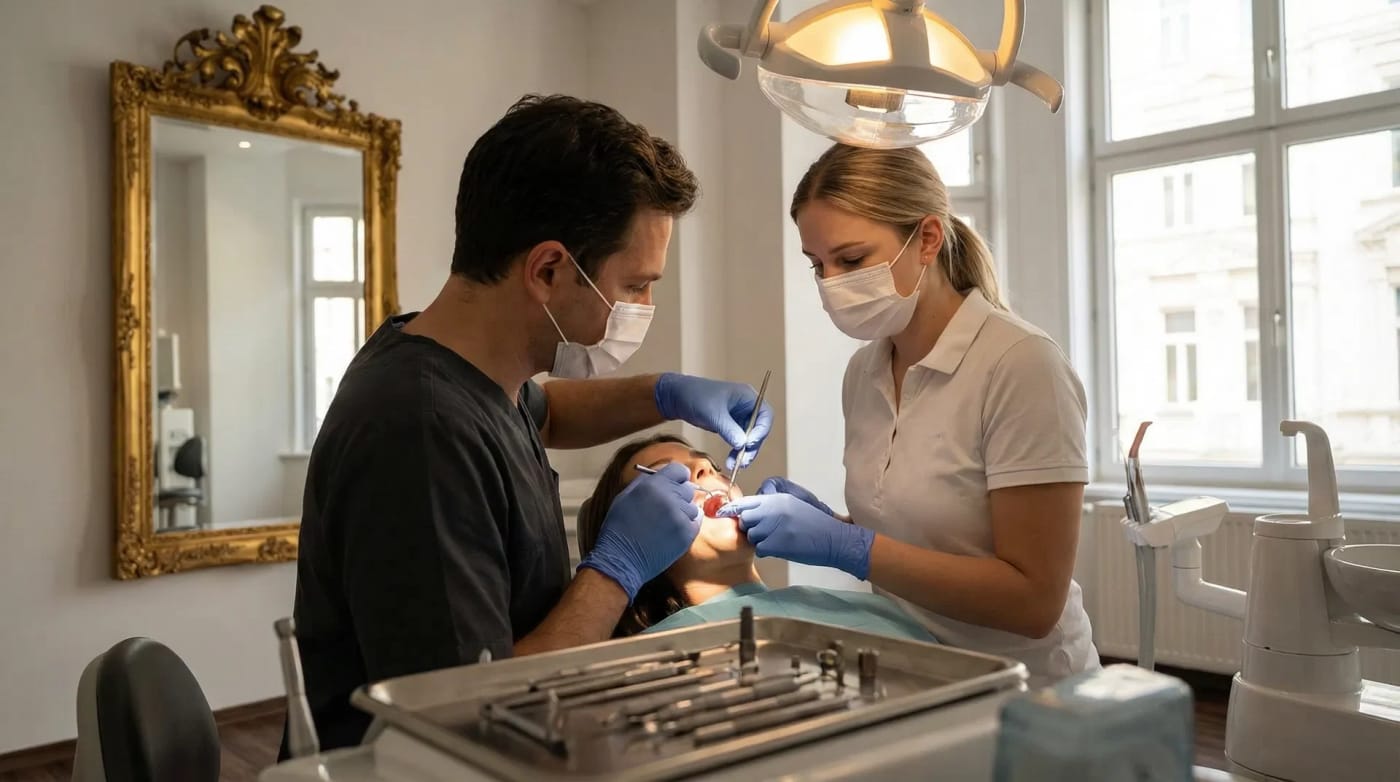
As gentle as possible
The tooth is released from its supporting tissues rather than pulled out forcefully, and divided if needed to preserve the bone walls. The more intact the socket, the more smoothly it heals and the less bone is lost.
More topics in this area
Deepen your knowledge – find all information regarding the treatment process, costs, and results.
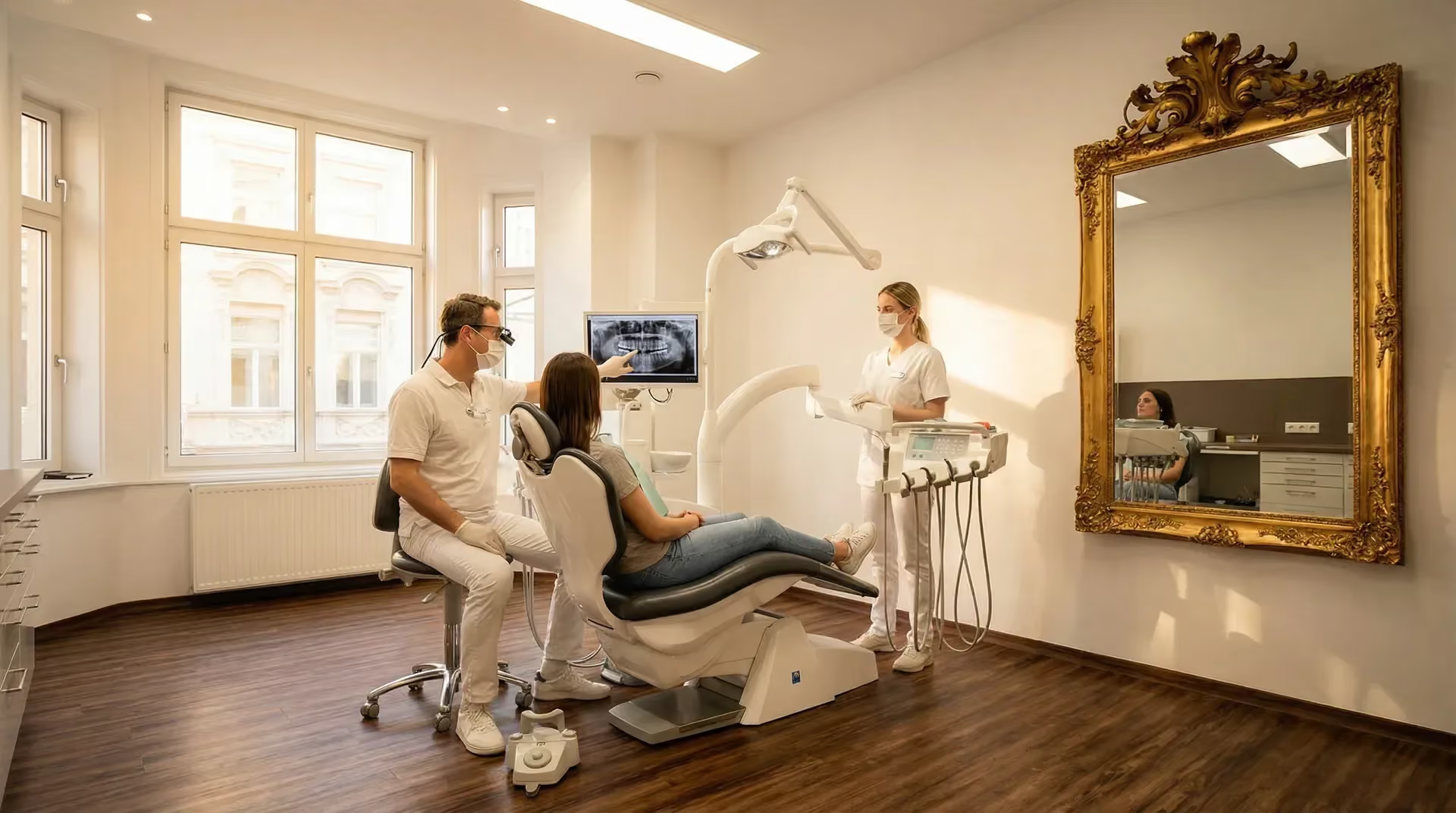


Kärntner Straße 9
100 meters from Stephansplatz, Innere Stadt.
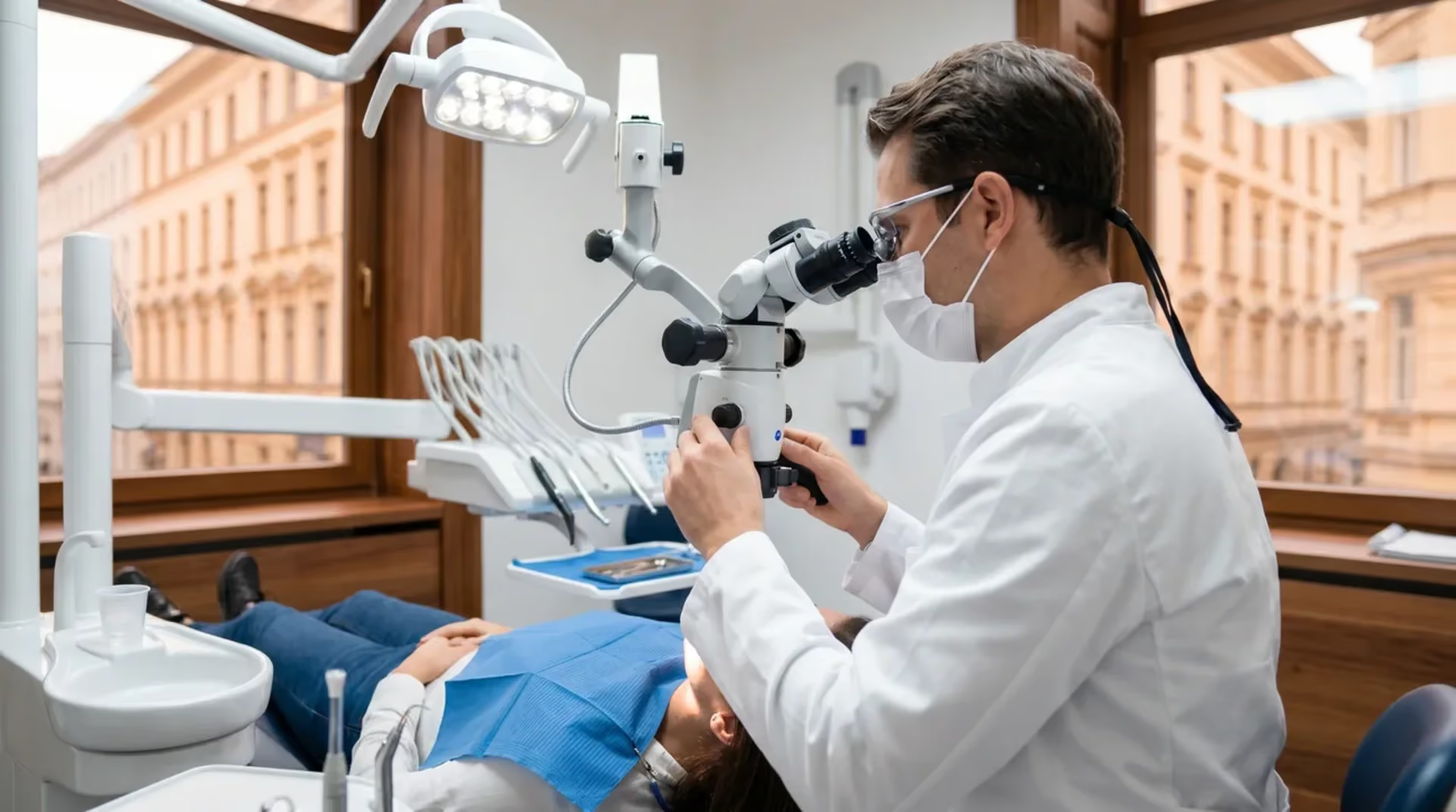

Partnerships & Memberships & References