All-on-4 in Vienna: a fixed arch on four implants
Would you like a fixed arch instead of a loose denture? Learn which options All-on-4 offers and what matters before deciding.
A fixed arch
Four implants per jaw
Individual planning
Personal consultation
All-on-4 Vienna
all-on-4-zahnimplantate-wien
4.9★
Doctify rating
25+
Years of experience
Personal
In-practice consultation
1010 Vienna
Kärntner Straße 9
At a glance
Who may be suitable for All-on-4?
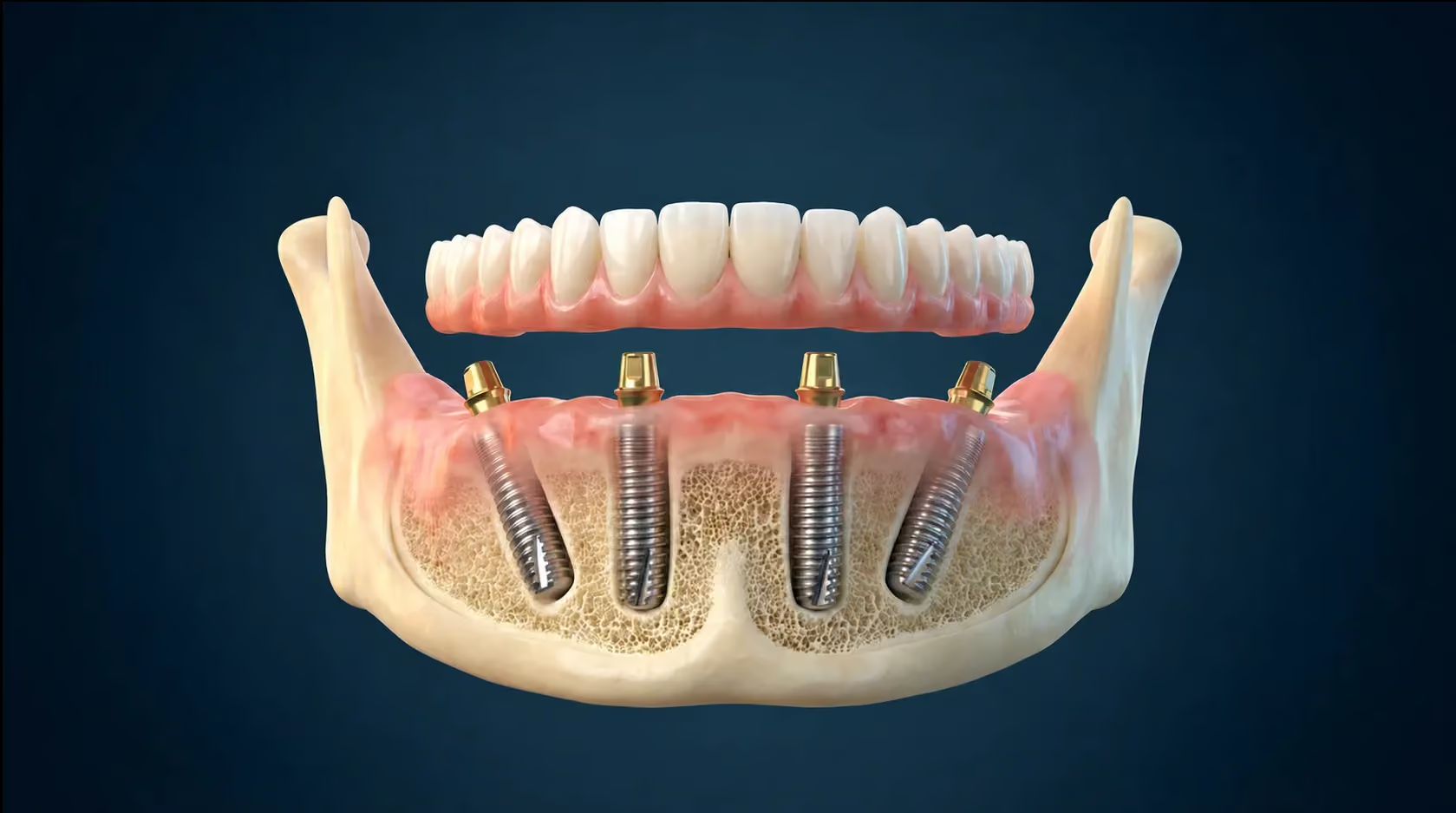
With All-on-4, four implants support a fixed arch in one jaw.
The procedure may suit people missing all teeth in one jaw, or whose remaining teeth cannot be preserved, who want a fixed rather than removable solution. Requirements include enough bone for four stable implants, treated inflammation and good oral hygiene.
Are fixed teeth in one day possible with All-on-4?
With sufficient implant stability, a fixed temporary bridge may be screwed in on the day of surgery. It remains temporary initially. When the final bridge can be fitted and loaded depends on stability, findings, progress and the planned loading protocol. The temporary bridge does not mean unrestricted loading is allowed; if stability is insufficient, restoration takes place later.*
How long does an All-on-4 restoration last?
A long time, but not indefinitely: a retrospective case series of 471 people with All-on-4 lower-jaw restorations estimated cumulative prosthesis survival of 98.8 % and implant survival of 93 % up to 18 years. 149 people (31.6 %) were lost to follow-up; group figures are not an individual prognosis.* Biological and technical complications still occurred; regular checks remain necessary.
What are the disadvantages of All-on-4 implants?
The bridge is screwed in place and cannot be removed by you for cleaning. Technical problems are not uncommon: in a long-term study of 471 people, 36.7 % experienced mechanical complications such as fractures or loose components.*
What All-on-4 could mean for you
All-on-4 replaces a complete arch of teeth with a bridge attached to four dental implants. You do not remove this bridge yourself in daily life. The concept may suit a toothless jaw or a jaw with remaining teeth that cannot be preserved after careful assessment.
The number four refers to implants per jaw. It does not establish whether this restoration is right for you. Available bone, bite and the ability to clean beneath the bridge are among the decisive factors. Teeth that can be preserved are not removed simply because a fixed complete restoration is desired.
Fixed teeth in one day: what does that mean?
This usually means a temporary fixed arch shortly after implant placement. Whether this is possible mainly depends on how stable the implants are in the bone. The final restoration is fitted only after the planned healing and further adjustments. An early fixed restoration therefore does not mean you may chew everything immediately. A prospective five-year study of immediate loading in the lower jaw recorded no implant loss among followed participants, but did observe inflammation over time (Krennmair et al., 2022) — this also does not establish a general guarantee of success.
No firm promise can be made before examination. Also discuss an interim solution in case the implants need protected healing first. The ITI recommendations on loading complete arches emphasise individual selection.
How treatment is planned
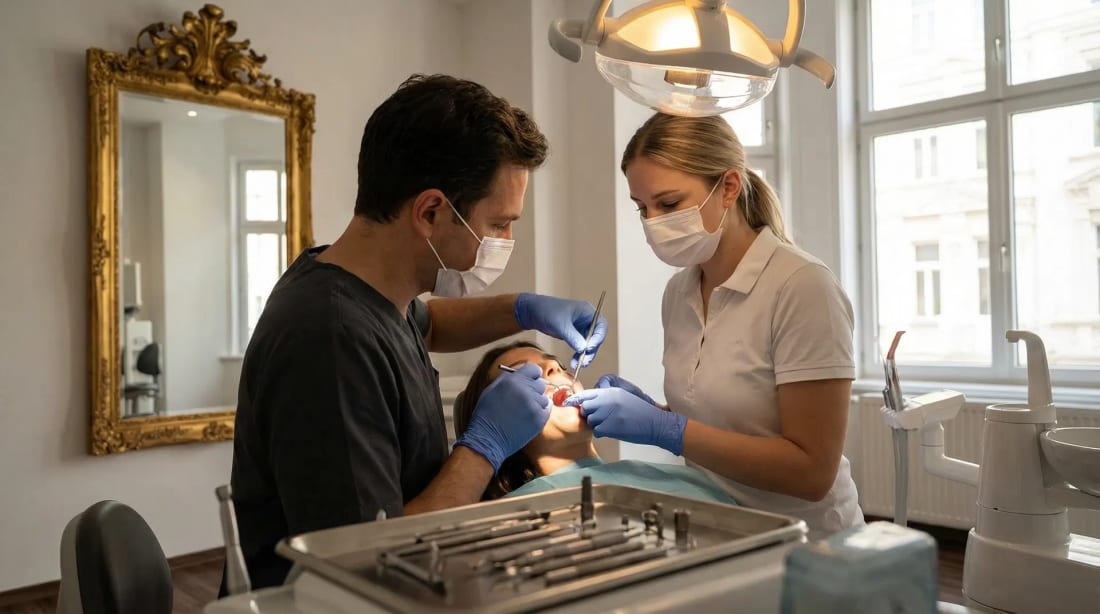
We start with your dental status, wishes and medical history. Examination establishes which teeth can be preserved, where implants can gain stability and which restoration fits your bite. Three-dimensional imaging may support planning. Whether further preparatory treatment is needed follows from these findings.
Implant placement, the interim restoration and healing follow. For the final restoration, fit, bite and access for cleaning are among the factors checked. The All-on-4 treatment process page explains the pathway and possible changes.
What you should know about durability, care and risks
All-on-4 can function long term. The implants in the bone and the bridge attached to them must be considered separately: even when implants remain, the bridge may need repairs or adjustments. A cohort study of implant-supported full-arch restorations reported implant survival of 99.4 per cent and prosthesis survival of 98.2 per cent after five years (Papaspyridakos et al., 2019) — a point of reference, not an individual promise. A long-term lower-jaw study documents both long-term retention and biological and technical complications. An individual durability guarantee cannot be derived from this.
Daily care includes the area beneath the bridge. Ask to be shown how to reach it with suitable aids. A review of different implant-supported upper-jaw restorations reported prosthesis loss of 4.6 per cent; complications were considerably more common. This is not an All-on-4-specific prognosis (Ng et al., 2026). Regular aftercare remains important. Symptoms, bleeding or a loose restoration need early assessment. The knowledge page explains All-on-4, its requirements and limitations in more detail.
Which solution suits you — and what does it cost?
A bridge on more implants, another fixed bridge or a removable restoration may also be suitable. Your findings, care, wishes and the complete treatment burden matter.
Price depends on the full scope of services: examination, surgery, temporary and final replacement teeth, and possible additional measures. The page on All-on-4 costs in Vienna explains how to compare quotations and understand your cost plan. Non-binding general guidance is available on our prices page; we discuss your personal cost plan after examination. Bring your questions to the consultation — especially about teeth that can be preserved, the temporary restoration and later care.
YOUR CONCERNS
What is on your mind?

Your denture feels unstable
If a removable denture causes difficulties in daily life, it is worth comparing restoration options.
Several teeth are badly damaged
Before a complete restoration, the question is which teeth can be preserved.
You would like clarity
A clear plan shows which solution fits and what steps are needed.
SUITABILITY CHECK
Is this treatment right for you?
YOUR JOURNEY
Your treatment process
Individual initial consultation
Getting to know your goals and your teeth
We will discuss your goals and examine which treatment is best suited for your teeth.


Individual treatment planning
Defining the next steps together
You will learn which steps are planned and which questions should be clarified in advance.
Precise execution
Guiding you through your treatment step by step
Your treatment follows your personal plan. Please ask questions and tell us about any discomfort at any time.
Aftercare and check-ups
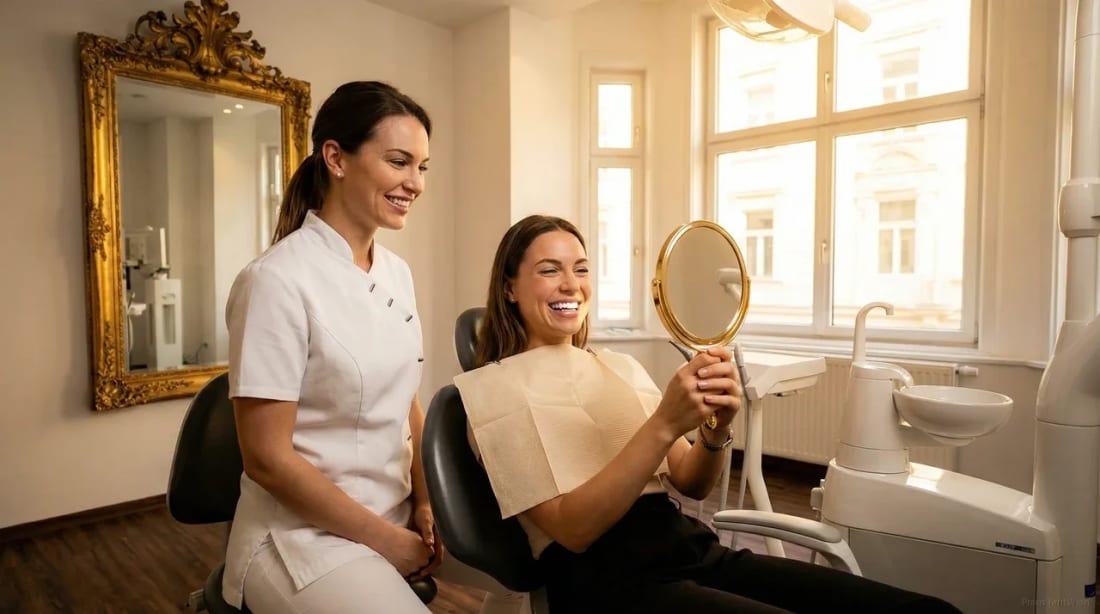
Discuss care and follow-up appointments
Finally, we will discuss ongoing care and the follow-up appointments that are right for you.
In everyday life
A fixed bridge can provide more stability for eating and speaking. Immediately after surgery, the restoration needs protection: what you may eat depends on healing and your treatment team’s instructions.
YOUR OPTIONS
TREATMENT OPTIONS COMPARED
◆ With suitable clinical findings
All-on-4®
A full-jaw restoration on four implants, often with temporary teeth on the day of surgery if the bone allows.
Established
Traditional implants
One implant for each missing tooth, with sufficient bone.
Budget-friendly
Removable denture
A reversible option without surgery for a limited budget.
We will discuss payment terms with you prior to treatment.
The indicative market prices in our price overview provide an initial guide. We will discuss which services are planned for you and the costs involved based on your examination findings and individual cost plan.
Advanced Dental Aesthetics & Implantology
Priv.Doz.Dr.Dr. K. Yerit
“Aesthetics is not a coincidence, but the result of precise planning and deep passion.”
All-on-4® restores your dental function step by step. A fixed temporary bridge can often be fitted on the day of surgery — full chewing is only permitted after healing.
View profile →Scientific references
Institute for Implantology and Digital Dentistry Vienna
Österreichische Gesellschaft für Implantologie (ÖGI)
European Association for Osseointegration (EAO)
Deutsche Gesellschaft für Implantologie (DGI)
International Team for Implantology (ITI)
Yerit Practice – Dentist Vienna
Excellence
Why Smile4Life
Fixed support
The screw-retained bridge stays in the mouth and does not need inserting or removing for daily wear.
A plan for the entire arch
Tooth position, bite and implant positions are considered together.
Possible early restoration
Under suitable conditions, a fixed temporary bridge can be fitted early.
Frequently asked questions
Frequently asked questions
Do you have a specific question about your diagnosis? Book a consultation appointment directly →
Questions about your treatment?
Discuss what matters to you and what the next steps look like with us.
Book your appointment nowYour orientation
A fixed arch that fits your everyday life.
Understanding what’s involved
Planning, surgery, healing and the final restoration are separate steps. The timetable depends on your findings.
In everyday life
A fixed bridge can provide more stability for eating and speaking. Immediately after surgery, the restoration needs protection: what you may eat depends on healing and your treatment team’s instructions.
Who this information is for
- Adults who need an entire jaw restored.
- People with enough usable bone for the planned implant positions.
- People able to include daily cleaning and regular checks in their routine.
Important limitations
- Untreated inflammation or medical conditions may require other treatment first.
- Insufficient suitable bone may require a different implant distribution, bone augmentation or another restoration.
- Heavy grinding, smoking and conditions or medicines affecting healing must be considered during planning.
Our approach
A fixed complete restoration needs a well-founded treatment decision. The overview of All-on-4 and All-on-6 describes both concepts as possible restorations; study averages do not establish general suitability for an individual.
SCIENTIFIC STUDIES
A fixed complete restoration needs a well-founded treatment decision. The overview of All-on-4 and All-on-6 describes both concepts as possible restorations; study averages do not establish general suitability for an individual.
Krennmair S et al. (2022). Immediately loaded implants placed in fresh extraction and healed sites supporting four-implant fixed mandibular prostheses using the All-on-4 concept: A 5-year prospective study
In a prospective study of the lower jaw, 22 of 24 people with 88 implants were followed for five years. No implant was lost in this group; inflammation nevertheless occurred. The result is not a general guarantee of success.
34800325
Moraschini V et al. (2024). Long-term survival and success rate of dental implants placed in reconstructed areas with extraoral autogenous bone grafts: A systematic review and meta-analysis
The review examined implants in areas reconstructed with the patient’s own bone harvested from outside the mouth. It reports long-term survival rates for these grafting procedures. The results cannot be applied generally to every type of bone grafting or substitute material, and they are not an individual guarantee of success.
38450931
Papaspyridakos P et al. (2019). Complications and survival rates of 55 metal-ceramic implant-supported fixed complete-arch prostheses: A cohort study with mean 5-year follow-up
After 5 years, implant-supported full-arch restorations had an implant survival rate of 99.4% and a prosthesis survival rate of 98.2% (The Journal of Prosthetic Dentistry, 2019).
30982622
Maló P et al. (2019). The All-on-4 treatment concept for the rehabilitation of the completely edentulous mandible: A longitudinal study with 10 to 18 years of follow-up
A retrospective study followed 471 people with All-on-4 in the lower jaw for ten to 18 years. It reports long-term retention, but also biological and technical complications. 31.6 percent were lost to follow-up; there is no individual lifespan guarantee.
30924309
Ng E et al. (2026). Prosthetic Outcomes of Implant-Assisted Maxillary Restorations in the Edentulous Maxilla: A Systematic Review and Meta-Analysis
The systematic review and meta-analysis examines fixed and removable implant-supported restorations in the edentulous upper jaw. The reported loss of around 4.6 percent over three to six years refers to prostheses, not implants. Retention does not mean freedom from complications. The pooled results are not an individual All-on-4 prognosis (Ng et al., 2026).
41846047
Shao WH et al. (2026). All-on-4 and All-on-6 implant-supported fixed prostheses for the edentulous jaw: a systematic review and meta-analysis
The review includes 55 studies on All-on-4 and All-on-6. Overall, results were similar, but the studies varied considerably. This does not establish general superiority of a particular number of implants or of guided surgery.
42031576
Having a dental implant (Patient information, Resource 2846/VER4)
For the treatment pathway described, the patient information from Guy’s and St Thomas’ generally states a healing period of at least three months before an implant can support a dental restoration; where bone grafting is performed beforehand, it mentions around four to six additional months (guysandstthomas.nhs.uk, accessed 03.11.2026).
More topics in this area
Deepen your knowledge – find all information regarding the treatment process, costs, and results.


Kärntner Straße 9
100 meters from Stephansplatz, Innere Stadt.

Partnerships & Memberships & References