Caring for dental implants: implant care in Vienna
An implant needs daily cleaning and regular checks. We show you which areas of your restoration need particular attention and how care can fit into your daily routine.
Clean thoroughly every day
Choose suitable cleaning aids
Plan individual aftercare
Have changes checked
Dental Implant Care Vienna
zahnimplantate-pflege-wien
4.9★
Doctify rating
25+
Years of experience
Personal
In-practice consultation
1010 Vienna
Kärntner Straße 9
At a glance
How do you care for dental implants properly?
Clean accessible surfaces and spaces between teeth daily with aids suited to your restoration. The size and technique are demonstrated on your own restoration. Regular check-ups assessing the tissue are also part of care, as recommended by European guidance.*
Which toothbrush is suitable for implants?
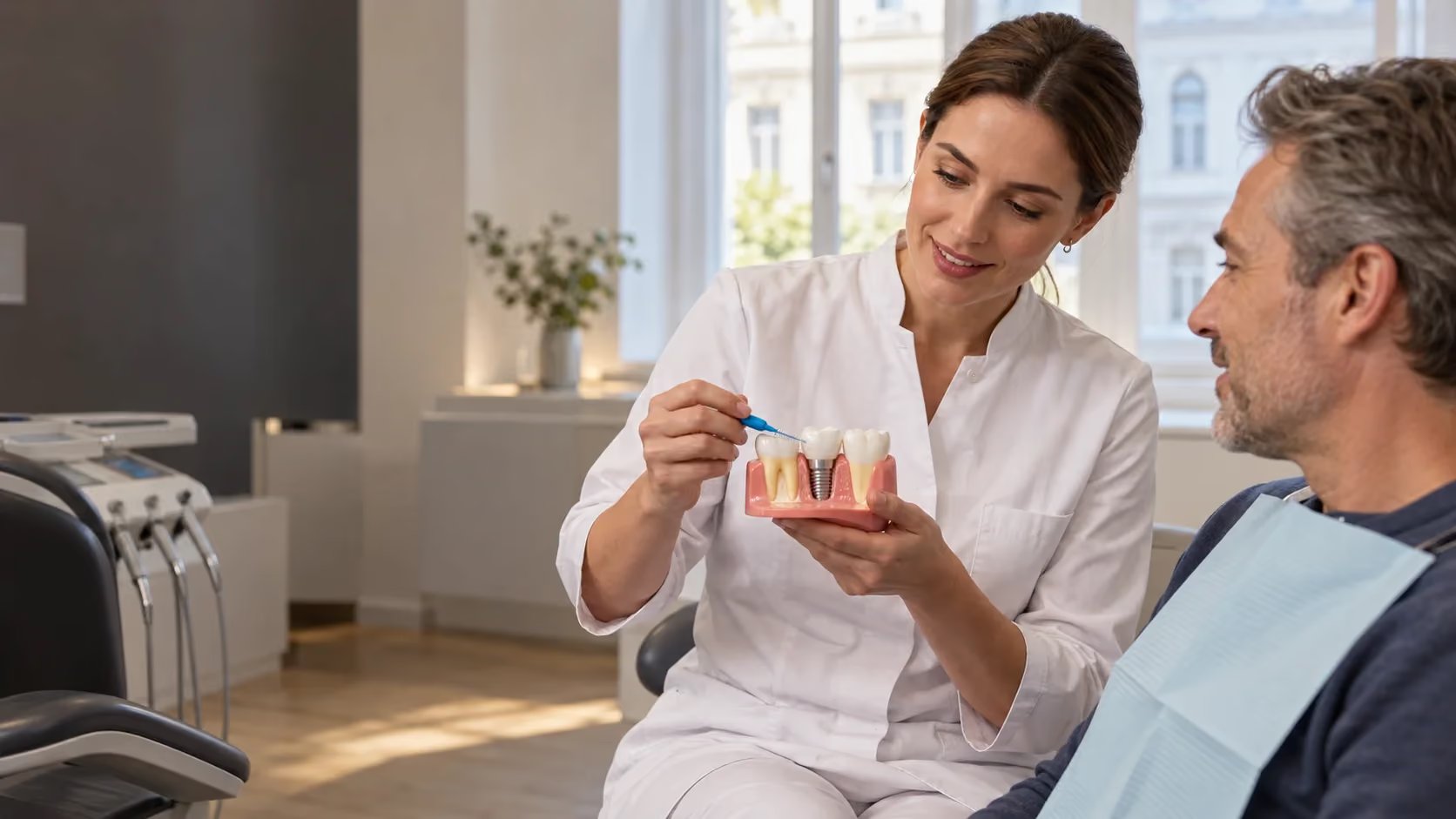
A soft manual or electric toothbrush is equally suitable; technique at the gum line matters more. For the spaces between teeth, you also need suitable interdental brushes, sized at the practice for your restoration.
How often does an implant need checking?
This depends on your risk, for example a history of periodontitis or smoking. Following treated peri-implantitis, aftercare intervals in the studies included in a review ranged from two months to one year; the practice sets your interval.*
What is the difference between mucositis and peri-implantitis?
In mucositis, only the gum around the implant is inflamed; peri-implantitis also involves bone loss. The YERIT guide Peri-implantitis: signs and prevention explains warning signs and prevention.
How do I clean my dental implant day to day?
An implant crown feels similar to a natural tooth when brushing. The junction with the gum needs particular attention. Plaque can collect there and in the spaces between teeth. Clean accessible surfaces with a toothbrush and the spaces between teeth with an aid suited to your restoration.
A small interdental brush can help in some areas. A different solution may be appropriate at tight contact points or beneath a bridge. Ask to be shown the right size and technique on your own restoration. An aid should reach the area without having to be forced in. A water flosser does not simply replace targeted plaque removal. The YERIT guide Dental implants: structure and function explains the basics in detail.
Follow your aftercare plan immediately after surgery
A fresh surgical wound needs different care from a healed implant. Follow the treatment team’s instructions during this phase. Ask explicitly when and how you should clean the wound area. Mouth rinses are not a standard long-term solution: if one is prescribed, the duration and method of use form part of the prescription.
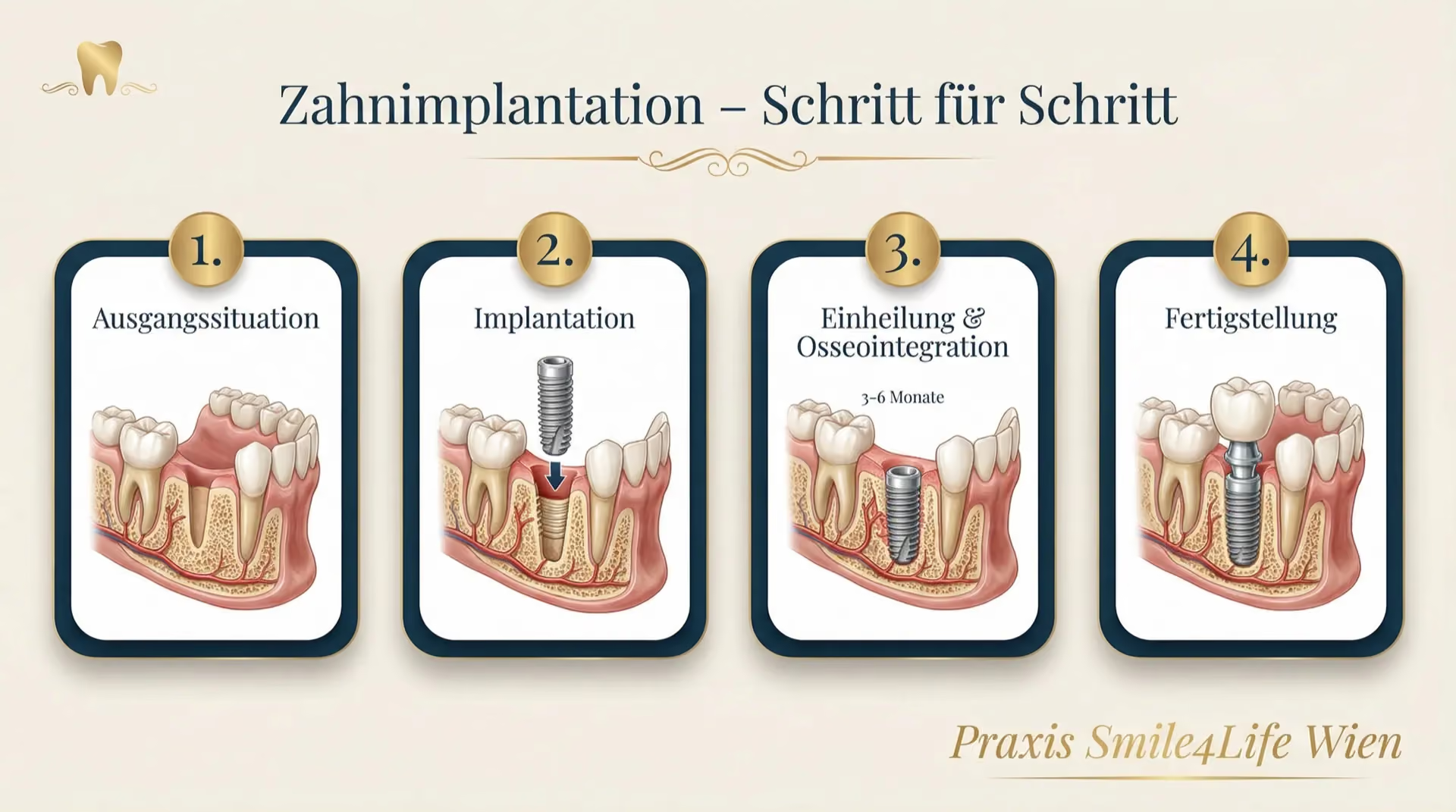
General online tips do not replace this plan. Read how wound checks, healing and the later restoration fit together under dental implant treatment process.
Implant care at the dentist: why check-ups matter
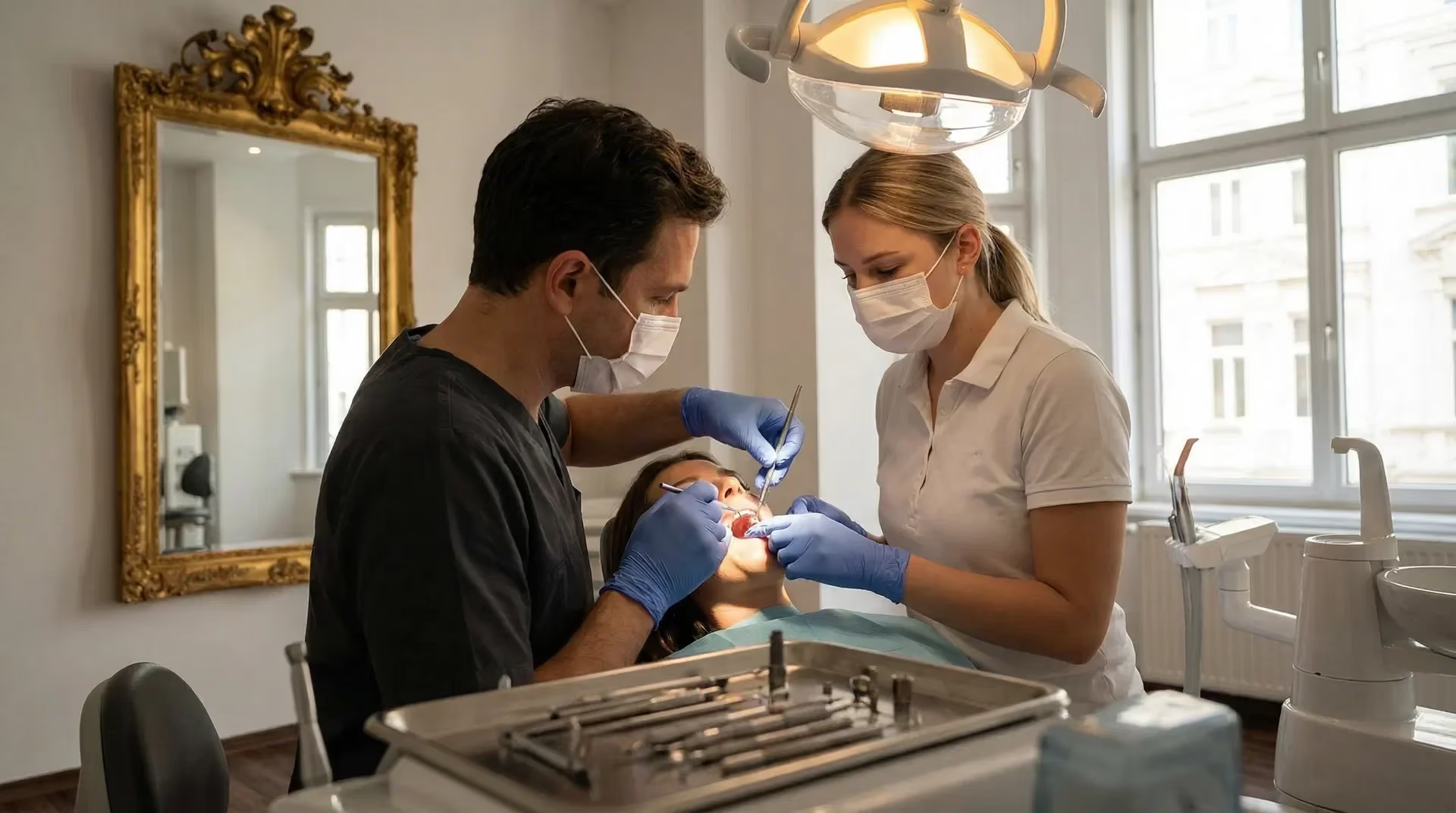
Aftercare involves more than removing plaque. The team also checks the tissue around the implant, your access for cleaning and the restoration. Inflammatory changes may initially cause little discomfort. X-rays are planned according to the clinical question and findings, rather than automatically at every appointment.
How often checks are appropriate depends on factors including previous periodontitis, signs of inflammation, smoking and daily cleaning. Agree on a personal schedule instead of a rigid interval found online. Bring your cleaning aids to the appointment if you are struggling with a particular area.
When should I contact the practice?
Recurrent gum bleeding, swelling, discharge of pus, an unpleasant taste or new pain need to be checked. If the crown or restoration feels loose, have it examined and do not test its movement yourself. Inflammation does not have to be very painful to matter.
After surgery, discuss significantly increasing discomfort or fever promptly with the treatment team. Heavy bleeding that cannot be stopped or a rapid deterioration requires urgent help. Do not wait until your next planned check-up.
Spaces between teeth and professional cleaning
Oral hygiene involves more than brushing the visible crown. Ask your dentist whether floss, interdental brushes or another aid are appropriate for your restoration. Also ask how to clean hard-to-reach areas beneath replacement teeth. A soft toothbrush may help you clean carefully; what matters is that the bristles reach the surfaces.
During professional cleaning, plaque is removed using suitable instruments. Thorough care helps keep the tissue healthy but does not remove every risk. Peri-implantitis affects the supporting jawbone as well as the inflamed tissue. Its treatment is a separate matter requiring professional care. The figures show why these checks matter: systematic reviews find signs of peri-implantitis in around 19.5 to 21 per cent of people with implants, and at least the reversible earlier stage, peri-implant mucositis, in almost half (Diaz et al., 2022; Galarraga-Vinueza et al., 2025). Structured aftercare may help following treatment for peri-implantitis. Study results varied considerably; no specific protocol or check-up interval suitable for everyone could be established. (Stiesch et al., 2023).
Caring for dental implants: finding the right approach together
Say openly if cleaning is difficult, for example because of limited hand mobility. A clear demonstration and suitable aids are more useful than a long shopping list. Care and aftercare form part of dental implant planning from the outset.
Sources and context
Ask to be shown how to clean your own restoration. Ask for help if an area is difficult to reach.
YOUR OPTIONS
TREATMENT OPTIONS COMPARED
We will discuss payment terms with you prior to treatment.
The indicative market prices in our price overview provide an initial guide. We will discuss which services are planned for you and the costs involved based on your examination findings and individual cost plan.
Advanced Dental Aesthetics & Implantology
Priv.Doz.Dr.Dr. K. Yerit
“Aesthetics is not a coincidence, but the result of precise planning and deep passion.”
A dental implant is not “set and forget” — appropriate care and regular preventive appointments create good conditions for it to last.
View profile →Scientific references
Institute for Implantology and Digital Dentistry Vienna
Österreichische Gesellschaft für Implantologie (ÖGI)
European Association for Osseointegration (EAO)
Deutsche Gesellschaft für Implantologie (DGI)
International Team for Implantology (ITI)
Yerit Practice – Dentist Vienna
Frequently asked questions
Frequently asked questions
Do you have a specific question about your diagnosis? Book a consultation appointment directly →
Questions about your treatment?
Discuss what matters to you and what the next steps look like with us.
Book your appointment nowYour orientation
Adapt cleaning and checks to your restoration.
Understanding what’s involved
The extent of treatment, appointments and aftercare are discussed based on your examination findings.
In everyday life
Ask to be shown how to clean your own restoration. Ask for help if an area is difficult to reach.
Who this information is for
Important limitations
Our approach
SCIENTIFIC STUDIES
Lupi SM et al. (2026). Dental implant survival and marginal bone loss after a minimum of 20 years: systematic review and meta-analysis of prospective studies
This systematic review examines the survival of titanium implants over at least 20 years. The findings describe implant retention under different study conditions, not a personal guarantee, the lifespan of the crown or freedom from complications.
42173763
Prevention and treatment of peri-implant diseases—The EFP S3 level clinical practice guideline
Inflammation around implants requires its own diagnosis and treatment. Cleaning, risk control and aftercare are part of this. No procedure guarantees implant preservation or complete tissue regeneration. These outcomes must not be equated with treatment outcomes for natural teeth.
37271498
Galarraga-Vinueza ME et al. (2025). Prevalence, incidence, systemic, behavioral, and patient-related risk factors and indicators for peri-implant diseases: An AO/AAP systematic review and meta-analysis
An AO/AAP review of 102 studies and 13,030 people reports a person-level prevalence of 46 percent for peri-implant mucositis and 21 percent for peri-implantitis. Periodontitis, smoking, diabetes, alcohol consumption and excess weight were identified as risk indicators; the review did not measure a protective effect of follow-up care or oral hygiene (Journal of Periodontology, 2025).
40489307
Stiller HL et al. (2024). The Effects of Smoking on Dental Implant Failure: A Current Literature Update
In 25 of the 33 studies examined, there was a clear association between smoking and an increased risk of implant loss, with a dose-response relationship: the more cigarettes smoked each day, the higher the risk (Dentistry Journal, 2024).
39452439
Krennmair S et al. (2022). Immediately loaded implants placed in fresh extraction and healed sites supporting four-implant fixed mandibular prostheses using the All-on-4 concept: A 5-year prospective study
In a prospective study of the lower jaw, 22 of 24 people with 88 implants were followed for five years. No implant was lost in this group; inflammation nevertheless occurred. The result is not a general guarantee of success.
34800325
Stiesch M et al. (2023). Supportive care for the prevention of disease recurrence/progression following peri-implantitis treatment: A systematic review
Supportive follow-up care may help after peri-implantitis treatment. However, study results were inconsistent, and the reported tissue stability varied considerably. The evidence is insufficient to derive a specific protocol or a fixed interval between check-ups. Recurrence cannot be ruled out.
37339881
More topics in this area
Deepen your knowledge – find all information regarding the treatment process, costs, and results.



Kärntner Straße 9
100 meters from Stephansplatz, Innere Stadt.

Partnerships & Memberships & References