Dental implants: requirements before treatment
Before implant treatment, your oral health, bone and general health are assessed. This forms the basis for a plan: what is possible, what needs treating first and which alternative suits you?
Assess findings carefully
Consider your health
Coordinate preparation
Compare alternatives
Dental Implant Requirements Vienna
zahnimplantate-voraussetzungen-wien
4.9★
Doctify rating
25+
Years of experience
Personal
In-practice consultation
1010 Vienna
Kärntner Straße 9
At a glance
What are the requirements for a dental implant?
You need gums free from inflammation, enough jawbone or the possibility of augmentation, completed jaw growth and stable general health. Daily cleaning and regular check-ups are also needed; European guidance includes these as an integral part of prevention.*
Does a medical condition automatically rule out an implant?
A medical condition does not automatically mean exclusion. Whether preparatory treatment, further investigation or another restoration is needed depends on your situation. Untreated periodontitis, acute inflammation and a jaw that is still growing must be considered. In type-2 diabetes, a meta-analysis found no worse survival for immediately loaded implants when blood glucose was well controlled.*
Does periodontitis need treating before an implant?
Yes. Active periodontitis should be treated and stabilised beforehand, because it increases the risk of inflammation around an implant: a review of 102 studies identifies periodontitis alongside smoking and diabetes as risk indicators for peri-implantitis.*
Am I suitable for dental implants if I smoke?
You are not automatically excluded, but the risk increases: a meta-analysis found around twice the risk of early implant loss in smokers, with an even greater increase in the upper jaw. Stopping smoking before and after surgery improves the starting conditions.*
Which requirements are assessed before implant placement?
A gap can cause difficulties when eating or in everyday life. This page brings together the specific requirements assessed before implant placement: oral health, gums, jawbone, general health, possible preparatory treatment and later care.
If you would first like to understand your personal suitability, also read Am I suitable for dental implants? An overview of implant restorations is available under dental implants in Vienna. The YERIT guide Dental implants: basics, support and limitations explains the basics, options and limitations of dental implants.
What exactly is assessed at your examination?
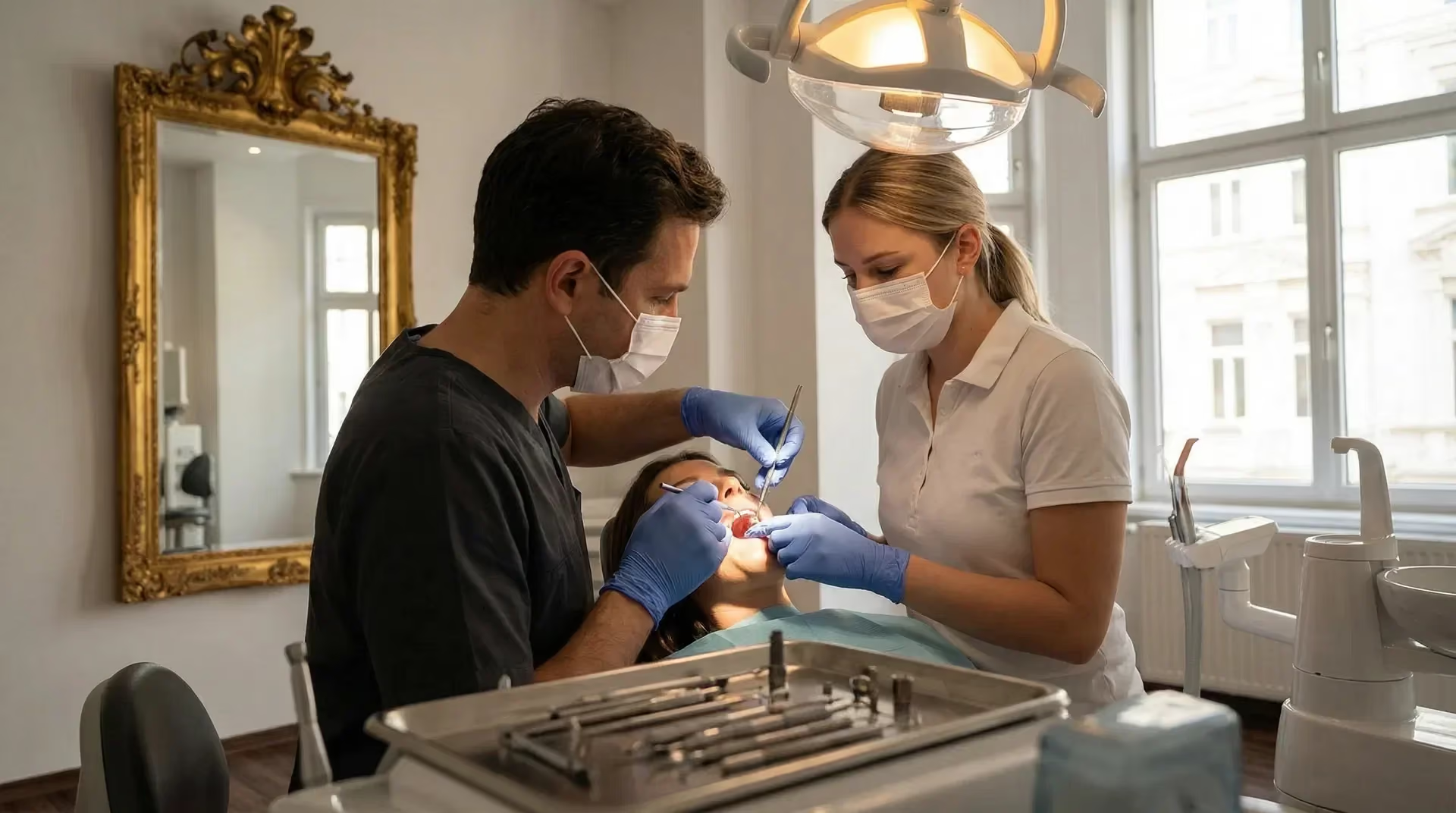
We start with your symptoms, wishes and whether a diseased tooth can still be preserved. Where there is a gap, the gums, neighbouring teeth, bite and space for the eventual restoration are among the factors assessed. An implant must be planned so that the restoration functions and can be cleaned.
The requirements therefore involve more than the amount of bone. The shape of the gums, the position of sensitive structures and possible inflammation also matter. The examination shows which questions still need answering before surgery.
Address inflammation and oral hygiene first
Untreated periodontitis or inflammation in the planned area may require preparatory treatment. The aim is a starting situation that is as stable as possible. A history of periodontitis remains relevant for later aftercare; it does not automatically rule out an implant.
Preparation also includes a realistic care plan. If certain areas are difficult to reach, mention this. The planned restoration should be manageable to keep clean in daily life. Read more on our implant care page.
Diabetes, smoking and medication
Bring an up-to-date medication list and any existing examination records or reports. Relevant factors include diabetes, conditions or treatments that can affect healing, and medicines for osteoporosis or certain cancers. Anticoagulant medication also needs to be discussed. Do not stop taking medication on your own before dental treatment.
A meta-analysis of immediately loaded implants in people with type-2 diabetes found no statistically detectable difference in implant survival compared with people without diabetes. The authors emphasise blood glucose control, oral hygiene and adherence to the treatment protocol. This does not establish general suitability for every implant treatment. A single HbA1c value from an online list is therefore neither approval nor a prohibition. Whether coordination with your treating doctor is needed depends on your situation.
Smoking has a different effect: several reviews find a significantly increased risk of early implant loss, which rises with the number of cigarettes smoked (Fan et al., 2024; Stiller et al., 2024). Smoking does not automatically rule out an implant, but it needs to be discussed openly during planning — together we can clarify which preparation and support would help.
Age: no rigid criterion
A fixed upper age limit is of little help for this decision. Your health, the demands of treatment and how you can care for the restoration long term matter more. Any support you need in daily life may also be part of planning.
In younger people, whether jaw growth has finished is considered. This cannot be determined from a birthday alone. A personal examination is therefore more informative than an age list online.
How is the jawbone assessed before dental implants?
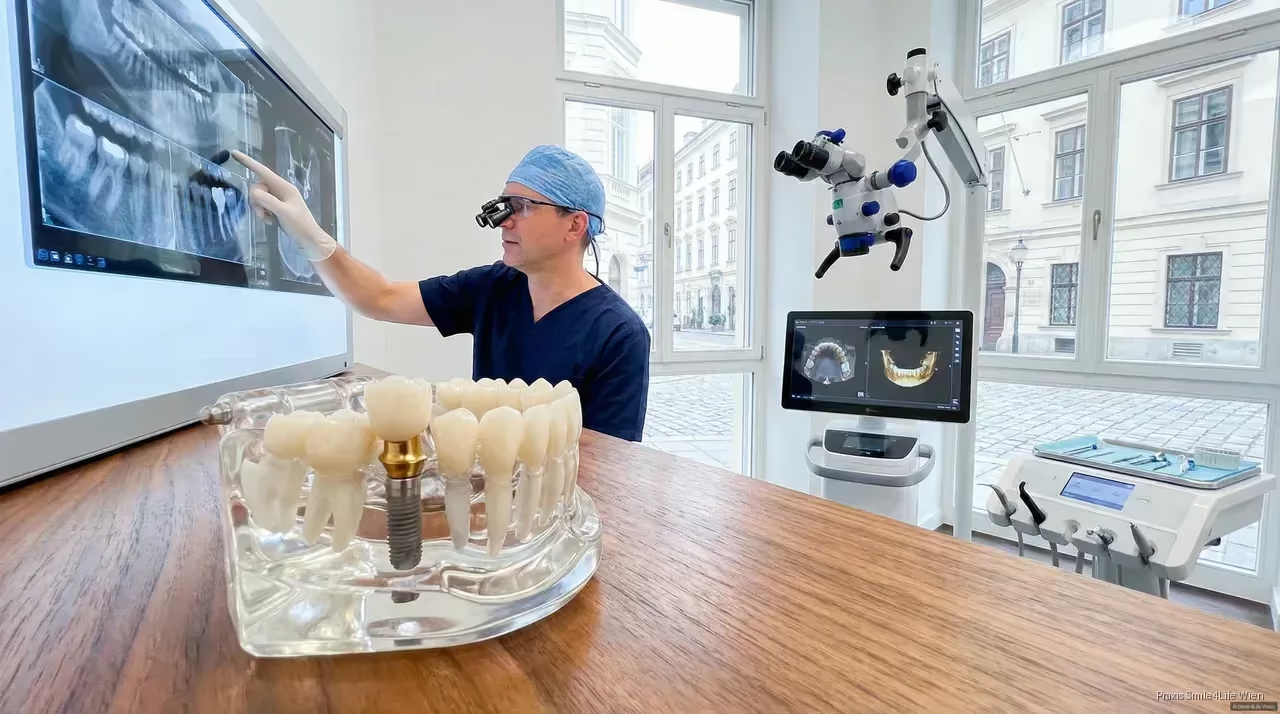
The examination and appropriate X-rays help assess the available bone and the planned position. Whether additional three-dimensional imaging is needed is decided according to the specific clinical question. A CBCT scan is not simply a promise of quality for every initial consultation.
If the starting conditions are insufficient, preparatory treatment and alternatives are discussed. A millimetre measurement alone cannot determine which restoration suits you. In the upper jaw, proximity to the sinus may be relevant; in the lower jaw, the position of a nerve may matter. Details of augmentation are described on the bone augmentation page.
When is implant placement initially postponed?
If active inflammation needs treating or important information about general health is missing, dental implant placement may initially be deferred. This does not mean a permanent exclusion. The dentist assesses which requirement for an implant still needs to be established or examined more closely.
Where jawbone is limited, we assess whether bone augmentation is appropriate and possible or whether another restoration is more suitable. Such anatomical limits cannot be determined from a general minimum bone height. The process and risks of the necessary steps are considered together in the treatment plan.
How are alternatives considered in the treatment plan?
The examination also includes weighing up tooth preservation, a bridge or removable replacement teeth. Ask which options your findings allow and which preparatory treatment each would require. For your personal decision, Am I suitable for dental implants? also discusses care, everyday life and expectations.
What do I take away from the consultation?
Ask which findings matter for the decision, whether preparatory treatment is needed and how the time until your restoration can be bridged. Ask about alternatives and the full scope of services too. Bring your medication list, existing examination records or reports and your most important questions.
The treatment process describes the steps from examination to restoration. Return to the overview under dental implants in Vienna.
Sources and context
A restoration that is easy to clean and suitable preparatory treatments are considered during planning.
YOUR OPTIONS
TREATMENT OPTIONS COMPARED
We will discuss payment terms with you prior to treatment.
The indicative market prices in our price overview provide an initial guide. We will discuss which services are planned for you and the costs involved based on your examination findings and individual cost plan.
Advanced Dental Aesthetics & Implantology
Priv.Doz.Dr.Dr. K. Yerit
“Aesthetics is not a coincidence, but the result of precise planning and deep passion.”
We carefully assess your starting situation and discuss what needs treating first and which alternative suits you.
View profile →Scientific references
Institute for Implantology and Digital Dentistry Vienna
Österreichische Gesellschaft für Implantologie (ÖGI)
European Association for Osseointegration (EAO)
Deutsche Gesellschaft für Implantologie (DGI)
International Team for Implantology (ITI)
Yerit Practice – Dentist Vienna
Frequently asked questions
Frequently asked questions
Do you have a specific question about your diagnosis? Book a consultation appointment directly →
Questions about your treatment?
Discuss what matters to you and what the next steps look like with us.
Book your appointment nowYour orientation
The necessary steps depend on your examination findings.
Understanding what’s involved
The extent of treatment, appointments and aftercare are discussed based on your examination findings.
In everyday life
A restoration that is easy to clean and suitable preparatory treatments are considered during planning.
Who this information is for
Important limitations
Our approach
SCIENTIFIC STUDIES
Stiller HL et al. (2024). The Effects of Smoking on Dental Implant Failure: A Current Literature Update
In 25 of the 33 studies examined, there was a clear association between smoking and an increased risk of implant loss, with a dose-response relationship: the more cigarettes smoked each day, the higher the risk (Dentistry Journal, 2024).
39452439
Galarraga-Vinueza ME et al. (2025). Prevalence, incidence, systemic, behavioral, and patient-related risk factors and indicators for peri-implant diseases: An AO/AAP systematic review and meta-analysis
An AO/AAP review of 102 studies and 13,030 people reports a person-level prevalence of 46 percent for peri-implant mucositis and 21 percent for peri-implantitis. Periodontitis, smoking, diabetes, alcohol consumption and excess weight were identified as risk indicators; the review did not measure a protective effect of follow-up care or oral hygiene (Journal of Periodontology, 2025).
40489307
Andrade CAS et al. (2021). Survival rate and peri-implant evaluation of immediately loaded dental implants in individuals with type 2 diabetes mellitus: a systematic review and meta-analysis
The meta-analysis examined immediately loaded implants in people with type-2 diabetes and found no statistically significant difference in implant survival compared with people without diabetes. The authors emphasize blood glucose control, oral hygiene and adherence to the treatment protocol. This does not establish general suitability for every implant treatment.
34586502
Giok KC et al. (2026; online 2025). Factors leading to implant failure: An umbrella review of meta-analyses of observational studies and trials
The review reports an association between smoking and implant loss. For immediate compared with delayed implant placement, pooled randomized studies provide moderate evidence of a higher risk of failure. This is not an individual risk estimate; print 2026, online 2025; PMID 40425441.
40425441
Prevention and treatment of peri-implant diseases—The EFP S3 level clinical practice guideline
Inflammation around implants requires its own diagnosis and treatment. Cleaning, risk control and aftercare are part of this. No procedure guarantees implant preservation or complete tissue regeneration. These outcomes must not be equated with treatment outcomes for natural teeth.
37271498
Krennmair S et al. (2022). Immediately loaded implants placed in fresh extraction and healed sites supporting four-implant fixed mandibular prostheses using the All-on-4 concept: A 5-year prospective study
In a prospective study of the lower jaw, 22 of 24 people with 88 implants were followed for five years. No implant was lost in this group; inflammation nevertheless occurred. The result is not a general guarantee of success.
34800325
More topics in this area
Deepen your knowledge – find all information regarding the treatment process, costs, and results.




Kärntner Straße 9
100 meters from Stephansplatz, Innere Stadt.

Partnerships & Memberships & References