Periodontitis in Vienna: recognising and treating gum disease
Would you like to know what your gums need? Examination clarifies your clinical findings and which treatment can support your teeth.
Understand your findings
Understand treatment
Discuss daily care
Clarify next steps
Periodontitis Vienna
parodontitis-wien
4.9★
Doctify rating
25+
Years of experience
Personal
In-practice consultation
1010 Vienna
Kärntner Straße 9
At a glance
What is periodontitis and how is it treated?
Periodontitis is inflammation of the tissues supporting the teeth, which can lead to the loss of supporting tissue and bone. Treatment takes place in stages: daily care and risk factors such as smoking or diabetes are addressed, followed by thorough cleaning deep inside the pockets, often over several appointments. Healing is reviewed after around six to twelve weeks.*
How does periodontitis develop?
It usually develops from untreated gum inflammation: the gums separate from the tooth, pockets containing bacterial deposits form, and connective tissue and bone break down. Smoking, poor oral hygiene and poorly controlled diabetes increase the risk.*
How can I tell whether I have periodontitis?
Signs include bleeding gums, gum recession, sensitive tooth necks, bad breath and, later, loose teeth — symptoms often appear late. Specialists therefore recommend basic periodontal screening with a measuring probe once a year.*
Can periodontitis be cured?
It can be controlled effectively, but susceptibility remains. After deep cleaning, studies found that an average of 74% of pockets closed; lost bone does not automatically grow back.* Lifelong follow-up care is therefore part of treatment.
A clear diagnosis helps you decide
The gums and the tissues supporting the teeth have different functions. Examination establishes where inflammation is present and whether teeth have lost support.
The findings determine the treatment needed and when its effects should be reviewed. Your questions about symptoms, cleaning and the care involved belong in this discussion.
What is examined when periodontitis is suspected
Repeated gum bleeding, bad breath, exposed tooth necks or loose teeth are reasons for a dental examination. On their own, they do not prove periodontitis. The disease can also be present without pain. “Parodontose” is a colloquial German term for periodontitis.
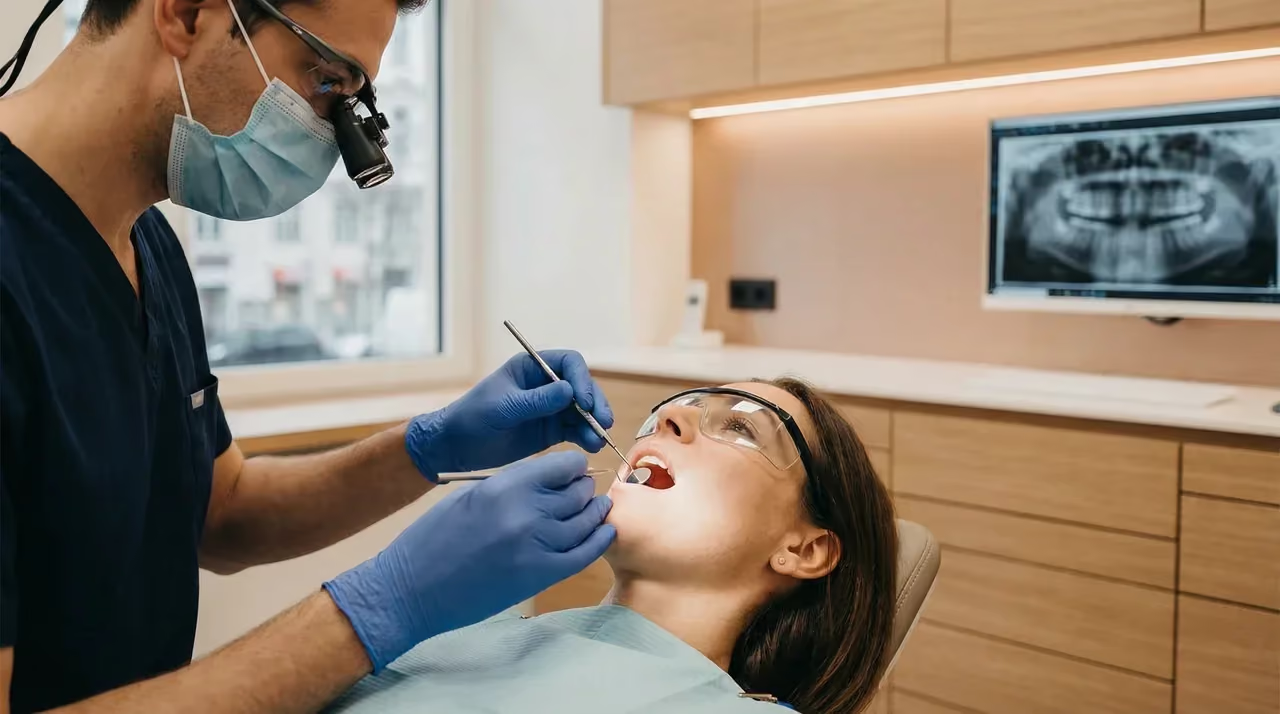
Basic periodontal screening provides initial guidance. If findings are abnormal, a detailed periodontal assessment follows, recording gum pockets, bleeding and tooth support, among other factors. X-rays can help assess the bone. The images needed depend on the clinical question; three-dimensional imaging is not automatically part of every examination. Classification by disease stage and grade provides the basis for an individual treatment plan (Dietrich et al., 2019).
Which treatment can support your teeth
The first aim is to remove bacterial deposits and make daily cleaning easier. With periodontitis, affected areas below the gum margin also need targeted cleaning. This is known as subgingival instrumentation. It can reduce inflammation and pocket depths, but does not automatically fully restore lost supporting tissue (Suvan et al., 2020).
Measurements are repeated after healing. If pockets still need treatment, further cleaning or, in selected cases, surgery may be considered. Examination determines the sequence and extent of care. We explain the periodontitis treatment process on a separate page.
What you can contribute
Thorough, gentle oral hygiene and cleaning between your teeth support treatment. Ask to be shown which aids suit your teeth. Smoking and diabetes are among the factors considered in planning. Tell the treating clinician about medication and other illnesses as well. The association with cardiovascular disease is considered sufficiently established for professional societies in both disciplines to recommend closer cooperation (Sanz et al., 2020, consensus report with cardiology).
Active treatment is followed by supportive periodontal therapy (known as UPT in German). This includes reviews and further targeted cleaning when needed. Appointment intervals depend on individual risk. This care involves more than occasional cosmetic tooth cleaning.
Realistic goals and your next step
The inflammation can be treated and often stabilised over the long term. Support already lost does not automatically grow back completely. Whether a tooth can be preserved depends on its findings and subsequent progress. The association between periodontitis and general diseases also does not mean that gum treatment will reliably prevent other illnesses.
Inflammation limited to the gums, known as gingivitis — an inflammation that, unlike periodontitis, is fully reversible with consistent treatment (Trombelli et al., 2018) — needs a different assessment from periodontitis. Symptoms around an implant are assessed separately because different diagnostic criteria apply; see our page on peri-implantitis. The YERIT guide to periodontitis explains the background.
Your clinical findings, the scope of treatment and cost planning matter for your personal decision. A separate page explains what determines the cost of periodontitis treatment. Arrange an examination to discuss these points for your teeth.
Sources and context
Sanz and colleagues (2020): EFP S3 guideline on treating periodontitis
The guideline describes four treatment stages after diagnosis, including long-term follow-up care.
Context: It applies to stages I to III and does not replace a personal treatment plan.
Papapanou and colleagues (2018): Classification of periodontitis
Stage and grade describe severity, treatment complexity and progression.
Context: The foundational classification consensus predates 2019. Symptoms alone do not allow classification.
Austrian health portal: Periodontitis
The patient information explains symptoms, examination and treatment.
Context: General guidance last updated in 2022; a personal diagnosis requires examination.
YOUR CONCERNS
What is on your mind?
Repeated gum bleeding
Examination clarifies the cause and the condition of the tissues supporting your teeth.
Receding gums or loose teeth
Changes can have different causes and should be assessed.
Persistent bad breath
Deposits and inflammation are possible causes; examination determines the next steps.
SUITABILITY CHECK
Is this treatment right for you?
YOUR JOURNEY
Your treatment process
Individual initial consultation
Getting to know your goals and your teeth
We will discuss your goals and examine which treatment is best suited for your teeth.


Individual treatment planning
Defining the next steps together
You will learn which steps are planned and which questions should be clarified in advance.
Precise execution
Guiding you through your treatment step by step
Your treatment follows your personal plan. Please ask questions and tell us about any discomfort at any time.


Aftercare and check-ups
Discuss care and follow-up appointments
Finally, we will discuss ongoing care and the follow-up appointments that are right for you.
In everyday life
Thorough, gentle cleaning supports treatment. Have new or worsening symptoms assessed.
YOUR OPTIONS
TREATMENT OPTIONS COMPARED
We will discuss payment terms with you prior to treatment.
The indicative market prices in our price overview provide an initial guide. We will discuss which services are planned for you and the costs involved based on your examination findings and individual cost plan.
Advanced Dental Aesthetics & Implantology
Priv.Doz.Dr.Dr. K. Yerit
“Aesthetics is not a coincidence, but the result of precise planning and deep passion.”
Periodontitis can be treated effectively when it is identified and treated consistently — our goal is to preserve your own teeth.
View profile →Scientific references
Institute for Implantology and Digital Dentistry Vienna
Österreichische Gesellschaft für Parodontologie
European Federation of Periodontology (EFP)
Deutsche Gesellschaft für Parodontologie (DG PARO)
American Academy of Periodontology (AAP)
Yerit Practice – Dentist Vienna
Excellence
Why Smile4Life
Understand your findings
Measurements and examination provide the basis for decisions.
Treat in stages
Further steps depend on progress and reassessment.
Ongoing support
Daily care and follow-up are adapted to your needs.
Frequently asked questions
Frequently asked questions
Do you have a specific question about your diagnosis? Book a consultation appointment directly →
Questions about your treatment?
Discuss what matters to you and what the next steps look like with us.
Book your appointment nowYour orientation
Understand the findings and plan appropriate next steps.
Understanding what’s involved
The extent of care and appointments depend on your individual situation.
In everyday life
Thorough, gentle cleaning supports treatment. Have new or worsening symptoms assessed.
Who this information is for
An individual examination is useful for people with gum changes, suspected periodontitis or an existing diagnosis.
Important limitations
Existing illnesses and medication can affect planning. Any adjustment is discussed based on your clinical findings; do not stop medication on your own.
Our approach
Treatment follows the diagnosis and is reviewed as it progresses. Realistic goals are controlling inflammation and preserving teeth for as long as possible. Lost tissue is not automatically fully restored.
SCIENTIFIC STUDIES
Treatment follows the diagnosis and is reviewed as it progresses. Realistic goals are controlling inflammation and preserving teeth for as long as possible. Lost tissue is not automatically fully restored.
Galarraga-Vinueza ME et al. (2025). Prevalence, incidence, systemic, behavioral, and patient-related risk factors for peri-implant diseases
A current systematic review and meta-analysis of 102 studies involving more than 13,000 patients reports person-level prevalence of peri-implant mucositis of 46% and peri-implantitis of 21%. Previous periodontitis, smoking and diabetes were observed risk indicators. This does not establish cause and effect.
40489307
Suvan J et al. (2020). Subgingival instrumentation for treatment of periodontitis. A systematic review
This systematic review informing the EFP S3 guideline evaluates randomised trials of subgingival instrumentation. Probing depth decreased by an average of 1.4 mm (95% confidence interval 1.0 to 1.7) after six to eight months, and 74 percent of pockets closed (95% CI 64 to 85). Hand or powered instruments, quadrant-based treatment or a single course showed no significant difference (Journal of Clinical Periodontology, 2020).
31889320
Trombelli L et al. (2018). Plaque-induced gingivitis: Case definition and diagnostic considerations
The consensus paper from the 2017 World Workshop on periodontal classification defines clinical gingivitis as a common, clearly distinguishable condition that is fully reversible with consistent treatment.
29926936
More topics in this area
Deepen your knowledge – find all information regarding the treatment process, costs, and results.



Kärntner Straße 9
100 meters from Stephansplatz, Innere Stadt.



Partnerships & Memberships & References