Laser Dental Treatment in Vienna: Uses and Limits
Diode and Er:YAG lasers — where studies show meaningful advantages, and where the evidence is more cautious than the trend
Diode laser & Er:YAG
Anaesthetic based on findings
Evidence-based use
Several applications
Laser Dental Treatment Vienna
laser-zahnbehandlung-wien
4.9★
Doctify rating
25+
Years of experience
Personal
In-practice consultation
1010 Vienna
Kärntner Straße 9
At a glance
What is laser dental treatment?
Focused light of a particular wavelength cuts, vaporises or heats tissue. Periodontal research has examined erbium lasers at 2780 to 2940 nm and diode lasers at 810 to 980 nm, for example — each device has different uses.*
Is laser treatment at the dentist painful?
This depends on the procedure. Across 20 studies of decay removal, significantly fewer patients needed anaesthetic with a laser than with a drill — but certainty of this evidence is very low.*
What does a dentist use a laser for?
Uses include shaping gum tissue, releasing a lip frenum, relieving pain from mouth ulcers and removing decay. Across 21 studies of aphthous ulcers, low-level laser reduced pain, particularly during the first one to three days.*
Is a laser better than conventional methods?
Not inherently. For decay removal, a review found no clear difference in filling survival compared with a drill, with low certainty of evidence; this does not prove equivalence. Preparation took longer. For periodontitis, the European guideline advises against routine laser use alongside pocket cleaning.*
Lasers do not work equally well for every purpose.
A tool with several uses
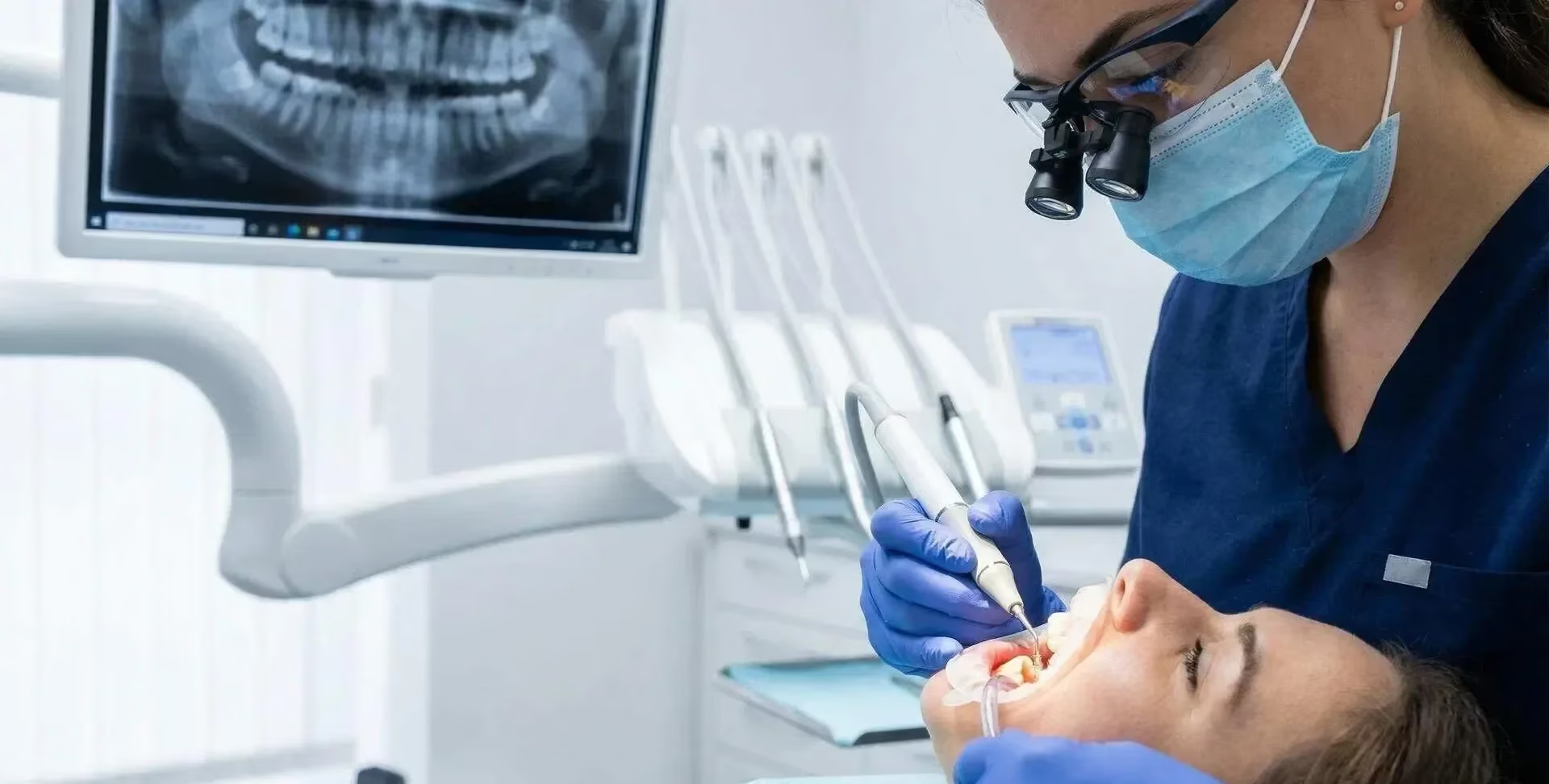
Dental lasers range from diode lasers for soft tissue to Er:YAG lasers for hard tooth tissue. Actual benefit varies considerably according to the indication — gingivectomy, frenectomy, treatment of mouth ulcers or decay removal.
Evidence rather than a trend
We use lasers where studies demonstrate a meaningful advantage — and explain just as openly where current research shows no additional benefit over conventional methods.

Laser systems for targeted use
Diode lasers for soft tissue; Er:YAG lasers also for hard tooth tissue — we select the system according to the specific indication, rather than using one approach for everyone.
In more detail
Laser dental treatment in Vienna: what a laser actually offers
‘Laser treatment’ covers very different uses — from minimally invasive soft-tissue incisions to additional treatment for periodontitis. Benefit depends critically on the particular indication.
For orthodontically associated gum enlargement, a systematic review of seven studies reported less pain and bleeding with diode laser gingivectomy than with scalpel surgery (Maboudi et al., 2023). This applies to the situation studied and does not demonstrate an advantage for every gum correction. A comparison study of upper-lip frenectomy found shorter treatment and less bleeding with an Er:YAG laser, without a demonstrated difference in patient satisfaction (Sarmadi et al., 2020). This does not establish a general recommendation for all lip- or tongue-tie procedures.
Where the evidence is more cautious
The picture differs for peri-implant mucositis and untreated periodontitis: a meta-analysis of 3 randomised controlled studies found no statistically significant additional benefit from diode laser therapy over mechanical cleaning alone (Atieh et al., 2022), while another review describes evidence for additional laser use in periodontitis as still limited (Salvi et al., 2020). Read more on our page Laser for Periodontitis Vienna.
Mouth ulcers and decay: two further uses
For recurrent aphthous ulcers, a recent meta-analysis found that low-level laser therapy (LLLT) significantly reduces pain and shortens healing time (Ma et al., 2025). A review comparing laser-assisted decay removal with conventional drills found no clear difference in filling survival, with low certainty of evidence. Less pain and reduced need for anaesthetic were reported with very low certainty; preparation took longer (Esteves-Oliveira et al., 2025).
Why ‘laser’ means several devices rather than one
Wavelength determines which tissues a laser affects. Diode lasers act on soft tissue; Er:YAG lasers also act on enamel and dentine. A study result from one use therefore cannot be transferred to another. YERIT explains the relationship between wavelength and mechanism in its guide Laser therapy.
What happens during a laser dental appointment?
Clinical findings come first. Our preparation information explains what you can bring to the appointment. We establish the indication, whether a laser offers a demonstrated benefit for it and which non-laser treatment would be appropriate. We then discuss whether local anaesthetic is needed. This depends on the procedure: for decay removal, there were indications of reduced anaesthetic requirements compared with a drill, but certainty was very low (Esteves-Oliveira et al., 2025). Anaesthetic may also be appropriate for gum or lip-frenum treatment.
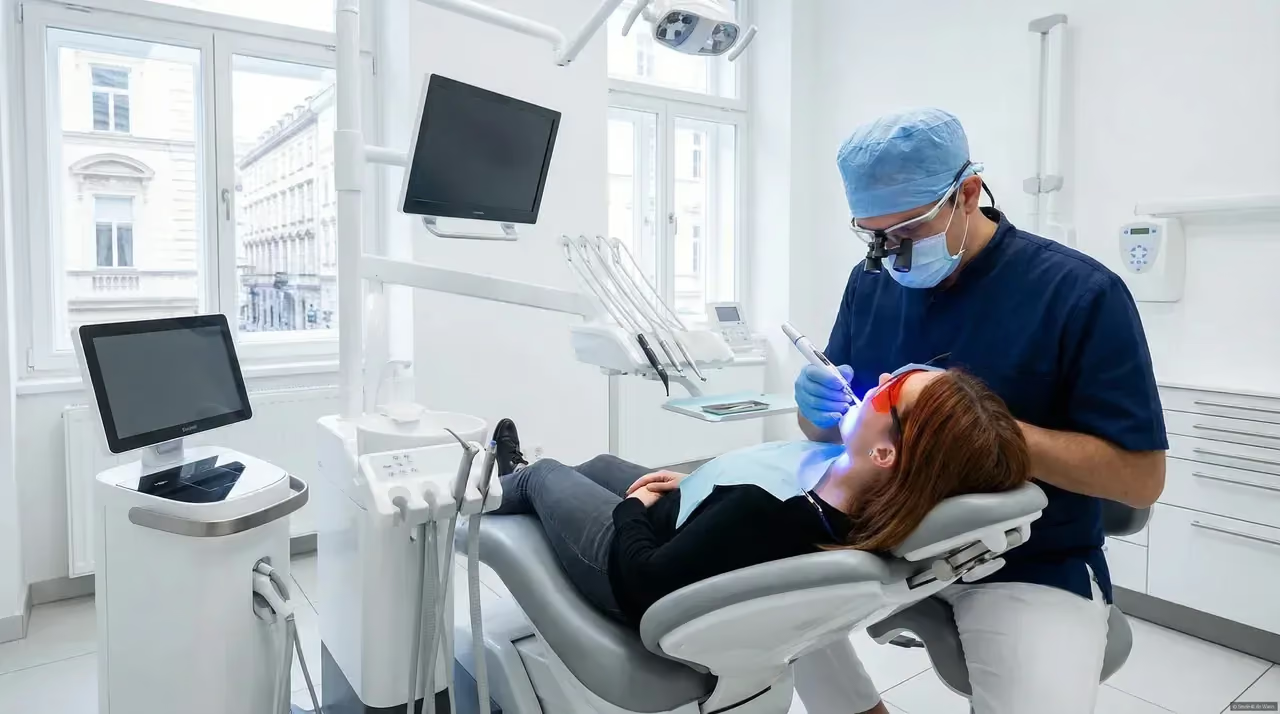
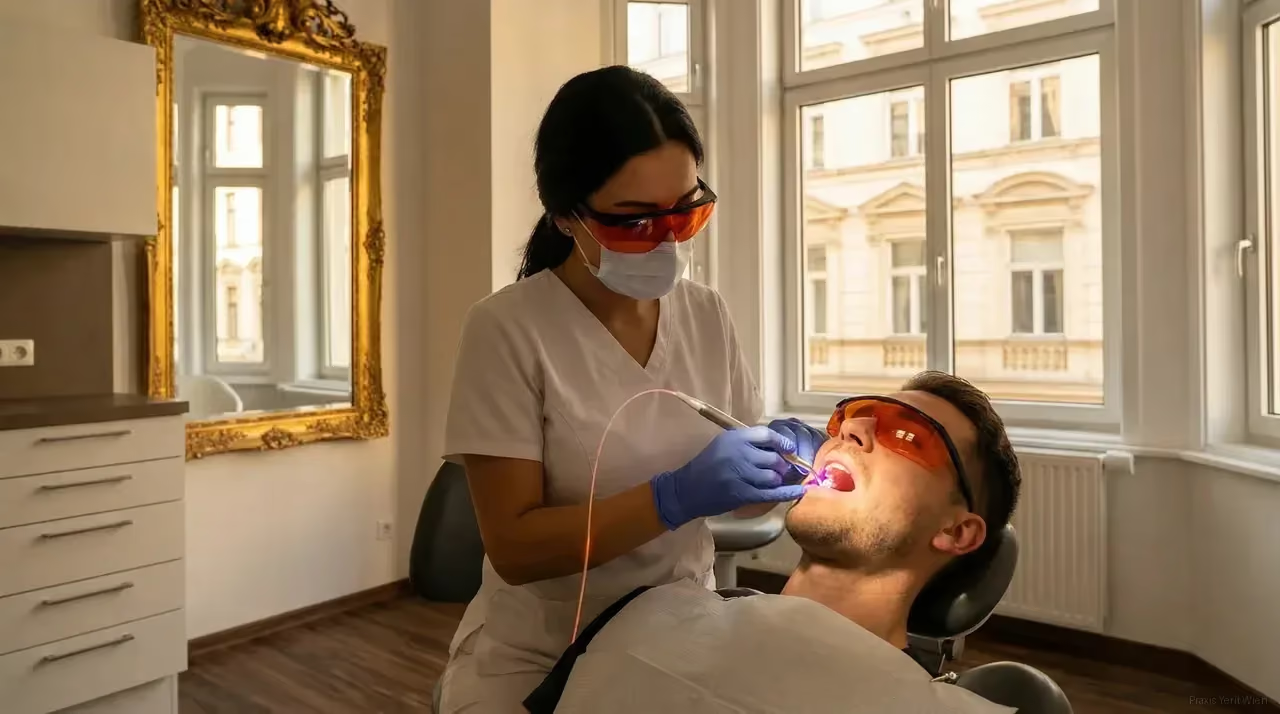
During treatment, everyone in the room wears safety glasses suited to the device's wavelength — including you. Afterwards, we explain how to care for the treated area over the next few days and when to contact us. For laser use in periodontitis, find details on the page Laser Therapy for the Gums.
What a laser does not replace
No laser replaces mechanical root-surface cleaning in periodontitis. The European S3 guideline for stage I to III periodontitis identifies subgingival and supragingival instrumentation as a central treatment step, with additional procedures expressly alongside it rather than in its place (Sanz et al., 2020). Nor does a laser replace a filling, surgical care or daily oral hygiene at home. It may make individual steps more comfortable or reduce bleeding — it does not remove the need for treatment itself.
How we decide together
Diagnosis comes before the device for every laser application. We consider the indication, available evidence and whether any potential benefit is worth the additional treatment involved for you. For decay removal, evidence of reduced anaesthetic requirements is of very low certainty; preparation took longer than with a drill in the studies (Esteves-Oliveira et al., 2025). If the answer is less encouraging, we say so. We do not recommend a treatment without demonstrated additional benefit simply because it is technically possible. Cost guidance is available on our page Prices; we discuss your personal cost plan after examination.
YOUR CONCERNS
What is on your mind?
Periodontitis treatment
A laser can accompany mechanical cleaning for periodontitis — we explain where research shows an advantage and where it does not.
Gum correction
For orthodontically associated gum enlargement, a review reported less pain and bleeding with a diode laser than with a scalpel. This cannot be transferred to every gum correction.
Decay removal
Laser-assisted decay removal shows indications of reduced anaesthetic requirements, but certainty is very low. Preparation took longer in the studies.
SUITABILITY CHECK
Is this treatment right for you?
YOUR OPTIONS
TREATMENT OPTIONS COMPARED
We will discuss payment terms with you prior to treatment.
The indicative market prices in our price overview provide an initial guide. We will discuss which services are planned for you and the costs involved based on your examination findings and individual cost plan.
Advanced Dental Aesthetics & Implantology
Priv.Doz.Dr.Dr. K. Yerit
“Aesthetics is not a coincidence, but the result of precise planning and deep passion.”
A laser is a tool, not a miracle treatment — we use it where studies show a meaningful advantage and explain openly where that evidence is still missing.
View profile →Scientific references
Institute for Implantology and Digital Dentistry Vienna
Medizinische Universität Wien
Österreichische Gesellschaft für Laserzahnmedizin (ÖGZL)
World Federation for Laser Dentistry (WFLD)
Österreichische Gesellschaft für Parodontologie
Yerit Practice – Dentist Vienna
Excellence
Why Smile4Life
Targeted use
We use a laser where studies show a meaningful advantage — not routinely for every indication.
Two laser systems
Diode lasers for soft tissue; Er:YAG lasers also for hard tooth tissue — according to the treatment goal.
Clear information
Where evidence is more cautious than the trend suggests, we explain this openly.
Frequently asked questions
Frequently asked questions
Do you have a specific question about your diagnosis? Book a consultation appointment directly →
Questions about your treatment?
Discuss what matters to you and what the next steps look like with us.
Book your appointment nowYour orientation
The outcome and any repeat treatment depend on diagnosis, cause and aftercare. Choosing a laser does not promise a lasting effect.
Understanding what’s involved
Depending on the indication, from a single appointment (e.g. frenectomy) to several sessions within ongoing treatment (e.g. periodontitis).
In everyday life
Care and rest depend on the procedure. You receive specific instructions for the treated area. Report increasing pain, persistent bleeding or growing swelling.
Who this information is for
For patients with an indication supported by laser research — such as gingivectomy, frenectomy, recurrent aphthous ulcers or decay removal where reduced anaesthetic requirements are desired. For periodontitis and peri-implant mucositis, we discuss openly whether a laser offers additional benefit in the individual case.
Important limitations
A laser does not replace necessary mechanical cleaning or surgery when medically indicated. Certain existing conditions or medicines may limit laser treatment — we clarify this during consultation.
Our approach
We use lasers where research shows a meaningful advantage — not because they appear more modern. For orthodontically associated gum enlargement, a systematic review reported less pain and bleeding with a diode laser than with scalpel surgery (Maboudi et al., 2023). A comparison study of the upper lip frenum found shorter treatment with an Er:YAG laser (Sarmadi et al., 2020). These findings apply to the specific procedures studied.
We also explain openly where evidence is missing: for peri-implant mucositis, a meta-analysis found no statistically significant additional benefit from diode laser therapy over mechanical cleaning alone (Atieh et al., 2022), and evidence for additional laser in untreated periodontitis remains limited (Salvi et al., 2020). We regard a laser as an additional tool rather than a replacement for established methods.
SCIENTIFIC STUDIES
We use lasers where research shows a meaningful advantage — not because they appear more modern. For orthodontically associated gum enlargement, a systematic review reported less pain and bleeding with a diode laser than with scalpel surgery (Maboudi et al., 2023). A comparison study of the upper lip frenum found shorter treatment with an Er:YAG laser (Sarmadi et al., 2020). These findings apply to the specific procedures studied.
We also explain openly where evidence is missing: for peri-implant mucositis, a meta-analysis found no statistically significant additional benefit from diode laser therapy over mechanical cleaning alone (Atieh et al., 2022), and evidence for additional laser in untreated periodontitis remains limited (Salvi et al., 2020). We regard a laser as an additional tool rather than a replacement for established methods.
Atieh MA et al. (2022). Diode Laser as an Adjunctive Treatment for Peri-implant Mucositis: A Systematic Review and Meta-analysis
A meta-analysis of 3 randomised controlled studies found no statistically significant additional benefit from diode laser therapy over mechanical cleaning alone for peri-implant mucositis — neither in probing depth (mean difference −0.36 mm; 95 % CI −0.88 to 0.16; p = 0.18) nor bleeding on probing (International Dental Journal, 2022).
35931559
Salvi GE et al. (2020). Adjunctive laser or antimicrobial photodynamic therapy to non-surgical mechanical instrumentation in patients with untreated periodontitis
The review of untreated periodontitis examined direct laser applications and antimicrobial photodynamic therapy (aPDT) separately. Direct laser applications showed highly variable clinical results after six months. The meta-analysis of two studies concerned aPDT and found no statistically established additional effect on probing depth (WMD 0.35 mm; 95 % CI −0.04 to 0.73; p = 0.08). Evidence was limited by few controlled studies and heterogeneous procedures; patient-reported advantages remain to be demonstrated (Salvi et al., Journal of Clinical Periodontology, 2020).
31859395
Maboudi A et al. (2023). Gingivectomy with Diode Laser Versus the Conventional Scalpel Surgery and Nonsurgical Periodontal Therapy in Treatment of Orthodontic Treatment-Induced Gingival Enlargement
A systematic review of 7 randomised studies of orthodontically associated gum enlargement found significantly less pain and bleeding during and after diode-laser gingivectomy than conventional scalpel surgery or non-surgical periodontal therapy (Photobiomodulation, Photomedicine, and Laser Surgery, 2023).
37738371
Sarmadi R et al. (2020). Evaluation of upper labial frenectomy: A randomized, controlled comparative study of conventional scalpel technique and Er:YAG laser technique
A randomised controlled comparison study of 40 patients found significantly shorter treatment and less bleeding with Er:YAG laser frenectomy than with conventional scalpel surgery. The wound was initially larger immediately after laser treatment, but no difference remained after 5 days; patient satisfaction was the same in both groups (Clinical and Experimental Dental Research, 2020).
33369213
Ma Y et al. (2025). The effectiveness of lower-level laser therapy on the treatment of minor recurrent aphthous ulcers
A meta-analysis of 21 randomised studies involving 810 patients found that low-level laser therapy (LLLT) significantly reduces pain from minor recurrent aphthous ulcers, particularly during the first 1 to 3 days, and shortens healing time. No consistent effect was found on ulcer size or functional recovery (Lasers in Medical Science, 2025).
41286369
Esteves-Oliveira M et al. (2025). Efficacy of laser-assisted caries removal and hard tissue preparation: A meta-analysis
The meta-analysis of laser-assisted decay removal and hard-tooth-tissue preparation included 20 clinical studies involving at least 2,263 teeth in over 1,090 people. With low certainty, it found no clear difference from conventional drills in filling survival or pulp vitality; this does not establish equivalence. Indications of less pain and reduced anaesthetic requirements had very low certainty. Preparation took longer (Esteves-Oliveira et al., 2025).
40120794
Sanz M et al. (2020). Treatment of stage I-III periodontitis — The EFP S3 level clinical practice guideline
The European S3 guideline for stage I to III periodontitis identifies subgingival and supragingival instrumentation as a central treatment step; additional procedures are expressly alongside it rather than in its place (Journal of Clinical Periodontology, 2020).
32383274
Yu S et al. (2022). Clinical effectiveness of adjunctive diode laser on scaling and root planing in the treatment of periodontitis
A meta-analysis of 30 randomised studies involving 825 participants found additional clinical benefits from diode laser alongside root-surface cleaning, strongly dependent on whether it was applied inside the pocket or externally and over how many sessions (Lasers in Medical Science, 2022).
34536183
Aoki A et al. (2023). Er:YAG laser-assisted comprehensive periodontal pocket therapy for residual periodontal pocket treatment
A randomised controlled split-mouth study of 18 patients with residual pockets of at least 5 mm after prior treatment found greater probing-depth reduction (2.78 mm versus 1.89 mm) and greater attachment gain with Er:YAG laser-assisted pocket treatment than root-surface cleaning alone after twelve months (Journal of Periodontology, 2023).
37015852
Smiley CJ et al. (2015). Systematic review and meta-analysis on the nonsurgical treatment of chronic periodontitis by means of scaling and root planing with or without adjuncts
An American Dental Association expert panel assessed 72 papers on non-surgical periodontitis treatment. Root-surface cleaning itself produced an average attachment gain of around 0.5 mm; additional procedures added between 0.2 and 0.6 mm. Among laser procedures, the panel rated only diode-laser photodynamic therapy beneficial with moderate certainty (Journal of the American Dental Association, 2015).
26113099
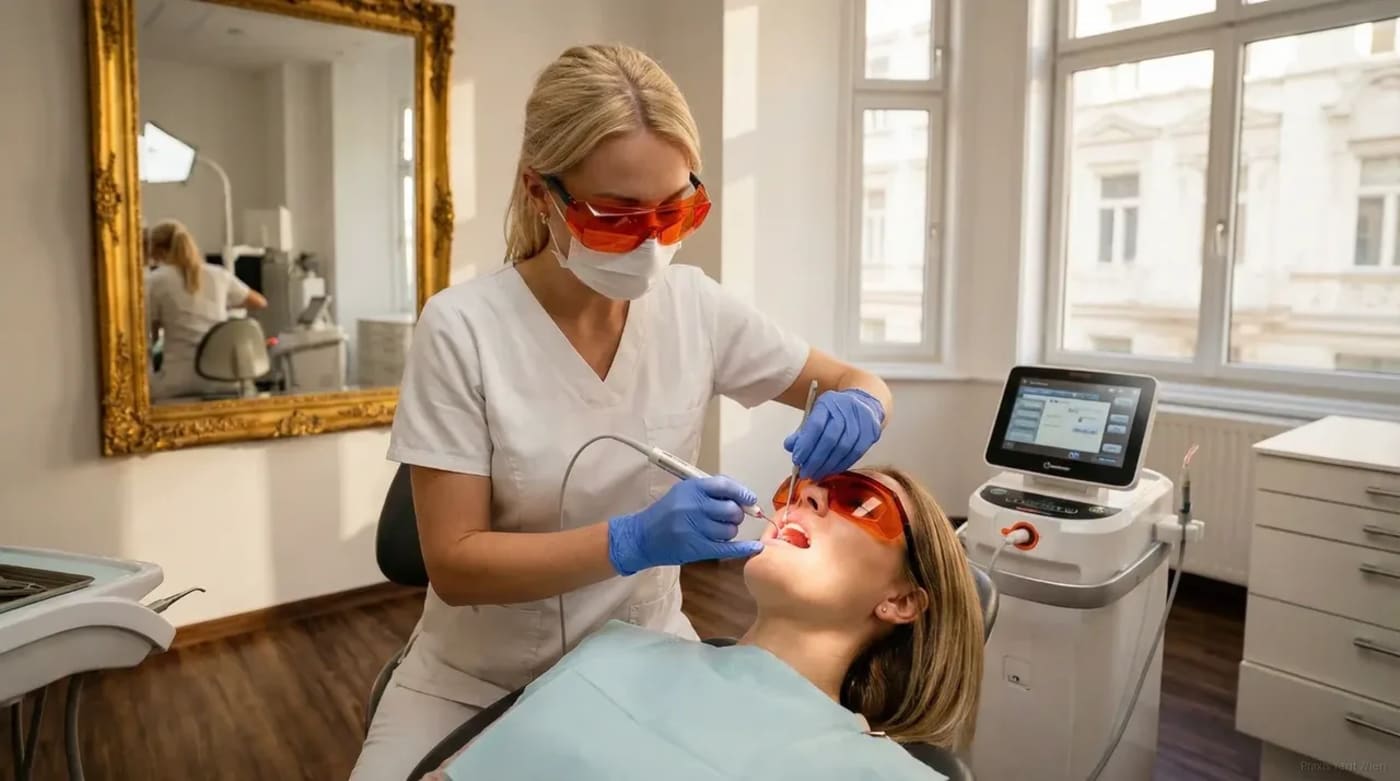
Precision at the tissue
Wavelength, power and application are matched to the treatment goal. Appropriate protective measures and experience with the specific procedure matter; a laser does not preserve healthy tissue under all conditions.
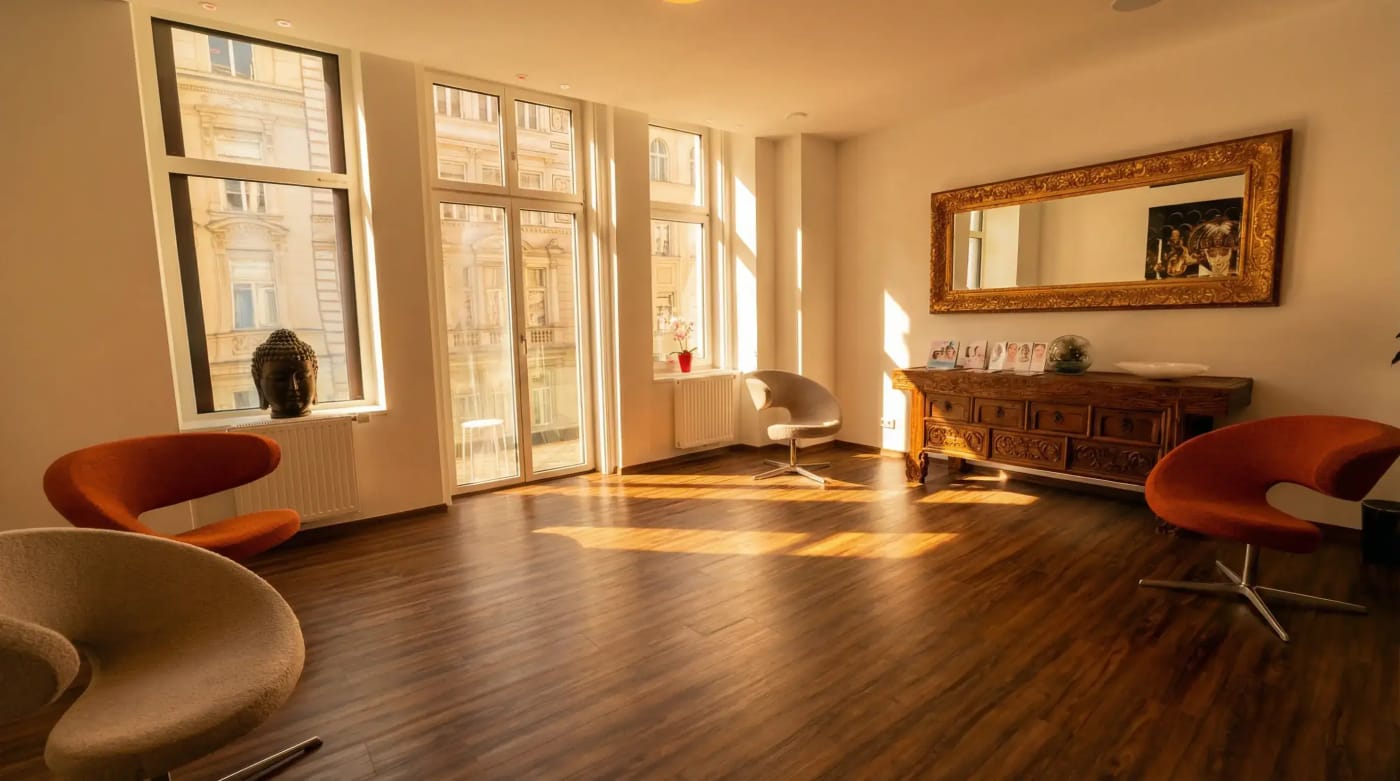
Kärntner Straße 9
100 meters from Stephansplatz, Innere Stadt.

Partnerships & Memberships & References