
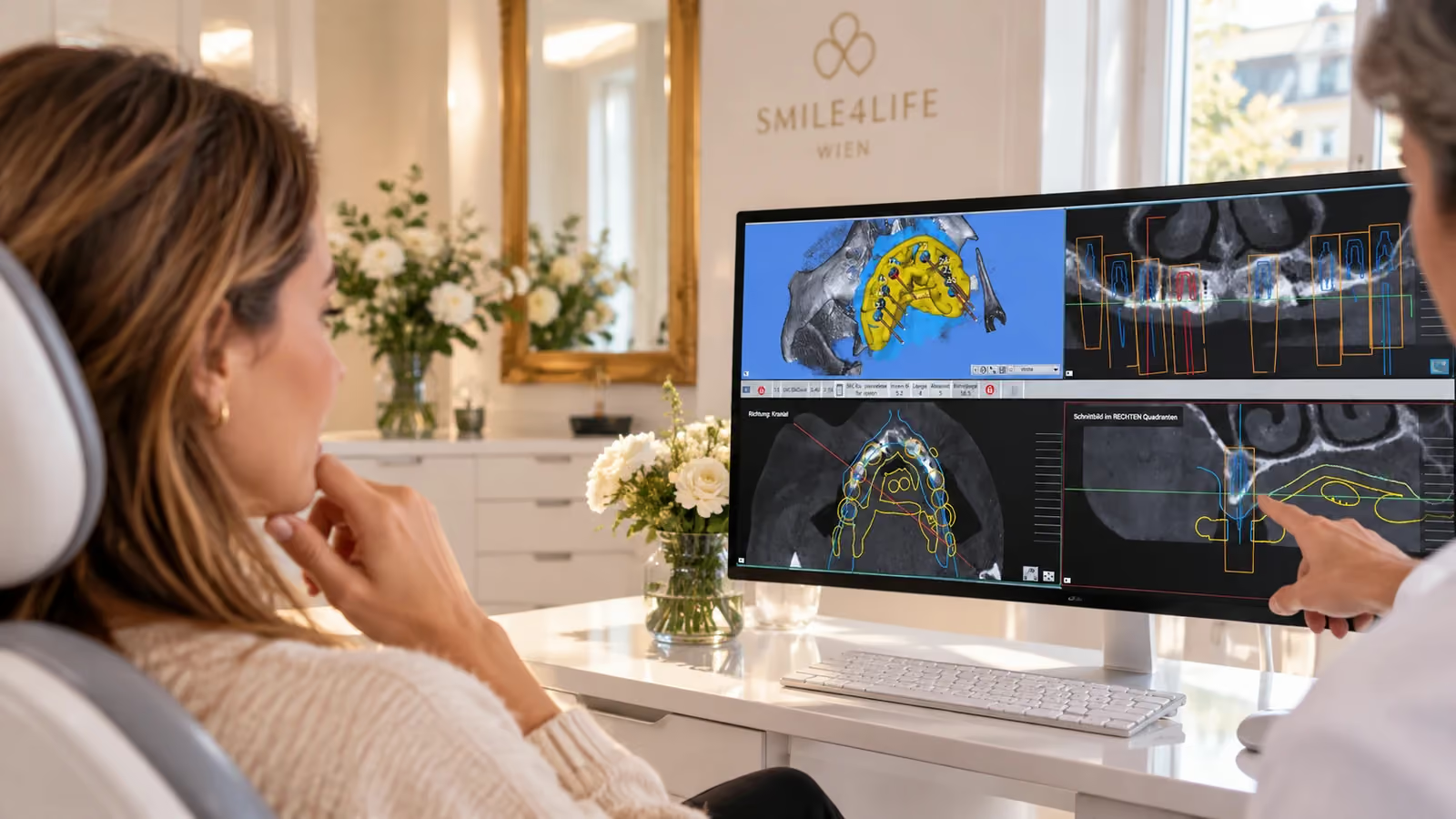
Peri-implantitis in Vienna: Treating Inflammation Around an Implant
Bleeding or changes around your implant need examination. Your findings determine which treatment may help preserve it.
Understand your findings
Understand treatment
Discuss daily care
Clarify next steps
Peri-implantitis Vienna
peri-implantitis-wien
4.9★
Doctify rating
25+
Years of experience
Personal
In-practice consultation
1010 Vienna
Kärntner Straße 9
At a glance
What is peri-implantitis and what should I do?
Peri-implantitis involves inflammation around an implant and loss of supporting bone. Have the implant examined soon. The European guideline recommends non-surgical cleaning followed by reassessment first. Treatment goals include residual pockets up to 5 mm, no more than one bleeding site and no pus.* If these goals are not reached after non-surgical treatment, the guideline recommends further care; whether surgery is appropriate also depends on findings and home oral hygiene.
Is peri-implantitis serious?
It needs to be taken seriously: unlike mucositis, it involves bone loss around the implant and, in advanced cases, loss of the implant. An analysis of 102 studies found peri-implantitis in 21% of implant patients.*
How can I recognise inflammation around an implant?
Warning signs include bleeding during brushing, redness, swelling and pus; pain is often absent. A large review found mucositis, an earlier inflammatory condition, in 46% of implant patients.* Assessment includes probing around the implant and, where indicated, appropriate X-rays for comparison. Three-dimensional imaging is considered only for a specific additional question.
Peri-implantitis symptoms: when to have your implant checked
Bleeding during cleaning, swelling, pus or a changed sensation around an implant are reasons for examination. Do not wait for severe pain. Inflammation can progress unnoticed.
If something feels loose, it may involve the restoration, a screw connection or the implant itself. You cannot reliably distinguish these at home. Have the cause assessed promptly and do not try to tighten the connection yourself.
Which examination is appropriate
Examination assesses the tissues around the implant, bleeding, probing depths and stability. X-rays help assess bone levels; previous reports can make comparison easier. Access for cleaning and the restoration are also considered.
Bring your implant passport and earlier documents if available. Peri-implant mucositis involves soft-tissue inflammation without the progressive bone loss characteristic of peri-implantitis. In peri-implantitis, the bone supporting the implant is also affected.
How peri-implantitis treatment is planned
Treatment depends on inflammation, bone loss and the implant situation. Accessible deposits are first removed using implant-appropriate methods and home cleaning is adapted. Previous or active periodontitis around natural teeth is also considered.
Persistent peri-implantitis may require surgery to improve access to the affected implant surface. Whether regeneration is possible depends on factors including defect shape. No method restores the original condition around every implant.
Temporary pain or discomfort may occur after non-surgical or surgical treatment. Regenerative surgery can also involve healing problems, such as wound opening or an exposed membrane. We discuss the burdens and risks relevant to your planned procedure and care for the site beforehand.
Measurements from treatment of natural tooth roots cannot be transferred to implants. Your implant situation is therefore assessed separately. A particular laser or additional procedure does not constitute a general promise of success.
What matters for preservation and follow-up
The aim is to control inflammation and preserve the implant where possible. With unfavourable findings, removal may also be discussed. A feeling of looseness alone is not a sufficient diagnosis.
Regular implant-specific reviews and manageable daily cleaning are part of ongoing care. Intervals depend on findings and risk. Smoking, diabetes and a history of periodontitis are important points to discuss.
The YERIT guide to peri-implantitis explains the background. For treatment of natural teeth, see periodontitis in Vienna. Examination and the scope of care are needed before personal cost planning; the prices page offers general market guidance only.
Sources and context
Herrera and colleagues (2023): EFP S3 guideline on peri-implant diseases
Diagnosis, cleaning, risk control and follow-up are part of implant-specific care.
Context: No procedure guarantees implant preservation. Results for natural teeth cannot be freely transferred to implants.
University Clinic of Dentistry Vienna: Specialist peri-implantitis clinic
An implant passport and existing reports help individual treatment planning.
Context: The page describes the university clinic and does not confirm a particular service at Smile4Life.
Galarraga-Vinueza and colleagues (2025): Review of peri-implant diseases
The review includes 102 studies with 13,030 people. Pooled estimates found mucositis in 46 percent and peri-implantitis in 21 percent.
Context: Uncertainty ranges were 41–51 and 17–24 percent respectively. Person-level frequencies do not predict your individual risk of disease. Observed risk indicators do not establish cause and effect.
Thorough, gentle cleaning supports treatment. Have new or worsening symptoms assessed.
YOUR OPTIONS
TREATMENT OPTIONS COMPARED
We will discuss payment terms with you prior to treatment.
The indicative market prices in our price overview provide an initial guide. We will discuss which services are planned for you and the costs involved based on your examination findings and individual cost plan.
Advanced Dental Aesthetics & Implantology
Priv.Doz.Dr.Dr. K. Yerit
“Aesthetics is not a coincidence, but the result of precise planning and deep passion.”
People with implants should take peri-implantitis prevention as seriously as care for their natural teeth.
View profile →Scientific references
Institute for Implantology and Digital Dentistry Vienna
Österreichische Gesellschaft für Parodontologie
European Federation of Periodontology (EFP)
Deutsche Gesellschaft für Parodontologie (DG PARO)
American Academy of Periodontology (AAP)
Yerit Practice – Dentist Vienna
Frequently asked questions
Frequently asked questions
Do you have a specific question about your diagnosis? Book a consultation appointment directly →
Questions about your treatment?
Discuss what matters to you and what the next steps look like with us.
Book your appointment nowYour orientation
Understand the findings and plan appropriate next steps.
Understanding what’s involved
The extent of care and appointments depend on your individual situation.
In everyday life
Thorough, gentle cleaning supports treatment. Have new or worsening symptoms assessed.
Who this information is for
Important limitations
Our approach
SCIENTIFIC STUDIES
Galarraga-Vinueza ME et al. (2025). Prevalence, incidence, systemic, behavioral, and patient-related risk factors for peri-implant diseases
A current systematic review and meta-analysis of 102 studies involving more than 13,000 patients reports person-level prevalence of peri-implant mucositis of 46% and peri-implantitis of 21%. Previous periodontitis, smoking and diabetes were observed risk indicators. This does not establish cause and effect.
40489307
Suvan J et al. (2020). Subgingival instrumentation for treatment of periodontitis. A systematic review
This systematic review informing the EFP S3 guideline evaluates randomised trials of subgingival instrumentation. Probing depth decreased by an average of 1.4 mm (95% confidence interval 1.0 to 1.7) after six to eight months, and 74 percent of pockets closed (95% CI 64 to 85). Hand or powered instruments, quadrant-based treatment or a single course showed no significant difference (Journal of Clinical Periodontology, 2020).
31889320
Trombelli L et al. (2018). Plaque-induced gingivitis: Case definition and diagnostic considerations
The consensus paper from the 2017 World Workshop on periodontal classification defines clinical gingivitis as a common, clearly distinguishable condition that is fully reversible with consistent treatment.
29926936
Prevention and treatment of peri-implant diseases—The EFP S3 level clinical practice guideline
Inflammation around implants requires its own diagnosis and treatment. Cleaning, risk control and aftercare are part of this. No procedure guarantees implant preservation or complete tissue regeneration. These outcomes must not be equated with treatment outcomes for natural teeth.
37271498
More topics in this area
Deepen your knowledge – find all information regarding the treatment process, costs, and results.


Kärntner Straße 9
100 meters from Stephansplatz, Innere Stadt.
Partnerships & Memberships & References




