All-on-4 treatment: planning, surgery and healing
From the first examination to the completed arch: explore each step and what you can clarify for your own planning.
Steps clearly explained
Individual preparation
Support healing
Plan aftercare
All-on-4 Treatment Process Vienna
all-on-4-ablauf-wien
4.9★
Doctify rating
25+
Years of experience
Personal
In-practice consultation
1010 Vienna
Kärntner Straße 9
At a glance
What happens in All-on-4 treatment step by step?
Examination, necessary imaging and shared planning come first. The specific X-ray indication is determined before imaging. Preparatory treatment follows if needed. Four implants per jaw are then placed and, if sufficiently stable, a fixed temporary bridge screwed in. Healing is followed by the final bridge and regular checks.
How long does All-on-4 treatment take?
The four implants are placed in one procedure; a fixed temporary bridge is only possible under suitable conditions. Healing and final-restoration timing depend on stability, findings, progress and the planned loading protocol. An early temporary restoration does not mean unrestricted loading is allowed. Preparatory treatment may lengthen the process.*
When can I eat normally again after All-on-4?
Only soft food initially, because the temporary bridge must not be fully loaded during healing. Which foods become suitable and when depends on your findings and progress. Loading and further diet are discussed individually at check-ups.*
What happens during healing after All-on-4?
The implants integrate firmly with the jawbone while wounds and gums heal. You chew carefully and clean the temporary bridge thoroughly. Stitches are removed after 7 to 14 days, and subsequent checks assess fit and tissue.*
The treatment process at a glance
From examination and preparation through placement and temporary restoration to healing, final bridge and aftercare.

1. All-on-4 treatment: examination and shared planning
The All-on-4 process begins with examination and a conversation about your wishes. Before replacing a full arch, it must be established which existing teeth can be preserved. Medical conditions, medication, previous dental treatment and possible denture problems are equally important.
Jawbone, gums and bite are assessed for planning. Three-dimensional imaging may help assess implant positions and important neighbouring structures. The planned arch and implants must fit together. Also ask about later cleaning under the bridge. The guide All-on-4 treatment step by step explains the planning phase in more detail at YERIT.
2. Preparatory treatment and preparing for surgery
Depending on the findings, inflammation may need treating first or teeth that cannot be preserved may need removing. After extraction, targeted ridge preservation may facilitate later implant planning, for example for soft-tissue contour and ridge width (Atieh et al., 2024) — whether this is useful in your case follows from the findings. Whether steps take place on one day or at separate appointments is decided for your situation. Not every All-on-4 plan has the same timetable.
Planned anaesthesia, the interim restoration and cost plan should be discussed before the appointment. Tell the treatment team if you are very anxious about surgery. Local anaesthesia, additional sedation and general anaesthesia are different options; which is suitable and planned must be clarified individually. Smile4Life does not provide sedation or general anaesthesia at its own practice. Suitability, the responsible team and treatment location are clarified individually in advance.
3. The four implants are placed
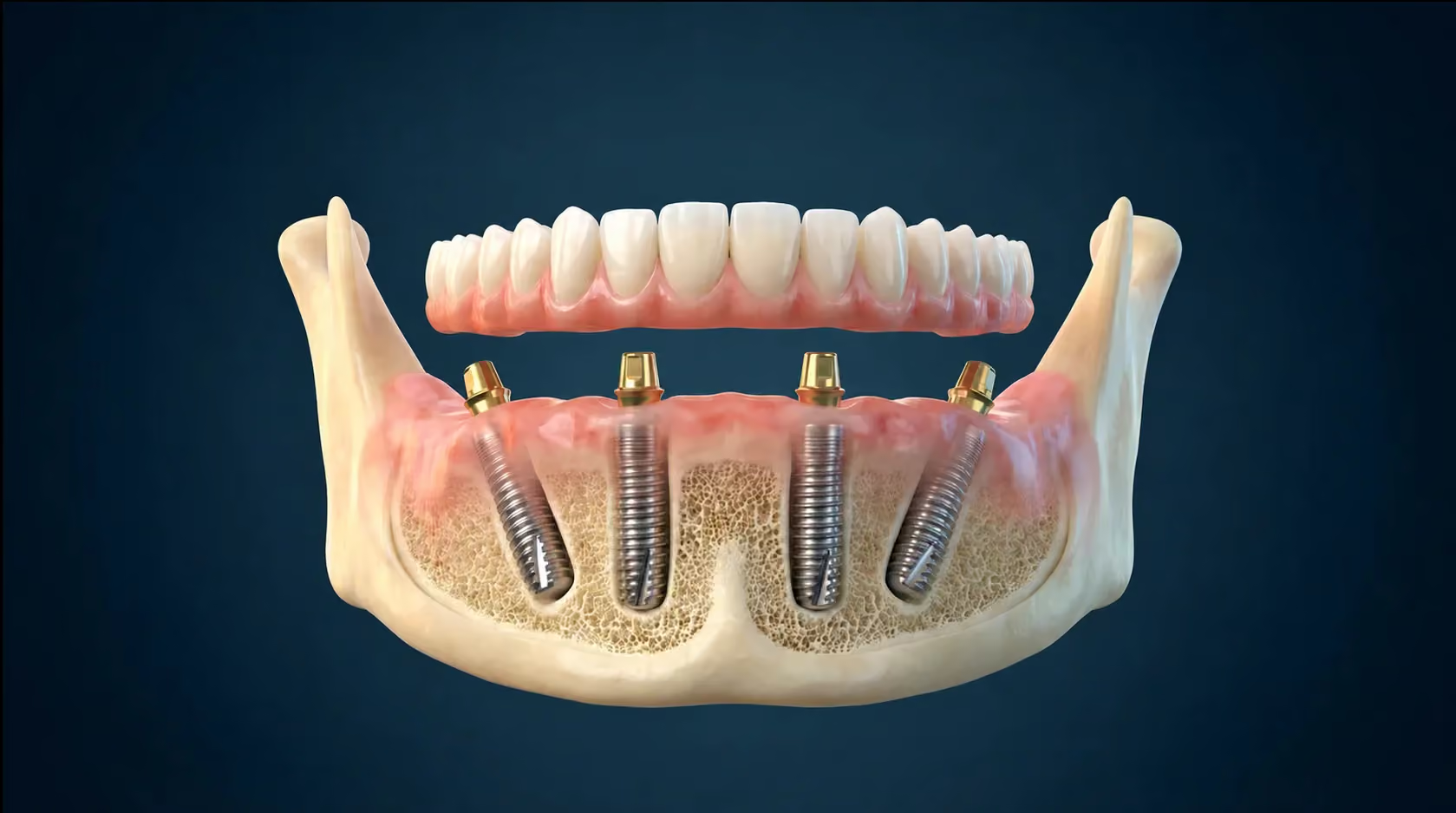
With All-on-4, four implants are positioned in one jaw to support a fixed arch together. The rear implants are often angled. Whether this approach suits your available bone is part of prior planning.
Operating time depends on factors including possible extractions, additional measures and whether one or both jaws are treated. A blanket number of minutes or hours would be unreliable for your appointment planning. Ask for an estimated duration for your procedure.
4. Temporary fixed teeth — if stability is sufficient
After placement, implant stability in the bone is assessed. If this initial stability is sufficient and other requirements are met, a fixed temporary bridge may be fitted early. This early use is called immediate loading. The ITI recommendations explicitly tie it to appropriate case selection. A prospective five-year study of immediately loaded All-on-4 implants in the lower jaw recorded no loss among followed participants, but did observe inflammation over time (Krennmair et al., 2022) — an indication, not a general guarantee of success.
Immediate implant placement, by contrast, describes placement timing after extraction. The terms are not synonymous. Even an immediately placed implant need not be loaded immediately.
If stability is insufficient for an early fixed restoration, an adapted plan is needed for healing. Discuss this possibility before surgery. “Fixed teeth in one day” does not mean the entire treatment is finished that day.
5. Healing, eating and cleaning
During healing, bone bonds with the implants. This takes time even when the bridge already feels secure. The final restoration often follows only after several months of healing. The specific timing depends on progress and necessary checks.
Loading must be adapted initially. Follow advice on soft foods and increase chewing only after consultation. A fixed bridge is not permission to bite hard foods immediately. A quality-of-life survey after immediately loaded full-arch restoration reports that after four months most respondents felt more confident smiling and less often reported difficulty eating certain foods (Dellepiane et al., 2020) — a trend, not an individual promise. Also ask to be shown how to clean wound areas and later the space under the bridge.
Pain and swelling may follow surgery. The team discusses appropriate care and signs requiring contact. Have increasing symptoms or a bridge that feels loose assessed promptly rather than waiting for the next routine appointment.
6. The final bridge
Once requirements for the final restoration are met, fit, tooth position and bite are adjusted. Access for cleaning also matters. The final restoration replaces the interim solution; it is a separate step with its own fabrication and fitting.
The bridge material is planned separately from the implant material. Discuss which design is intended and what maintenance is expected. Details of service scope are available on the All-on-4 costs page.
7. Aftercare and possible changes
Daily care and regular checks remain important after treatment. A review of implant-supported full-arch upper-jaw restorations reports low prosthesis-loss rates of around 4.6 per cent over three to six years and describes regular aftercare as essential for long-term success (Ng et al., 2026). The interval depends on your risk and restoration condition. Implants may develop problems; bridge components may loosen or need repair. Long-term studies describe such events despite good overall restoration retention. Follow-up over 10 to 18 years for All-on-4 in the lower jaw reports both long-term retention and biological and technical complications, with a considerable proportion lost to follow-up (Maló et al., 2019) — this establishes no individual durability guarantee.
Bring these questions to the consultation: which teeth can remain? Which restoration is planned during healing? What happens if immediate loading is impossible? Which appointments must I plan for? The All-on-4 overview helps place the process within your treatment decision.
Planning, surgery, healing and the final restoration are separate steps. The timetable depends on your findings.
YOUR OPTIONS
TREATMENT OPTIONS COMPARED
We will discuss payment terms with you prior to treatment.
The indicative market prices in our price overview provide an initial guide. We will discuss which services are planned for you and the costs involved based on your examination findings and individual cost plan.
Advanced Dental Aesthetics & Implantology
Priv.Doz.Dr.Dr. K. Yerit
“Aesthetics is not a coincidence, but the result of precise planning and deep passion.”
Careful digital planning before surgery is our foundation for aesthetic and functional results with All-on-4.
View profile →Scientific references
Institute for Implantology and Digital Dentistry Vienna
Österreichische Gesellschaft für Implantologie (ÖGI)
European Association for Osseointegration (EAO)
Deutsche Gesellschaft für Implantologie (DGI)
International Team for Implantology (ITI)
Yerit Practice – Dentist Vienna
Frequently asked questions
Frequently asked questions
Do you have a specific question about your diagnosis? Book a consultation appointment directly →
Questions about your treatment?
Discuss what matters to you and what the next steps look like with us.
Book your appointment nowYour orientation
Well prepared through each treatment step.
Understanding what’s involved
Examination, placement, healing and final replacement teeth follow an individually agreed timetable.
In everyday life
The initial period with a temporary restoration requires attention to eating and cleaning. Before surgery, ask what applies to your restoration and how to contact the treatment team with questions.
Who this information is for
Important limitations
Our approach
SCIENTIFIC STUDIES
Krennmair S et al. (2022). Immediately loaded implants placed in fresh extraction and healed sites supporting four-implant fixed mandibular prostheses using the All-on-4 concept: A 5-year prospective study
In a prospective study of the lower jaw, 22 of 24 people with 88 implants were followed for five years. No implant was lost in this group; inflammation nevertheless occurred. The result is not a general guarantee of success.
34800325
Moraschini V et al. (2024). Long-term survival and success rate of dental implants placed in reconstructed areas with extraoral autogenous bone grafts: A systematic review and meta-analysis
The review examined implants in areas reconstructed with the patient’s own bone harvested from outside the mouth. It reports long-term survival rates for these grafting procedures. The results cannot be applied generally to every type of bone grafting or substitute material, and they are not an individual guarantee of success.
38450931
Dellepiane E et al. (2020). Oral Health-Related Quality of Life and Full-Arch Immediate Loading Rehabilitation: An Evaluation of Preoperative, Intermediate, and Posttreatment Assessments of Patients Using a Modification of the OHIP Questionnaire
After 4 months, 92% of patients no longer felt insecure when smiling, and 92% had no difficulty eating certain foods. Quality of life improved markedly after immediately loaded full-arch rehabilitation (Journal of Oral Implantology, 2020).
33494102
Atieh MA et al. (2024). Alveolar ridge preservation versus early implant placement in single non-molar sites: A systematic review and meta-analysis
After tooth extraction, measures to preserve the jaw ridge can favourably influence soft-tissue shape and ridge width, potentially simplifying later implant treatment (Clinical Oral Implants Research, 2024).
38850092
Maló P et al. (2019). The All-on-4 treatment concept for the rehabilitation of the completely edentulous mandible: A longitudinal study with 10 to 18 years of follow-up
A retrospective study followed 471 people with All-on-4 in the lower jaw for ten to 18 years. It reports long-term retention, but also biological and technical complications. 31.6 percent were lost to follow-up; there is no individual lifespan guarantee.
30924309
Ng E et al. (2026). Prosthetic Outcomes of Implant-Assisted Maxillary Restorations in the Edentulous Maxilla: A Systematic Review and Meta-Analysis
The systematic review and meta-analysis examines fixed and removable implant-supported restorations in the edentulous upper jaw. The reported loss of around 4.6 percent over three to six years refers to prostheses, not implants. Retention does not mean freedom from complications. The pooled results are not an individual All-on-4 prognosis (Ng et al., 2026).
41846047
Shao WH et al. (2026). All-on-4 and All-on-6 implant-supported fixed prostheses for the edentulous jaw: a systematic review and meta-analysis
The review includes 55 studies on All-on-4 and All-on-6. Overall, results were similar, but the studies varied considerably. This does not establish general superiority of a particular number of implants or of guided surgery.
42031576
Having a dental implant (Patient information, Resource 2846/VER4)
For the treatment pathway described, the patient information from Guy’s and St Thomas’ generally states a healing period of at least three months before an implant can support a dental restoration; where bone grafting is performed beforehand, it mentions around four to six additional months (guysandstthomas.nhs.uk, accessed 03.11.2026).
After having a dental implant (Patient information, Resource 2846/VER4)
The patient information from Guy’s and St Thomas’ describes possible wound pain, swelling and bruising after the procedure. For the treatment pathway described there, it mentions usual painkillers, discomfort lasting up to one week and removal of stitches after 7 to 14 days (guysandstthomas.nhs.uk, accessed 03.11.2026).
More topics in this area
Deepen your knowledge – find all information regarding the treatment process, costs, and results.


Kärntner Straße 9
100 meters from Stephansplatz, Innere Stadt.
Partnerships & Memberships & References