Bone augmentation: treatment and healing in Vienna
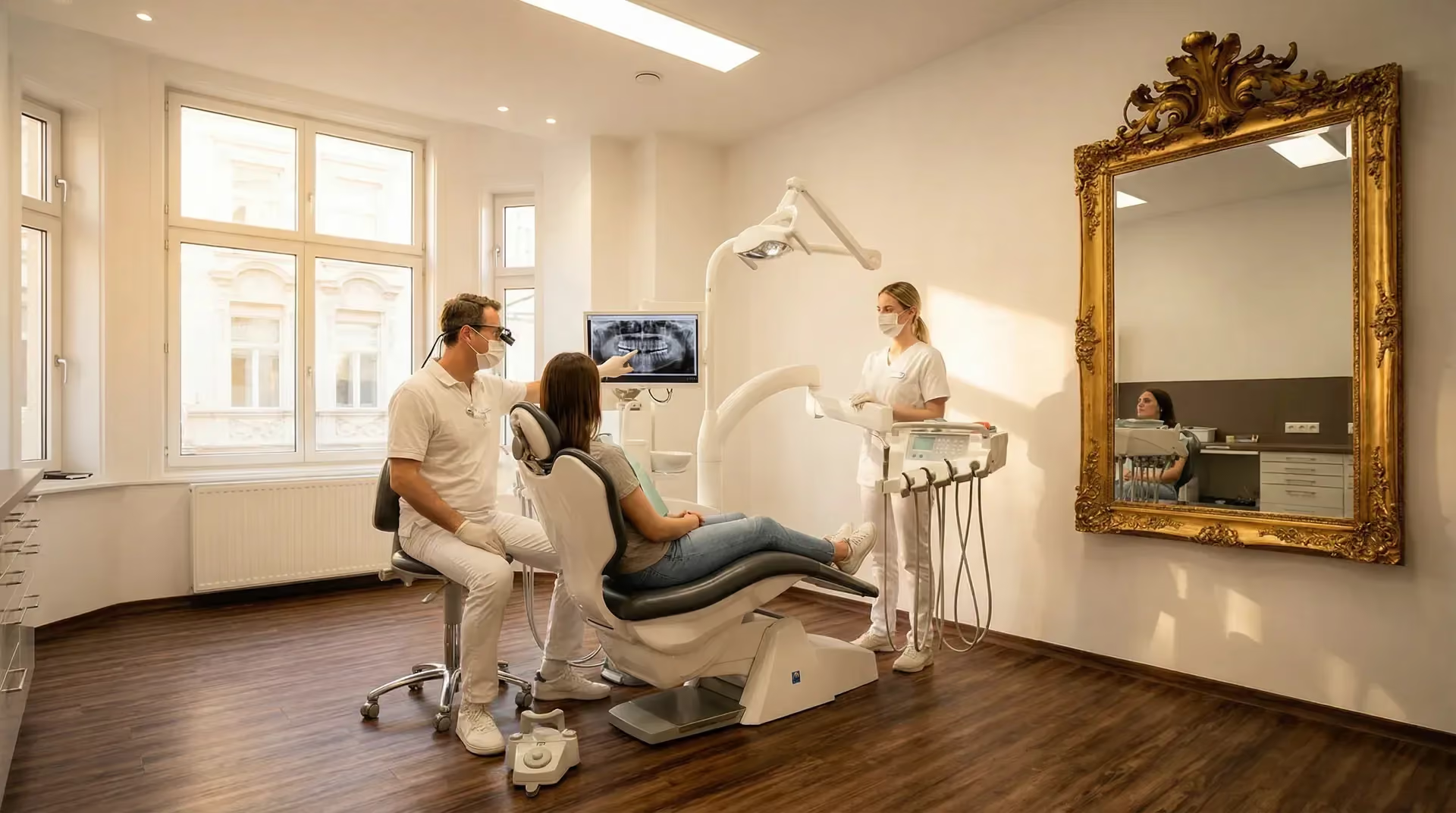
From discussing findings to further implant restoration: appointments depend on the procedure and how the bone heals.
Discuss the findings
Plan surgery
Check the wound
Allow time for integration
Bone Augmentation Treatment Vienna
knochenaufbau-ablauf-wien
4.9★
Doctify rating
25+
Years of experience
Personal
In-practice consultation
1010 Vienna
Kärntner Straße 9
At a glance
How is bone augmentation performed?
Under local anaesthesia, the gum is opened, your own bone or substitute material placed into the gap, usually covered with a membrane and sutured. Smaller augmentation may be performed alongside placement if findings are suitable. With a separate approach, the next stage is planned according to augmentation type and healing progress.*
How long does healing after augmentation take?
Augmentation usually heals for three to six months before placement. Jaw swelling generally settles after one to two weeks; a check with an X-ray shows when your bone is ready.*
How can healing after augmentation be accelerated?
Bone healing cannot be shortened, but disturbances can be avoided: do not smoke, do not put stress on the wound and follow oral-care instructions. Smoking delays wound healing because less oxygen reaches the tissue.*
Can an implant be placed at the same time as augmentation?
This may be possible if the implant can be stably anchored in existing bone and only small augmentation is needed. Larger defects may require augmentation first. Even with simultaneous augmentation, bone needs time to heal.*
The treatment process at a glance
From findings and imaging through augmentation and wound checks to healing and further implant planning.

1. Bone augmentation: process and planning
First, we establish where bone is lacking and what the eventual restoration should be like. Planning includes examination, existing findings and appropriate imaging. Where needed, three-dimensional imaging adds spatial information. It does not replace examination or discussing your health. YERIT explains the general pathway in the guide Bone augmentation: treatment process.
Tell the team about medical conditions and all regularly taken medication. It is particularly important that clinicians know about medicines affecting blood clotting or bone metabolism. Do not stop prescribed medicines yourself. This also applies to regularly prescribed low-dose aspirin — it must not be stopped without medical advice (NHS, 2026). Changes are coordinated with the responsible doctors.
The plan should state whether augmentation and placement can be combined, which material is intended and whether a harvesting site will be added. British hospital information also emphasises that augmentation replaces missing bone and integration takes time — subsequent steps are planned from the findings (Guy’s and St Thomas’, patient information). A possible alternative without augmentation and expected costs also belong in this conversation.
Whether augmentation is planned in the upper or lower jaw makes a difference: proximity to the sinus and the course of nerves create different requirements. A review with a decision model puts the combined sinus-anatomy factors in context (Lyu et al., 2023). The dental practice explains which imaging is needed for diagnosis. Cone-beam computed tomography, or CBCT, may be added for an appropriate clinical question.
Appointments usually follow this sequence; your findings determine the number and intervals of checks:
- Discussion of findings with examination and imaging, including CBCT if needed
- Surgery: bone augmentation, combined with placement where conditions are suitable
- Wound check, including stitch removal if needed
- Assessment of integration, including an X-ray among other checks
- Implant placement or, if the implant is already in place, further restoration with replacement teeth
2. Surgery and bone substitute material
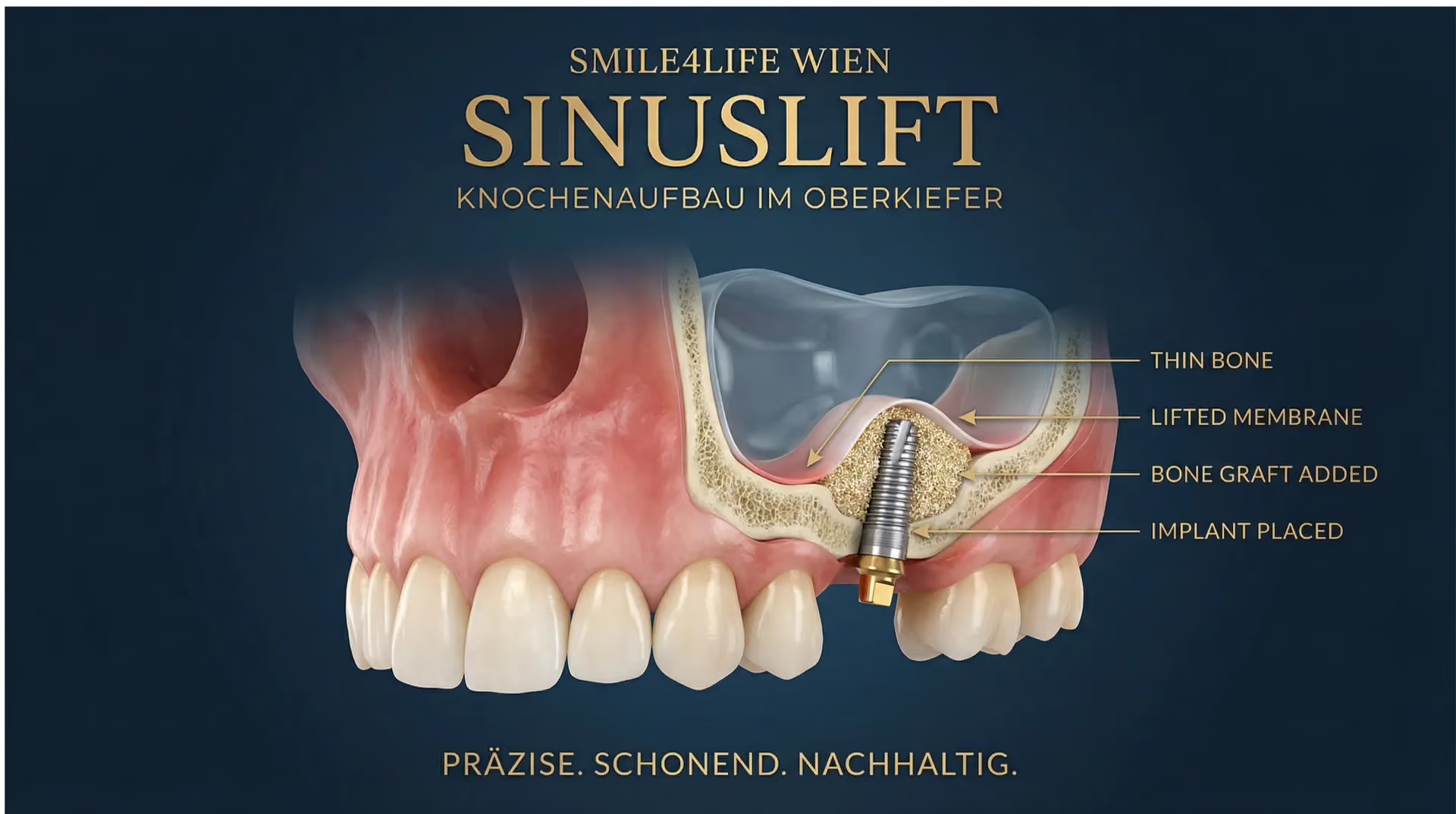
The exact process depends on the procedure. In GBR, augmentation at the affected site is stabilised and protected with a membrane. A sinus lift instead creates space beneath the sinus membrane. The bone augmentation overview compares procedures. The page Your own bone or substitute material? explains the differences.
Anaesthesia is discussed beforehand. Pain should be adequately controlled during surgery; pressure or movement may still be felt. A blanket operating time would be unhelpful because small local augmentation and extensive surgery need different amounts of time.
If the implant can be placed with sufficient stability in existing bone, simultaneous placement may be possible under suitable conditions. This does not mean it may immediately bear the final restoration.
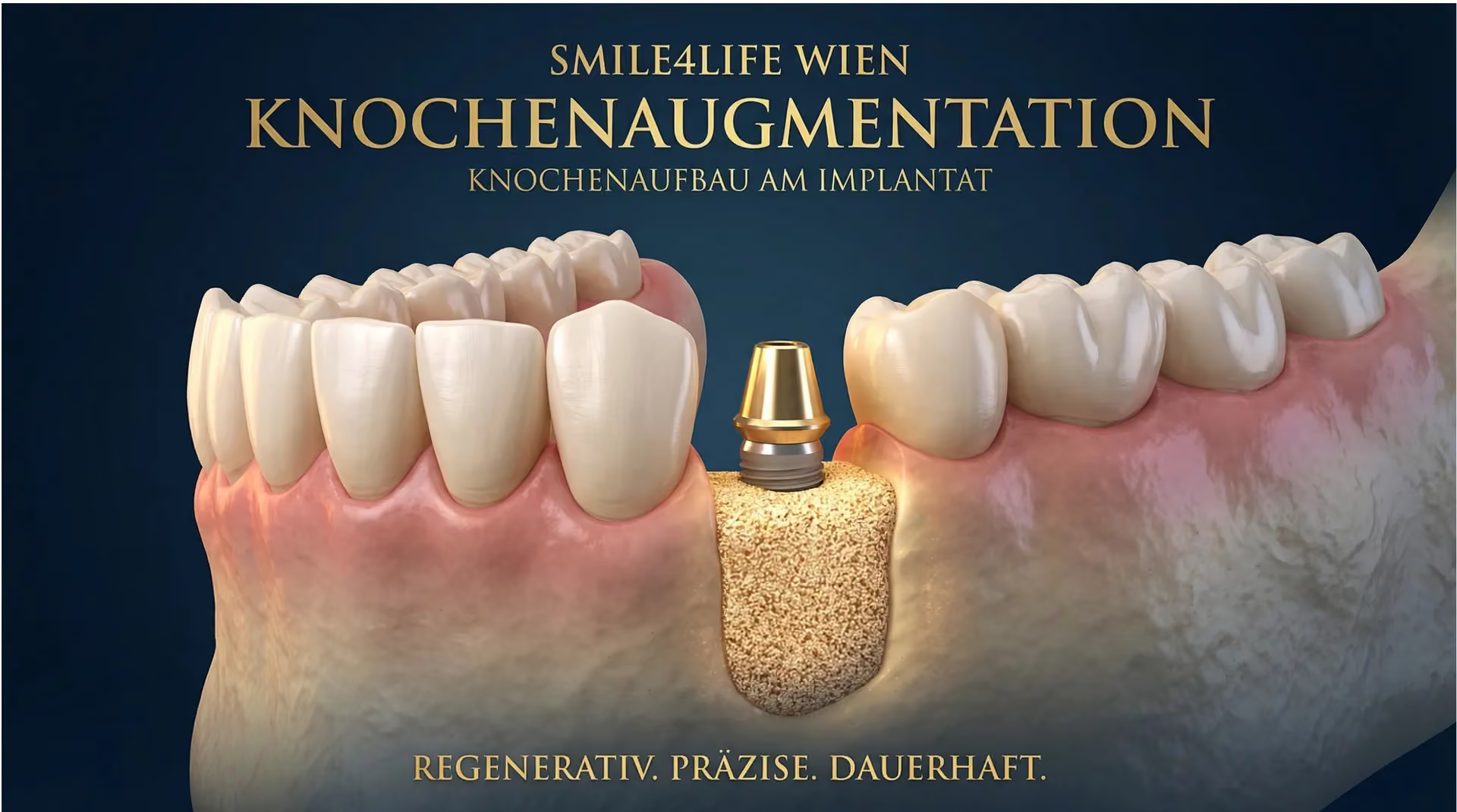
Bone substitute or your own bone is placed according to the defect. For your own material, its origin and whether an additional harvesting site needs care must be clarified. Where used, a membrane protects the space for jawbone regeneration. These steps and subsequent wound closure form part of surgical planning.
3. The first days at home
Swelling, wound discomfort and bruising may follow surgery. You receive advice on caring for the treated area, temporarily suitable food and planned medication. Follow this individual plan rather than applying general online deadlines to your procedure.
Ask beforehand when a check is planned and how to make contact if problems arise. Increasing symptoms, fever or an unusual wound need prompt assessment. An open wound or visible material is no reason to pull at or clean it yourself.
A sinus lift involves additional advice about pressure in the sinus area. Clarify planned flights, diving or other loads before the appointment. If the sinus membrane is injured, professional repair does not measurably reduce implant survival according to a meta-analysis of seven papers with 3,604 implants (97.68 versus 98.88 per cent, Díaz-Olivares et al., 2021); a review of 15 controlled studies also describes internal access as a minimally invasive and effective option for this area (Farina et al., 2022). Your work also affects how much recovery time is appropriate.
4. Integration, healing time and the dental implant
The wound may settle much earlier than the bone has integrated sufficiently. Depending on the situation, several months should be allowed for augmentation. One fixed date for every procedure would conceal this difference. British hospital information also confirms that integration takes time and subsequent steps are planned from the findings (Cambridge University Hospitals, 2024).
With a two-stage approach, we first assess whether enough bone has formed for placement. After placement, the necessary healing follows before the final restoration bears load. An international consensus report addresses how much bone wall is needed around the eventual implant — a single millimetre figure does not decide this alone (Jensen et al., 2023). Stages may overlap with simultaneous augmentation, but biological healing is still required.
Ask for a sequence with checkpoints: what must be achieved at the next appointment, and what determines continuation? The bone augmentation before dental implants overview helps with your next conversation.
How does bone augmentation in the lower jaw work?
The steps are the same as in the upper jaw: findings and planning, surgery, wound check, integration and implant. The neighbouring anatomy differs. There is no sinus in the lower jaw, so a sinus lift is not an option there. Instead, the mandibular nerve runs through the bone, and its distance from the planned implant site helps determine available height. CBCT may add spatial information for this question.
If width is mainly lacking in the lower jaw, the ridge is augmented laterally. As in the upper jaw, check-ups determine when the implant follows — not a date fixed before surgery.
The extent of treatment and appointments depend on the procedure and augmentation needed.
YOUR OPTIONS
TREATMENT OPTIONS COMPARED
We will discuss payment terms with you prior to treatment.
The indicative market prices in our price overview provide an initial guide. We will discuss which services are planned for you and the costs involved based on your examination findings and individual cost plan.
Scientific references
Institute for Implantology and Digital Dentistry Vienna
Medizinische Universität Wien
Österreichische Gesellschaft für Mund-, Kiefer- und Gesichtschirurgie (ÖGMKG)
International Team for Implantology (ITI)
Österreichische Gesellschaft für Implantologie
Yerit Practice – Dentist Vienna
Frequently asked questions
Frequently asked questions
Do you have a specific question about your diagnosis? Book a consultation appointment directly →
Questions about your treatment?
Discuss what matters to you and what the next steps look like with us.
Book your appointment nowYour orientation
Healing and next steps are assessed according to your progress.
Understanding what’s involved
The extent of treatment and appointments depend on the procedure and augmentation needed.
In everyday life
Who this information is for
For planning appointments, recovery time and subsequent implant restoration.
Important limitations
Duration depends on procedure, defect and healing progress. Other patients’ accounts are not your personal timetable.
Our approach
Bone augmentation is appropriate when it supports the planned restoration. We discuss your findings, possible alternatives and treatment limitations. A single millimetre measurement or general success rate does not replace this assessment.
SCIENTIFIC STUDIES
Bone augmentation is appropriate when it supports the planned restoration. We discuss your findings, possible alternatives and treatment limitations. A single millimetre measurement or general success rate does not replace this assessment.
Maxillary sinus floor augmentation: a review of current evidence on anatomical factors and a decision tree
For a sinus lift, the remaining bone, shape and condition of the maxillary sinus and its lining need to be considered together. A review with a decision model, not an individual treatment instruction.
37714889
Bone grafting for dental implants
Bone grafting may be performed before or at the same time as implant placement. Material origin, healing and risks are part of the consultation. Hospital-specific patient information, version 3. Its timings and aftercare do not constitute a fixed protocol for Smile4Life.
Chandrasekaran D et al. (2024). Treatment Outcome of Using Guided Bone Regeneration for Bone Augmentation for the Placement of Dental Implants - A Systematic Review
This systematic review compares guided bone regeneration (GBR) with block grafting and distraction osteogenesis for bone augmentation before implant placement. The authors consider GBR a stable and effective procedure but emphasize the limited evidence. This establishes neither general superiority nor an individual guarantee of success (Chandrasekaran et al., 2024).
39926965
Sabri H et al. (2024). Bone augmentation using titanium mesh: A systematic review and meta-analysis
This meta-analysis of 22 controlled clinical studies quantifies bone gain using titanium mesh as a shaping framework: 3.36 mm in height and 3.26 mm in width. Mesh exposure was the most common complication, and the pooled complication rate was 10.8 percent. Direct comparison with collagen membranes found no significant difference in width gain. Titanium mesh is therefore particularly suitable for defects requiring three-dimensional augmentation of around 4 mm (International Journal of Oral Implantology, 2024).
39283219
Smeets R et al. (2022). Horizontal augmentation techniques in the mandible: a systematic review
This systematic review evaluates eight clinical studies with a total of 276 bone augmentation procedures in the lower jaw, in which bone width was increased using animal-derived, autogenous or donor material, as granules or blocks. Seven of the eight papers reported a mean width gain of 4.8 mm, and the mean graft failure rate was 4.4 percent. The authors also note that randomized comparative studies are largely lacking and that combinations of donor bone blocks and resorbable membranes need reassessment (International Journal of Implant Dentistry, 2022).
35532820
Jensen SS et al. (2023). Group 1 ITI Consensus Report: The role of bone dimensions and soft tissue augmentation procedures on the stability of clinical, radiographic, and patient-reported outcomes of implant treatment
The bone wall around an implant is important for assessment. A single millimetre figure does not determine whether grafting is needed. The 1.5-mm finding concerns the outer (buccal) bone wall after implant placement at healed sites, not a general minimum width before surgery.
37750519
Farina R et al. (2022). Minimal invasiveness in the transcrestal elevation of the maxillary sinus floor: A systematic review
This systematic review evaluates 15 controlled studies of internal sinus lifts, in which the lining of the sinus floor is raised through the implant site. It concludes that the procedure is a minimally invasive, effective option for the back of the upper jaw with bone loss. Motor-driven instruments instead of a hand mallet and osteotome further reduce the burden on patients without reducing clinical effectiveness. A standardized sequence of instruments adapted to the remaining bone height, together with control of pressure and penetration depth, is essential (Periodontology 2000, 2022).
35913076
Díaz-Olivares LA et al. (2021). Management of Schneiderian membrane perforations during maxillary sinus floor augmentation with lateral approach in relation to subsequent implant survival rates: a systematic review and meta-analysis
This meta-analysis of seven papers includes 1,598 sinus lift procedures with a total of 3,604 implants and examines what happens if the sinus lining tears during an external sinus lift. The perforation rate was 30.6 percent. Implant survival was 97.68 percent under repaired, previously perforated membranes and 98.88 percent under intact membranes, with no statistically significant difference. The non-significant difference in implant retention does not mean that a tear has no other risks or consequences. The size of the tear and treatment adapted to it are crucial (International Journal of Implant Dentistry, 2021).
34250560
More topics in this area
Deepen your knowledge – find all information regarding the treatment process, costs, and results.


Kärntner Straße 9
100 meters from Stephansplatz, Innere Stadt.
Partnerships & Memberships & References