CAD/CAM ceramic in Vienna: manufacture, suitability and treatment
Scanning, designing, milling and fitting in one appointment — with a clear explanation of where it is not suitable
One appointment may suffice
A temporary may be avoided
95 % after four years
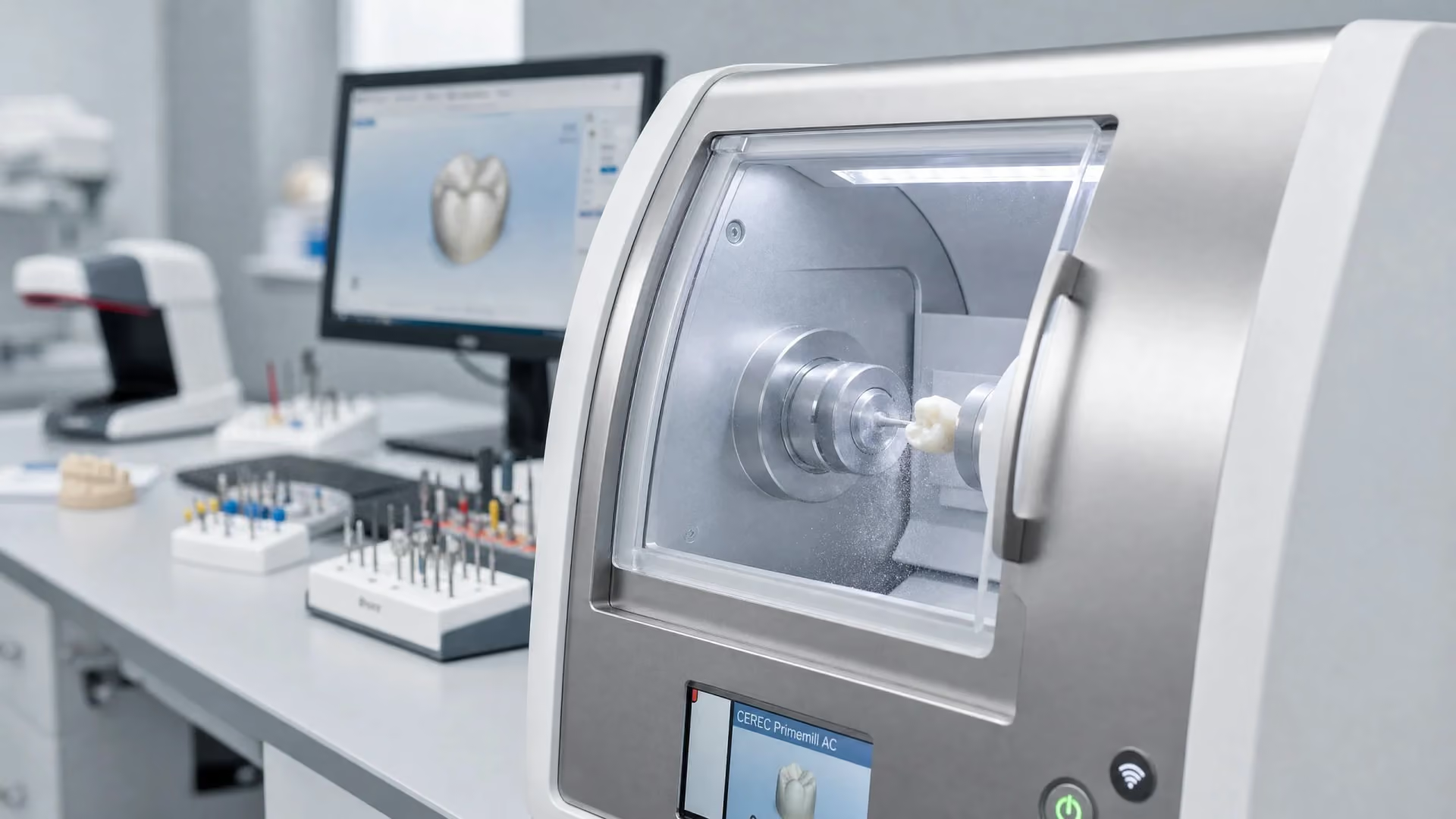
Milled in-house
Single-Visit CAD/CAM Ceramic
cerec-cad-cam-wien
4.9★
Doctify rating
25+
Years of experience
Personal
In-practice consultation
1010 Vienna
Kärntner Straße 9
At a glance
What is single-visit CAD/CAM ceramic?
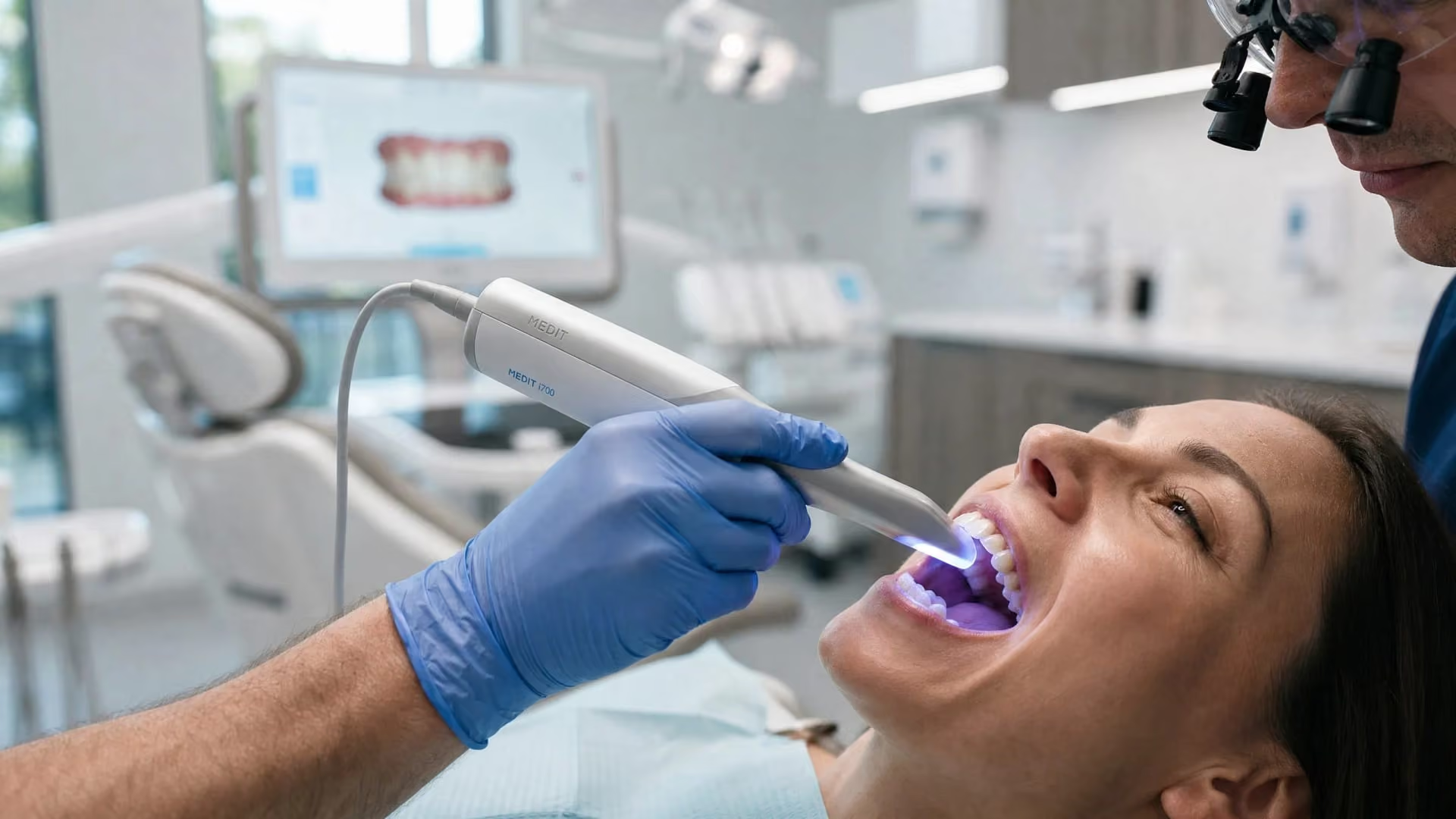
The tooth is scanned optically, the restoration designed on a computer and milled at the practice from a ceramic block. For suitable teeth, it is fitted the same day; one study found 95 % of these crowns in function after four years.* The procedure is often known by the brand name CEREC.
What are the disadvantages of a CAD/CAM crown?
Not every situation is suitable: hard-to-reach margins, blood or saliva make scanning more difficult. A follow-up of 210 milled posterior crowns found significantly worse results in the lower than upper jaw.*
Does a CAD/CAM crown last as long as a laboratory crown?
A retrospective study of 50 crowns in 25 people reported 96 % survival for milled lithium-disilicate crowns and 90.8 % for metal-ceramic after six years. Material and manufacturing process differed together; this establishes no general equivalence or superiority of digital manufacture.* How long your restoration lasts depends on factors including findings, material and care.
Which restorations suit CAD/CAM manufacture?
Mainly inlays, onlays, partial crowns and single crowns in the back-tooth region — this is also where long-term data are available, including 95 % survival after four years.* For multi-unit bridges, laboratory work is usually the appropriate choice.
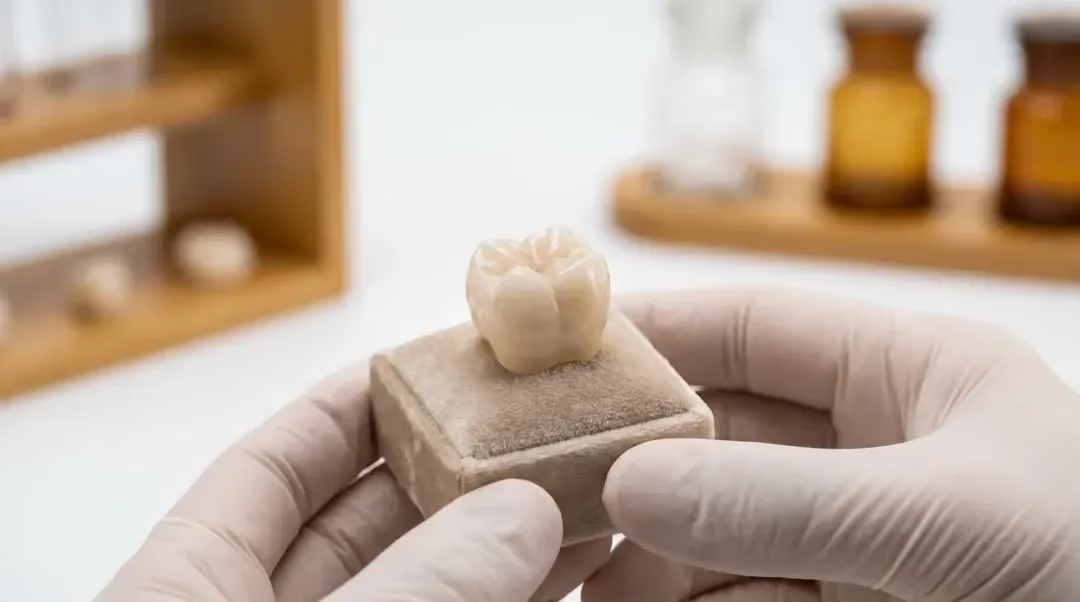
From scan to crown — in one appointment for suitable teeth.
Four steps to your restoration
The tooth is prepared, scanned digitally, designed on screen and milled from a ceramic blank. It is then fitted, polished and placed. For suitable findings and restorations, this is possible in the same appointment.
What this can avoid
When the restoration is completed in the same appointment, a temporary restoration and an additional fitting visit may be avoided. We clarify beforehand whether this is possible for your tooth and how much time to allow.

Digitally planned and manufactured
The 0.09 millimetres is a mean study value comparing digital and alginate full-arch impressions. The review includes 22 in-vivo studies and, in its clinical interpretation, concerns fully natural dentition. The value is not an accuracy guarantee for every scan or implant case.
Further detail
What long-term data show about CAD/CAM ceramic
For a procedure promising convenience, the decisive question is durability rather than comfort. Reliable figures are available.
Forty chairside-milled lithium-disilicate crowns achieved 95.0 per cent survival and 92.3 per cent success after four years — without a single ceramic chip or fracture (Aziz et al., 2019). A larger follow-up of 210 posterior crowns in 189 patients found 93.0 per cent survival after up to six years; notably, lower-jaw crowns performed significantly less well than upper-jaw crowns (Aziz et al., 2021).
Direct comparison with metal-ceramic
A retrospective follow-up compared 50 posterior crowns in 25 patients over six years: digitally fabricated lithium-disilicate versus metal-ceramic crowns. It reported 96 per cent survival and 96 per cent success versus 90.8 and 83.4 per cent for metal-ceramic. Two complications occurred in the ceramic group and twelve in the metal-ceramic group; patients also preferred the appearance (Aziz & El-Mowafy, 2023). The differences cannot be attributed solely to digital manufacture: material and manufacturing process differed together.
Context matters: these studies come from university training settings and concern posterior crowns. They provide useful evidence, not a promise for every situation.
Where we do not use CAD/CAM manufacture
For multi-unit bridges, particularly demanding front-tooth aesthetics and extensive reconstructions, we work with the laboratory. A milled blank has a uniform base colour; natural front teeth do not. Staining, glazing and layered laboratory work offer different design possibilities. The appropriate solution depends on material, findings and aesthetic aims; no blanket ranking of digital manufacture versus laboratory work follows. We assess which restoration suits your tooth under dental crowns and inlays and onlays. The guide CAD/CAM crowns explains the procedure in more detail at YERIT.
What changes ceramic over the years
Two laboratory investigations examined surface and appearance changes under simulated stresses. They do not predict how your restoration will change after a particular number of years. In 80 specimens of four glazed all-ceramics, 10 000 simulated brushing cycles reduced surface gloss, more with abrasive than conventional toothpaste (AlShehri & Rayyan, 2025). In 200 specimens of five additively or subtractively manufactured CAD/CAM materials, 10 000 coffee thermal cycles caused material-dependent colour and translucency changes that exceeded the acceptance thresholds used (Sasany et al., 2023). These experiments help put materials in context. They establish neither the clinical durability of every lithium-disilicate crown nor a specific discolouration for you.
YOUR CONCERNS
What is on your mind?

Limited time for appointments
Two visits with two weeks between them can be difficult to schedule. For suitable restorations, a single appointment is enough.
Previous problems with temporaries
A temporary has come loose or caused discomfort before. When manufacture is completed in one appointment, it is not needed.
You would like metal replaced
An old amalgam filling or metal crown is to be replaced with ceramic. Whether replacement makes sense depends on the existing restoration and your findings. An intact metal restoration does not need removing solely because of its material.
SUITABILITY CHECK
Is this treatment right for you?
YOUR JOURNEY
Your treatment process
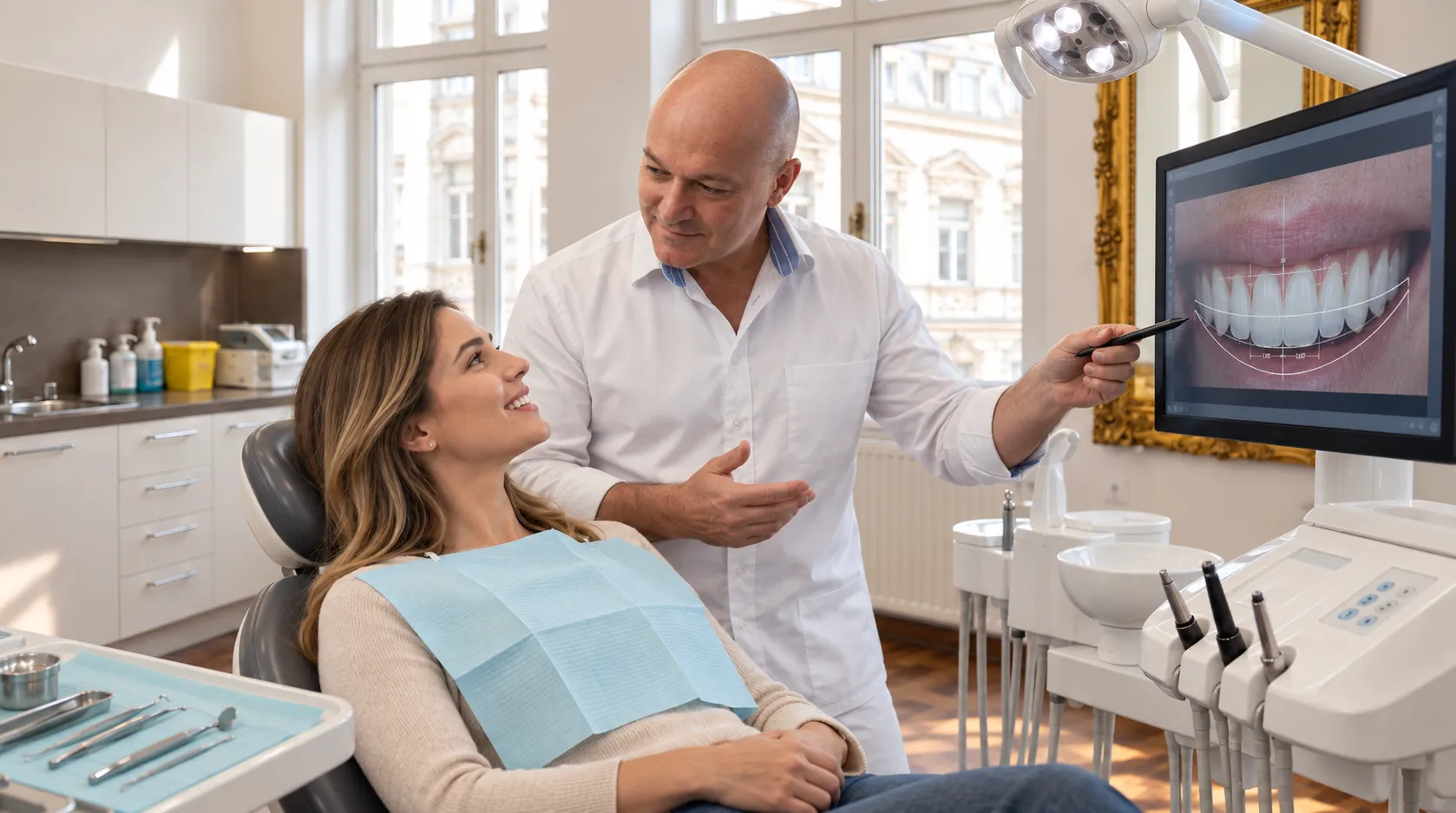
Individual initial consultation
Getting to know your goals and your teeth
We will discuss your goals and examine which treatment is best suited for your teeth.

Individual treatment planning
Defining the next steps together
You will learn which steps are planned and which questions should be clarified in advance.
Precise execution
Guiding you through your treatment step by step
Your treatment follows your personal plan. Please ask questions and tell us about any discomfort at any time.


Aftercare and check-ups
Discuss care and follow-up appointments
Finally, we will discuss ongoing care and the follow-up appointments that are right for you.
In everyday life
Appointment length depends on the tooth and restoration and is discussed beforehand. In suitable cases, the crown may be fitted in the same visit. You receive eating and care advice tailored to the restoration and any anaesthesia.
YOUR OPTIONS
TREATMENT OPTIONS COMPARED
We will discuss payment terms with you prior to treatment.
The indicative market prices in our price overview provide an initial guide. We will discuss which services are planned for you and the costs involved based on your examination findings and individual cost plan.
Advanced Dental Aesthetics & Implantology
Priv.Doz.Dr.Dr. K. Yerit
“Aesthetics is not a coincidence, but the result of precise planning and deep passion.”
For suitable restorations, single-visit manufacture may avoid a temporary and another fitting appointment. We assess whether this is possible for your tooth from the findings.
View profile →Scientific references
Institute for Implantology and Digital Dentistry Vienna
Medizinische Universität Wien
Österreichische Gesellschaft für Zahn-, Mund- und Kieferheilkunde (ÖGZMK)
International Society of Computerized Dentistry (ISCD)
Digital Dentistry Society (DDS)
Yerit Practice – Dentist Vienna
Excellence
Why Smile4Life
One appointment may suffice
For suitable restorations, scanning, design, milling and fitting may take place in the same appointment. Whether a temporary or further appointment is needed depends on the findings.
Documented long-term data
Studies of individual posterior crowns reported 95 per cent survival after four years and 93 per cent after up to six. A small retrospective comparison also examined different materials; the figures are not an individual prognosis.
Clear limitations
For multi-unit bridges and demanding front-tooth aesthetics, we work with the laboratory. Not every restoration belongs in the milling unit.
Frequently asked questions
Frequently asked questions
Do you have a specific question about your diagnosis? Book a consultation appointment directly →
Questions about your treatment?
Discuss what matters to you and what the next steps look like with us.
Book your appointment nowYour orientation
Studies of posterior crowns reported 95 per cent survival after four years and 93 per cent after up to six. These are results for the groups studied, not predictions for your tooth.
Understanding what’s involved
For suitable restorations, one appointment may suffice. Whether a temporary, further visits or repeat anaesthesia are needed depends on the findings and treatment progress.
In everyday life
Appointment length depends on the tooth and restoration and is discussed beforehand. In suitable cases, the crown may be fitted in the same visit. You receive eating and care advice tailored to the restoration and any anaesthesia.
Who this information is for
For individual all-ceramic restorations: inlays, onlays, partial crowns and crowns, mainly in the back-tooth region. Particularly suited to patients with limited time for two visits, previous difficulties with temporaries or a wish to replace old metal restorations with ceramic.
Important limitations
For multi-unit bridges, extensive reconstructions and very high demands for front-tooth aesthetics, we recommend laboratory manufacture. A tooth with too little remaining structure first needs a build-up or another solution. For pronounced grinding, we discuss material choice and an accompanying bite splint, because otherwise the restoration bears the load.
Our approach
We use single-visit manufacture where long-term data support it: individual all-ceramic restorations in the back-tooth region. The evidence there is good — 95.0 per cent survival after four years (Aziz et al., 2019), 93.0 per cent after up to six (Aziz et al., 2021), and 96 versus 90.8 per cent survival in a six-year retrospective comparison of 50 lithium-disilicate and metal-ceramic crowns in 25 people (Aziz & El-Mowafy, 2023). Material and manufacture differed together; this does not establish a general CAD/CAM advantage.
We do not extend the procedure beyond that scope merely because it is faster. For multi-unit bridges and demanding front-tooth aesthetics, we assess laboratory options according to findings, material and design aims. We decide together before the restoration. Laboratory experiments also show material-dependent changes in surface gloss, colour and translucency under simulated brushing and coffee thermal cycling (AlShehri & Rayyan, 2025; Sasany et al., 2023). These do not predict changes in your crown after a particular number of years.
SCIENTIFIC STUDIES
We use single-visit manufacture where long-term data support it: individual all-ceramic restorations in the back-tooth region. The evidence there is good — 95.0 per cent survival after four years (Aziz et al., 2019), 93.0 per cent after up to six (Aziz et al., 2021), and 96 versus 90.8 per cent survival in a six-year retrospective comparison of 50 lithium-disilicate and metal-ceramic crowns in 25 people (Aziz & El-Mowafy, 2023). Material and manufacture differed together; this does not establish a general CAD/CAM advantage.
We do not extend the procedure beyond that scope merely because it is faster. For multi-unit bridges and demanding front-tooth aesthetics, we assess laboratory options according to findings, material and design aims. We decide together before the restoration. Laboratory experiments also show material-dependent changes in surface gloss, colour and translucency under simulated brushing and coffee thermal cycling (AlShehri & Rayyan, 2025; Sasany et al., 2023). These do not predict changes in your crown after a particular number of years.
Aziz A et al. (2019). Clinical performance of chairside monolithic lithium disilicate glass-ceramic CAD-CAM crowns
Forty chairside-milled lithium disilicate crowns in 32 patients were followed for four years. Survival was 95.0 % and success 92.3 %. Three complications occurred, with no ceramic chipping or fractures (Journal of Esthetic and Restorative Dentistry, 2019).
31565848
Aziz AM et al. (2021). Clinical performance of CAD-CAM crowns provided by predoctoral students at the University of Toronto
Follow-up of 210 posterior crowns in 189 patients for up to six years found a survival rate of 93.0 % and a success rate of 86.4 %. Lower-jaw crowns performed significantly worse than upper-jaw crowns; age, sex and cement type had no measurable effect (Journal of Prosthetic Dentistry, 2021).
33423821
Aziz A, El-Mowafy O (2023). Six-year clinical performance of lithium disilicate glass-ceramic CAD-CAM versus metal-ceramic crowns
A retrospective follow-up compared 50 posterior crowns in 25 patients over six years: CAD/CAM lithium disilicate crowns achieved 96 % survival and 96 % success, versus 90.8 % and 83.4 % for metal-ceramic crowns. There were two and twelve complications respectively. Since material and manufacturing method differed simultaneously, the comparison does not establish a general causal advantage of digital manufacture (Journal of Advanced Prosthodontics, 2023).
36908754
Kong L et al. (2022). Digital versus conventional full-arch impressions in linear and 3D accuracy: a systematic review and meta-analysis of in vivo studies
The review compared digital and alginate full-arch impressions of natural dental arches. It included 22 in-vivo studies, with 13 in the meta-analysis. Tooth widths and arch distances showed no significant difference; mean three-dimensional deviation was 0.09 millimetres, and precision for both methods was below 0.1 millimetres. These findings do not provide a general accuracy promise for prepared crown margins, implant restorations or other impression materials (Clinical Oral Investigations, 2022).
35786783
AlShehri KA, Rayyan MR (2025). Effect of simulated tooth brushing on the surface gloss of monolithic all-ceramic restorations
In a laboratory study, 80 specimens from four glazed all-ceramic materials, including Cerec Tessera and Cerec Blocs, underwent 10 000 simulated brushing cycles. Surface gloss decreased, more with abrasive toothpaste than conventional toothpaste. This concerns material specimens under experimental conditions and predicts neither clinical longevity nor the gloss loss of an individual crown after a particular number of years (Clinical Oral Investigations, 2025).
39960522
Sasany R et al. (2023). Stainability and translucency of CAD-CAM materials after coffee thermocycling
In a laboratory study, 200 specimens from five additively or subtractively manufactured CAD/CAM materials underwent 10 000 coffee thermocycling cycles. Colour and translucency changed depending on the material; the acceptance thresholds used were exceeded. These tests concern different material groups and do not directly predict the performance of a lithium disilicate crown or a specific clinical service life (Journal of Esthetic and Restorative Dentistry, 2023).
37877244

Designed and milled in-house
Scanning, design and milling take place in the practice. For suitable restorations, manufacture during the same session may avoid a temporary restoration and an additional fitting appointment. Whether this is possible depends on the clinical findings.
More topics in this area
Deepen your knowledge – find all information regarding the treatment process, costs, and results.

Kärntner Straße 9
100 meters from Stephansplatz, Innere Stadt.

Partnerships & Memberships & References