Bite Splints and Night Guards in Vienna: Individually Made
Night guard, Michigan splint or occlusal splint — which type may help with teeth grinding and TMD?
Individual grinding guard
Guide price on the pricing page
Production: 1–2 weeks
Worn at night
Bite Splint Vienna
aufbissschiene-wien
4.9★
Doctify rating
25+
Years of experience
Personal
In-practice consultation
1010 Vienna
Kärntner Straße 9
At a glance
What is a bite splint and when is it appropriate?
A bite splint is an individually fitted plastic appliance between the dental arches. It can protect teeth and support treatment of chewing-muscle and jaw joint symptoms. It may be appropriate when grinding or clenching visibly wears the teeth, or when chewing muscles and jaw joints hurt. According to the health portal, treatment is needed when bruxism causes chronic pain, headaches or lasting damage to the teeth.*
How long should I wear a bite splint?
For night-time grinding, every night during sleep for as long as your dentist recommends. Protection lasts only while the splint is worn and usually diminishes quickly after stopping use.*
How should I clean a bite splint?
Rinse with cold water after removal and clean daily with a soft brush and mild soap. Hot water may deform the plastic. Afterwards, rinse thoroughly and store dry in a clean box.
Does a bite splint help with headaches?
It may help if headaches result from grinding at night; pain around the temples on waking is typical in that case. A splint does not treat migraine or other types of headache, which require medical assessment.*
Individual protective splint
What is a bite splint?
You grind your teeth at night and wake with jaw pain — a bite splint may help. But which type is right for you?
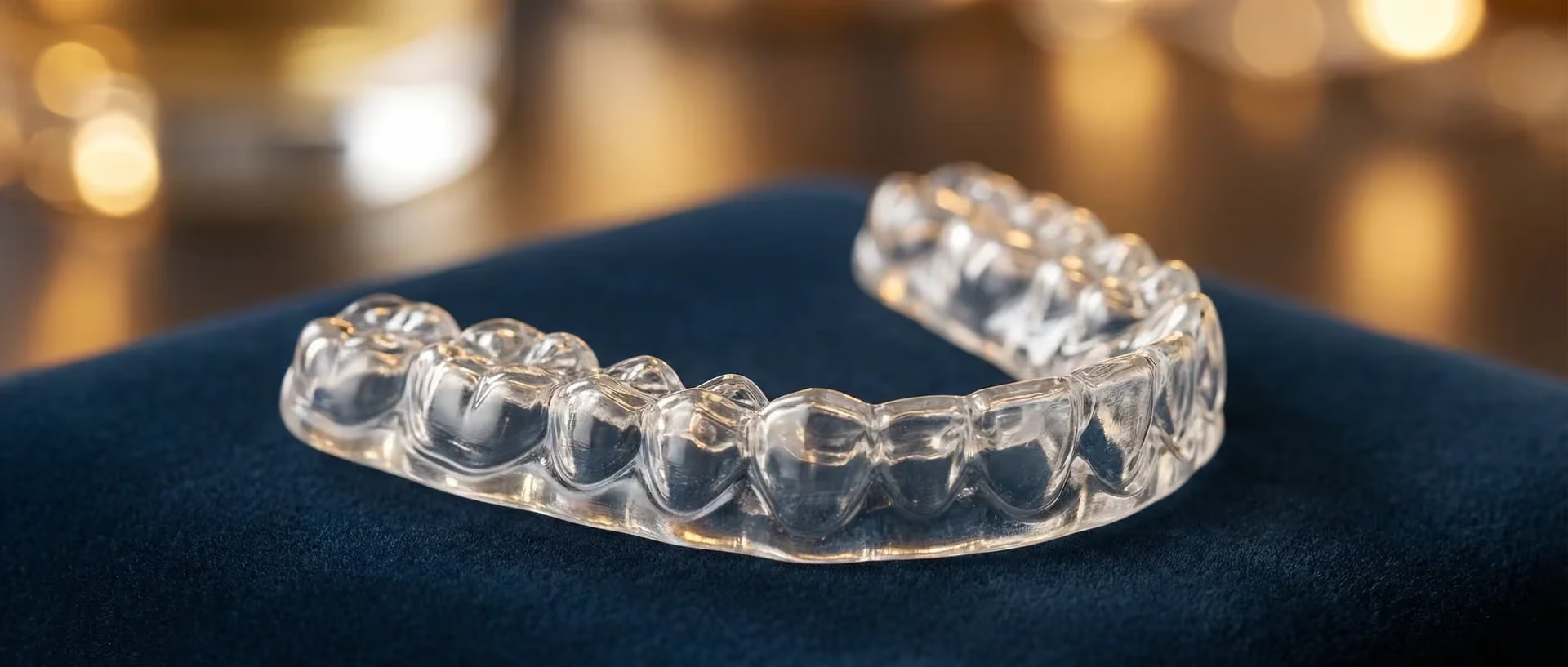
A bite splint — also called an occlusal splint, grinding guard or bruxism splint — is an individually made plastic appliance placed over the upper or lower teeth. It works like a shock absorber for the jaw joint: distributing chewing pressure evenly, preventing direct tooth contact and positioning the lower jaw in a relaxed position. The YERIT guide Bite splints in detail explains splint types and their use in more detail.
Is a night guard the same as a bite splint?
In everyday language, the terms usually mean the same thing; technically, ‘bite splint’ is the broader term. ‘Grinding guard’ describes its purpose — protection against grinding at night — while ‘occlusal splint’ describes its function at the bite surface, and ‘Michigan splint’ is a particular hard design.
The difference that really matters is not the name, but the material: hard or soft. The German S2k guideline recommends hard, full-coverage splints for its TMD and pre-prosthetic uses lasting longer than one month. Simple protective bruxism splints are excluded from this guideline section. For relaxation splints, it describes approximately two millimetres in the molar region; approximately four millimetres may be considered for particular indications or lack of response. Thickness is determined according to your diagnosis. Soft grinding guards may even increase chewing-muscle activity and are suitable only for short-term tooth protection. If you are looking for a grinding guard, ask about a hard one.
Which bite splint suits your symptoms?
A splint may be considered for Teeth grinding (bruxism), Jaw joint pain, TMD (temporomandibular disorders), tense chewing muscles and tooth wear from grinding at night. Not every jaw joint symptom automatically needs a splint; the decision is individual and based on findings. For pronounced clenching at night, an additional option may be masseter Botox.
| Splint type | Material | Use | Features |
|---|---|---|---|
| Michigan splint (relaxation splint) | Hard plastic (PMMA) | TMD, bruxism, jaw joint pain | Recommended by the guideline for long-term therapy; covers all teeth |
| Grinding guard (soft) | Soft plastic | Short-term tooth protection | For short-term use only — may increase grinding according to the guideline |
| NTI-tss splint | Hard plastic (small) | Acute bruxism | Only on the front teeth — reduces grinding pressure but does not replace long-term treatment |
Splint choice depends on your diagnosis. For teeth grinding and jaw joint symptoms, the guideline recommends a hard, full-coverage relaxation splint with sufficient thickness in the posterior tooth region for long-term treatment.
Is an over-the-counter bite splint sufficient?
Over-the-counter bite splints usually cost considerably less and are roughly moulded by heating them in a water bath. They provide some tooth protection but have important disadvantages: they fit the dental arch only approximately and may alter the bite. These self-fitted appliances do not replace examination and supervised adjustment. Certain prefabricated bite appliances, however, may be used deliberately as a temporary measure before diagnosis-specific care; this is not a general recommendation for every over-the-counter splint. An individual bite splint from a dentist is made in a dental laboratory from an accurate digital scan, fits your dental arch closely and supports the jaw joints in the intended therapeutic position.
How is your bite splint made at the practice?
Step 1 – functional assessment: At the initial appointment, we examine your jaw joints, assess your chewing muscles by touch and analyse your bite.
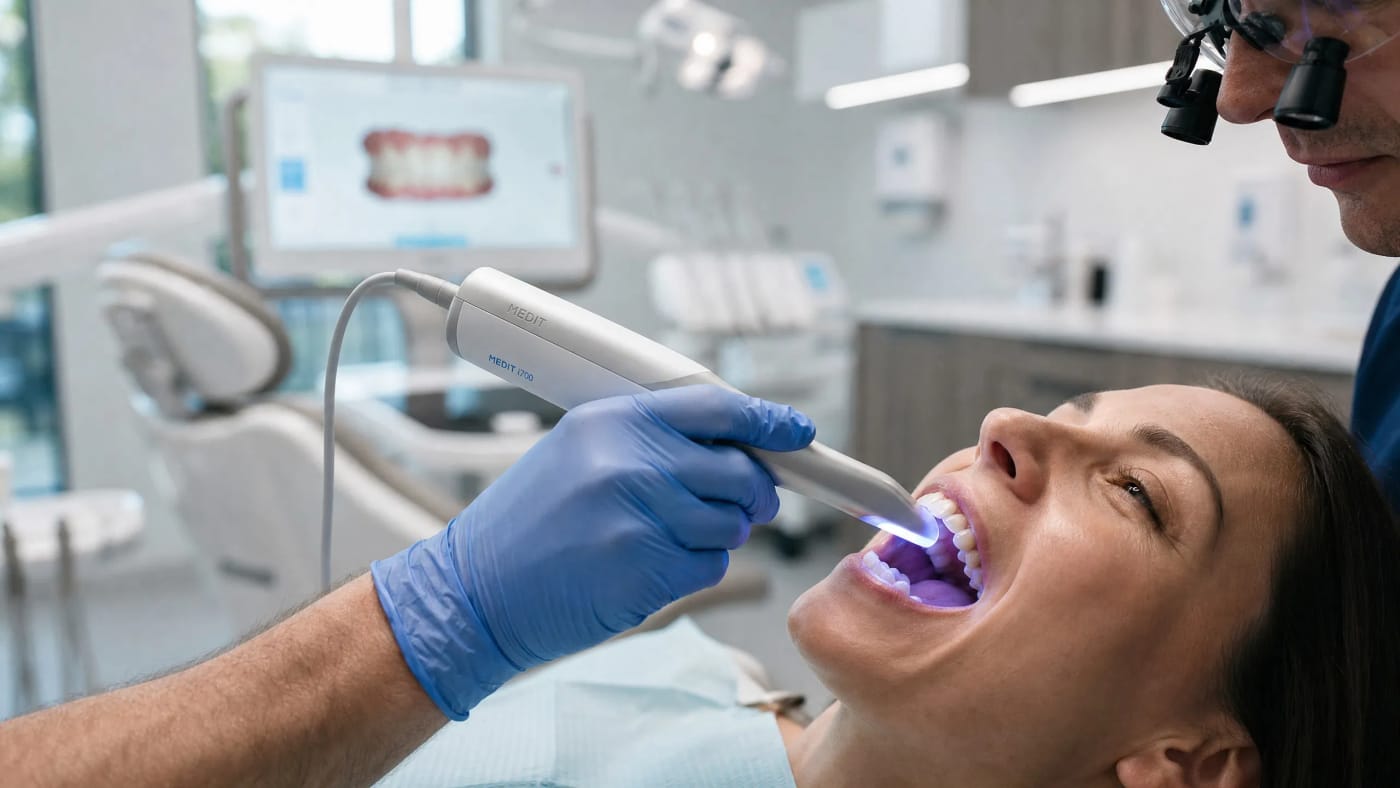
Step 2 – digital scan and bite registration: We take a digital intraoral scan of your dental arches and record the relationship between your jaws. These data go to our dental laboratory.
Step 3 – fitting and adjustment: At the second appointment, the finished bite splint is fitted and finely adjusted until its contacts are even.
Step 4 – follow-up and readjustment: After 2 to 4 weeks, we check the splint and adjust it if needed.
What side effects can a bite splint have?
Bite splints are generally well tolerated. Increased saliva, mild pressure points and a foreign-body sensation may occur in the first few days — these symptoms usually settle after a few days. Regular follow-up and readjustment reduce the risk of a poor fit.
What does a bite splint or night guard cost — and does ÖGK contribute?
| Service | Approximate market guide price in Vienna | Possible ÖGK reimbursement |
|---|---|---|
| Simple grinding guard | Based on findings, in the cost plan | Clarify eligibility beforehand |
| Michigan splint (individual) | 300–600 € | Clarify individual reimbursement beforehand |
| Functional assessment | According to the treatment required, stated in the cost plan | Clarify as a separate service beforehand |
Whether reimbursement is possible, and how much, depends on the planned splint, indication, insurer and the practice's contractual status. Clarify the specific service and any possible contribution with your insurer before treatment. Submitting an invoice does not guarantee coverage. Functional assessment and accompanying physiotherapy must be checked as separate services.
The figure for the Michigan splint is the usual market guide price from our pricing overview, rather than a quotation from our practice. Examination establishes which splint you need. You receive an individual cost plan after assessment at the practice.
Duration depends on the diagnosis and progress. If a splint is appropriate, wearing times, follow-up and any reduction in use are agreed individually.

Participants assessed in 57 studies of bite splints
The current Cochrane review of occlusal splints for jaw joint symptoms assesses 57 studies involving almost 2,900 participants. Hard splints may relieve muscle pain when chewing; certainty is very low for all comparisons and outcomes examined. Reliable general conclusions on effectiveness are therefore not possible.
YOUR OPTIONS
TREATMENT OPTIONS COMPARED
We will discuss payment terms with you prior to treatment.
The indicative market prices in our price overview provide an initial guide. We will discuss which services are planned for you and the costs involved based on your examination findings and individual cost plan.
Advanced Dental Aesthetics & Implantology
Priv.Doz.Dr.Dr. K. Yerit
“Aesthetics is not a coincidence, but the result of precise planning and deep passion.”
An individual bite splint protects your teeth while you wear it. We establish how long it is needed and when to adjust it at follow-up appointments.
View profile →Scientific references
Institute for Implantology and Digital Dentistry Vienna
AWMF – Arbeitsgemeinschaft der Wissenschaftlichen Medizinischen Fachgesellschaften
DGZMK – Deutsche Gesellschaft für Zahn-, Mund- und Kieferheilkunde
DGFDT – Deutsche Gesellschaft für Funktionsdiagnostik und -therapie
Cochrane Oral Health
Yerit Practice – Dentist Vienna
Frequently asked questions
Frequently asked questions
Do you have a specific question about your diagnosis? Book a consultation appointment directly →
Questions about your treatment?
Discuss what matters to you and what the next steps look like with us.
Book your appointment nowYour orientation
Understanding what’s involved
In everyday life
Adjustment usually takes a few days: initially there may be increased saliva and a foreign-body sensation, before the splint becomes part of your night-time routine. A more relaxed jaw in the morning is often the noticeable difference.
Who this information is for
Important limitations
Our approach
SCIENTIFIC STUDIES
DGFDT/DGZMK (2024). S2k-Leitlinie: Okklusionsschienen zur Behandlung craniomandibulärer Dysfunktionen und zur präprothetischen Therapie
The S2k guideline on TMD and pre-prosthetic therapy favours hard, full-coverage splints for use longer than one month; simple protective bruxism splints are excluded from this section. For relaxation splints, it describes approximately two millimetres in the molar region, with approximately four millimetres only for particular indications or lack of response. Wearing instructions and follow-up depend on findings; sufficient improvement may allow reduced use or gradual discontinuation. Not every TMD requires a splint.
DGZMK/DGFDT (2026). S3-Leitlinie: Diagnostik und Behandlung des Bruxismus, Version 2.1
The S3 guideline on diagnosing and treating bruxism is available in version 2.1 from 2026. Recommendation 24 lists botulinum toxin in adult chewing muscles as a possible option, with low GRADE certainty of evidence. Questions on target muscles, injection sites, dose and dilution remain open; off-label use and the required informed consent must be considered. This establishes no general first-line, repeat-treatment or cure schedule.
Bergmann A et al. (2020). Effect of treatment with a full-occlusion biofeedback splint on sleep bruxism and TMD pain: a randomized controlled clinical trial
A randomised controlled study finds that a biofeedback splint reduces night-time grinding episodes and muscle pain more than a conventionally adjusted occlusal splint.
32430774
Singh BP et al. (2024). Occlusal interventions for managing temporomandibular disorders
The current Cochrane review (57 studies, almost 2,900 participants) finds indications that hard bite splints may relieve muscle pain when chewing — but the evidence is very uncertain and does not permit reliable general conclusions on effectiveness.
39282765
Assiri HA et al. (2025). Bruxism treatment outcomes: A systematic review and meta-analysis
A current systematic review (22 studies) finds no single procedure universally effective for bruxism — splints, botulinum toxin and biofeedback are best combined within a multidisciplinary treatment approach.
41366915
Delcanho R et al. (2022). Botulinum Toxin for Treating Temporomandibular Disorders: What is the Evidence?
A review of 24 randomised studies finds good evidence for botulinum toxin in masseter hypertrophy and generally positive but inconsistent evidence for myogenous jaw joint pain and bruxism management.
35298571
Zähneknirschen (Bruxismus) – Öffentliches Gesundheitsportal Österreichs
A grinding splint is placed over the teeth in the evening; its effect lasts only while it is used. In certain adult cases, botulinum toxin in the chewing muscles may be considered as off-label use (gesundheit.gv.at, accessed 03.11.2026).
Digitally measured, carefully fitted
A digital intraoral scan records tooth surfaces for splint manufacture. Clinical functional examination and recording the jaw relationship are separate steps. Which records are needed depends on the findings; fit and bite contacts are checked during fitting.
More topics in this area
Deepen your knowledge – find all information regarding the treatment process, costs, and results.


Kärntner Straße 9
100 meters from Stephansplatz, Innere Stadt.
Partnerships & Memberships & References