
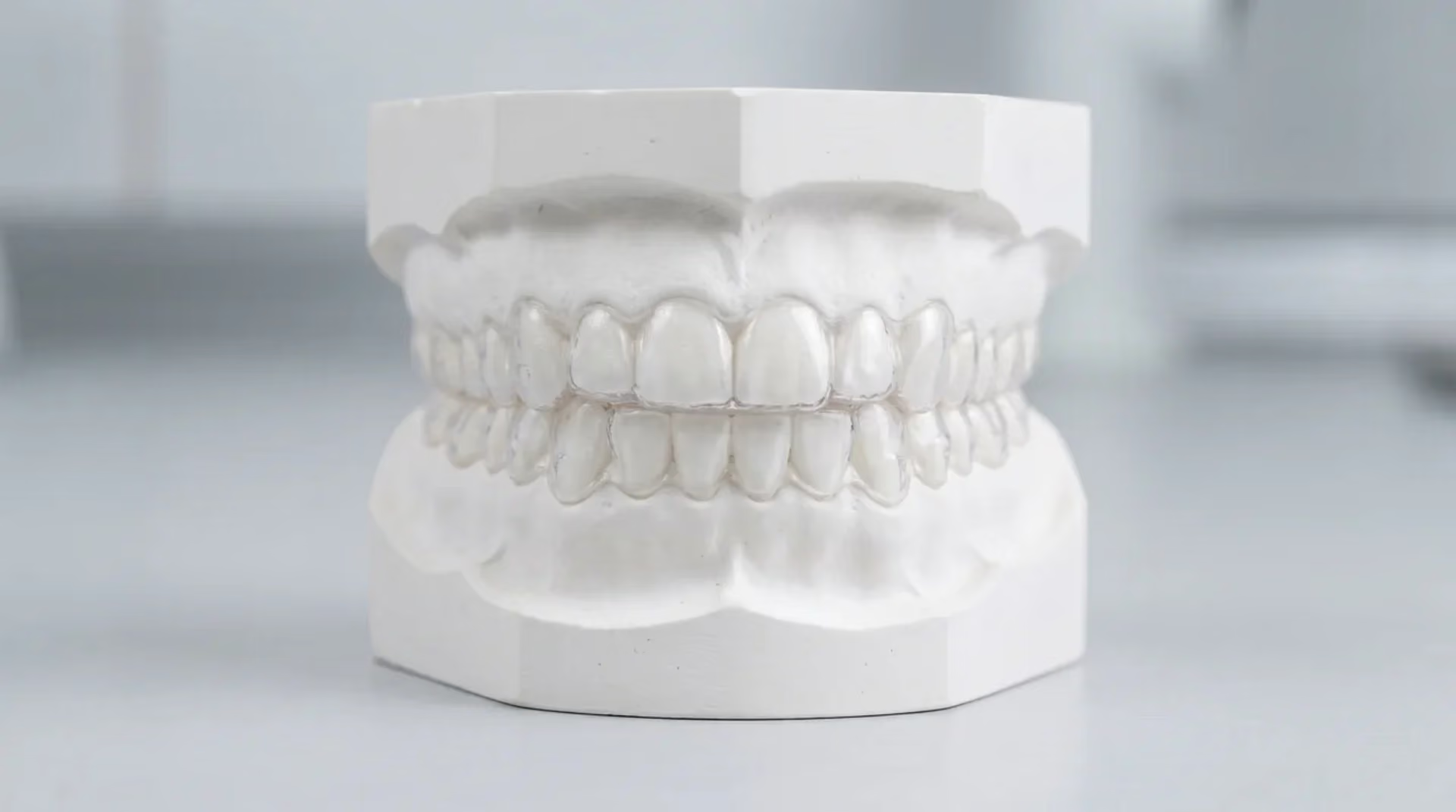
Retainers in Vienna: Maintain and Check Tooth Position
Your active orthodontic treatment is complete. A suitable retainer now helps maintain the new position. Understand your options.
Fixed or removable
After orthodontic treatment
Selection follows findings
Include care and checks
Retainers Vienna
retainer-wien
4.9★
Doctify rating
25+
Years of experience
Personal
In-practice consultation
1010 Vienna
Kärntner Straße 9
At a glance
What is a retainer, and what does it do?
A fixed wire or removable tray stabilises teeth after straightening. Without retention, teeth tend to move towards their previous position, according to the Cochrane review. Its 47 studies did not clearly establish the most reliable design.*
Lost your retainer tray: how do you get another?
Contact the practice promptly rather than waiting. First, tooth movement is assessed; a new tray is then made from a scan or impression. Bring the old tray or parts if available.
How quickly do teeth move without a retainer?
There is no fixed period; movement can begin early or years later. Pooled long-term data describe technical failures over varying follow-up periods with low-certainty evidence, not your personal likelihood of retainer failure. Regular checks remain important. Report loss or breakage promptly.*
When is a retainer fitted?
At the end of active treatment, when braces are removed or the final aligner completed. A fixed wire is bonded behind front teeth, while a removable tray is fitted from a scan or impression.
After braces, maintaining the result matters
A retainer supports care after tooth straightening. It aims to stabilise the achieved position, because teeth may move again even after successful treatment.
The suitable option starts with your findings
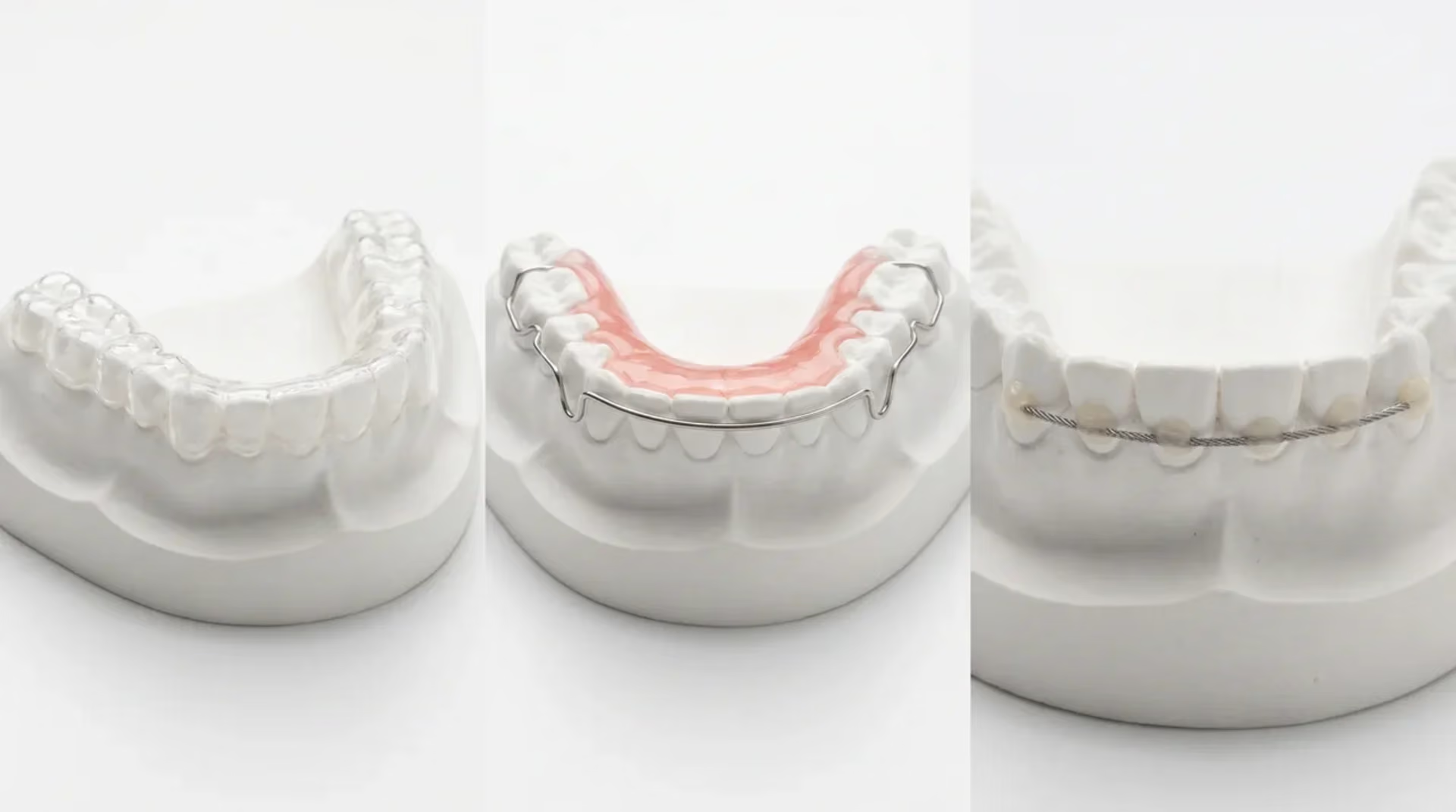
A thin wire behind front teeth and a removable tray have different daily requirements. Suitability depends on tooth position, bite and cleaning, among other factors.
Which retainer suits you after braces?
A fixed retainer is bonded to the inner surfaces of selected teeth. A removable retainer can be taken out for cleaning. Both need attention: fixed wires require care and checks; trays additionally require consistent wear.
Retention also belongs in planning after Invisalign or other aligners. Active movement is complete; a retainer now serves another purpose. This does not specify a brand.
The following section introduces retainer types; the retainer type comparison provides more detail. General basics are explained in Retainers: basics, types and durability.
Which retainer types exist?
A fixed retainer is a bonded inner wire. Removable options include transparent trays and Hawley retainers with an acrylic base and wire bow. Selection follows position, bite, care and daily life. The full comparison and limited comparative evidence are on the retainer type comparison page.
How long should you wear your retainer?
Recommendations are generally long term, often lifelong. This does not mean a single retainer lasts indefinitely. Wear duration and replacement are separate questions.
Removable-retainer instructions may initially require longer daily wear or night-time wear from the start. Follow your personal plan. The British Orthodontic Society recommends long-term retention; this cannot be reduced to a general minimum of two to five years.
Loose, broken or lost retainer: what should you do?
Contact your treating practice promptly. Describe the change and bring the tray or detached pieces. A wire may debond at one point; a tray may wear or no longer fit.
Checking establishes whether repair or replacement is needed, including assessment of altered tooth position. A technical defect does not automatically mean repeating treatment.
This is not unusual: a meta-analysis of 34 studies reported overall fixed-retainer failure of around 35 percent, with risk increasing markedly over longer wear (Aye et al., 2023). Available evidence also cannot establish a universal minimum or maximum retention duration (Martin et al., 2023). Your personal plan matters rather than a general number.
What is clarified in consultation and cost planning?
Current position, previous treatment and existing retainer condition guide selection. Bring records and questions, and discuss who will provide future checks.
The retainer costs in Vienna depend on agreed scope. Clarify one or both jaws and included checks. Your personal cost plan follows examination.
YOUR CONCERNS
What is on your mind?
Your braces will be removed soon
Discuss retention before active treatment ends so the next steps are clear.
Your retainer is damaged or lost
Contact your treating practice promptly. Do not wait for a routine visit with a detached wire.
You want to compare a wire and tray
Differences in cleaning, wear and checks support your decision. Suitability is assessed from your findings.
SUITABILITY CHECK
Is this treatment right for you?
YOUR JOURNEY
Your treatment process
Individual initial consultation
Getting to know your goals and your teeth
We will discuss your goals and examine which treatment is best suited for your teeth.

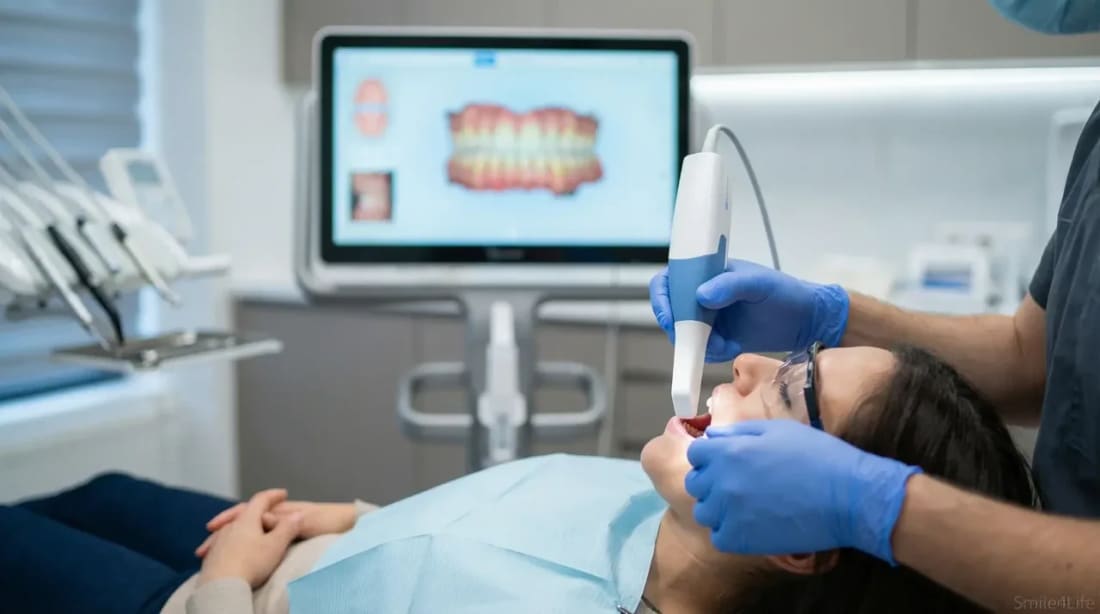
Individual treatment planning
Defining the next steps together
You will learn which steps are planned and which questions should be clarified in advance.
Precise execution
Guiding you through your treatment step by step
Your treatment follows your personal plan. Please ask questions and tell us about any discomfort at any time.
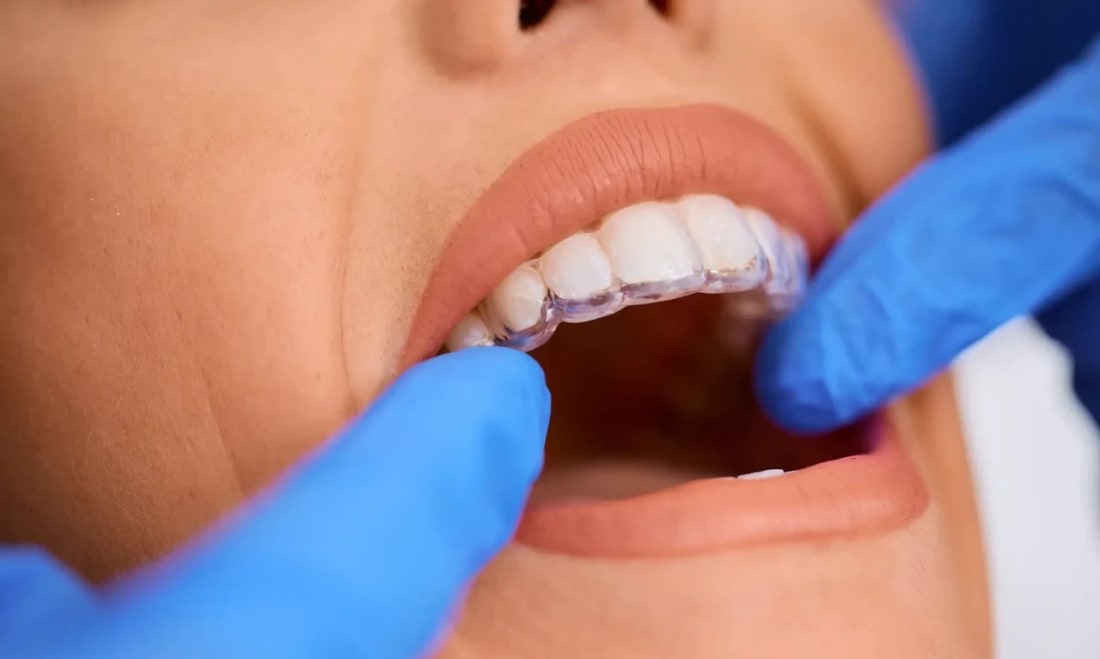

Aftercare and check-ups
Discuss care and follow-up appointments
Finally, we will discuss ongoing care and the follow-up appointments that are right for you.
In everyday life
Remove a removable tray for eating and oral care. Clean it as instructed. A fixed wire stays in place; ask how to clean beneath it.
YOUR OPTIONS
TREATMENT OPTIONS COMPARED
We will discuss payment terms with you prior to treatment.
The indicative market prices in our price overview provide an initial guide. We will discuss which services are planned for you and the costs involved based on your examination findings and individual cost plan.
Advanced Dental Aesthetics & Implantology
Priv.Doz.Dr.Dr. K. Yerit
“Aesthetics is not a coincidence, but the result of precise planning and deep passion.”
A retainer is not a formality after braces but part of completing treatment. Without consistent retention, tooth position changes again in most patients.
View profile →Scientific references
Institute for Implantology and Digital Dentistry Vienna
Deutsche Gesellschaft für Kieferorthopädie (DGKFO)
Österreichische Gesellschaft für Kieferorthopädie (ÖGKFO)
European Orthodontic Society (EOS)
Cochrane Oral Health
Yerit Practice – Dentist Vienna
Excellence
Why Smile4Life
Keep the result in view
Aim to preserve the achieved tooth position.
Suitable selection
Bite and position belong in the decision.
Consider daily life
A removable retainer requires reliable wear.
Plan cleaning
Cleaning around fixed wires needs attention.
Recognise changes
Retainer fit and condition are checked.
Understand costs
Initial fitting, checks and possible replacement belong in planning.
Frequently asked questions
Frequently asked questions
Do you have a specific question about your diagnosis? Book a consultation appointment directly →
Questions about your treatment?
Discuss what matters to you and what the next steps look like with us.
Book your appointment nowYour orientation
Help maintain the tooth position you worked towards.
Understanding what’s involved
Wear, cleaning and checks are tailored to your retainer.
In everyday life
Remove a removable tray for eating and oral care. Clean it as instructed. A fixed wire stays in place; ask how to clean beneath it.
Who this information is for
Retention is planned after orthodontic treatment, including fixed braces or aligners. Wire, tray or a combination is assessed individually.
Important limitations
Loose wires, poorly fitting trays or symptoms need examination. Cleaning difficulties and gum disease also affect selection. A retainer does not replace renewed treatment for substantial existing movement.
Our approach
Good retention planning connects tooth position, daily life and follow-up. The 2023 Cochrane review cannot establish a fixed method ranking because evidence is uncertain. Individual, reasoned selection therefore matters.
SCIENTIFIC STUDIES
Good retention planning connects tooth position, daily life and follow-up. The 2023 Cochrane review cannot establish a fixed method ranking because evidence is uncertain. Individual, reasoned selection therefore matters.
Martin C et al. (2023). Retention procedures for stabilising tooth position after treatment with orthodontic braces
The Cochrane review compares retention methods after braces. Evidence is low to very low, and firm conclusions favouring one approach are not possible. Aligner studies were excluded.
37219527
Husain S et al. (2022). Vacuum-Formed Retainers Versus Lingual-Bonded Retainers: A Systematic Review and Meta-Analysis
The review comparing clear trays and bonded wires rates evidence certainty as very low. Several stability measures did not differ statistically significantly. This does not establish general equivalence for every clinical situation.
36594552
Bardideh E et al. (2023). CAD/CAM-based fixed retainers versus conventional fixed retainers: systematic review and network meta-analysis
A network meta-analysis of seven randomised trials considers CAD/CAM nickel–titanium retainers a promising short-term alternative, supported chiefly by lower plaque index. Evidence on long-term durability and failure is lacking, so the authors recommend individual decisions.
37471113
Adanur-Atmaca R et al. (2021). Effects of different lingual retainers on periodontal health and stability
A randomised trial involving 132 patients found the lowest gingival and tartar scores with CAD/CAM nitinol retainers, with a significant tartar difference from two comparison groups and at least comparable stability. After one year, however, none of the four groups showed clinically meaningful periodontal deterioration or relapse.
33587126
Aye ST et al. (2023). The prevalence of the failure of fixed orthodontic bonded retainers: a systematic review and meta-analysis
A meta-analysis of 34 studies involving 3,484 participants estimates overall fixed-retainer failure at around 35 percent, increasing markedly with follow-up from around 24 percent short term to around 54 percent long term. The authors rate evidence quality as low; no meaningful difference between bonding methods was found.
37824794
More topics in this area
Deepen your knowledge – find all information regarding the treatment process, costs, and results.


Kärntner Straße 9
100 meters from Stephansplatz, Innere Stadt.






Partnerships & Memberships & References




