
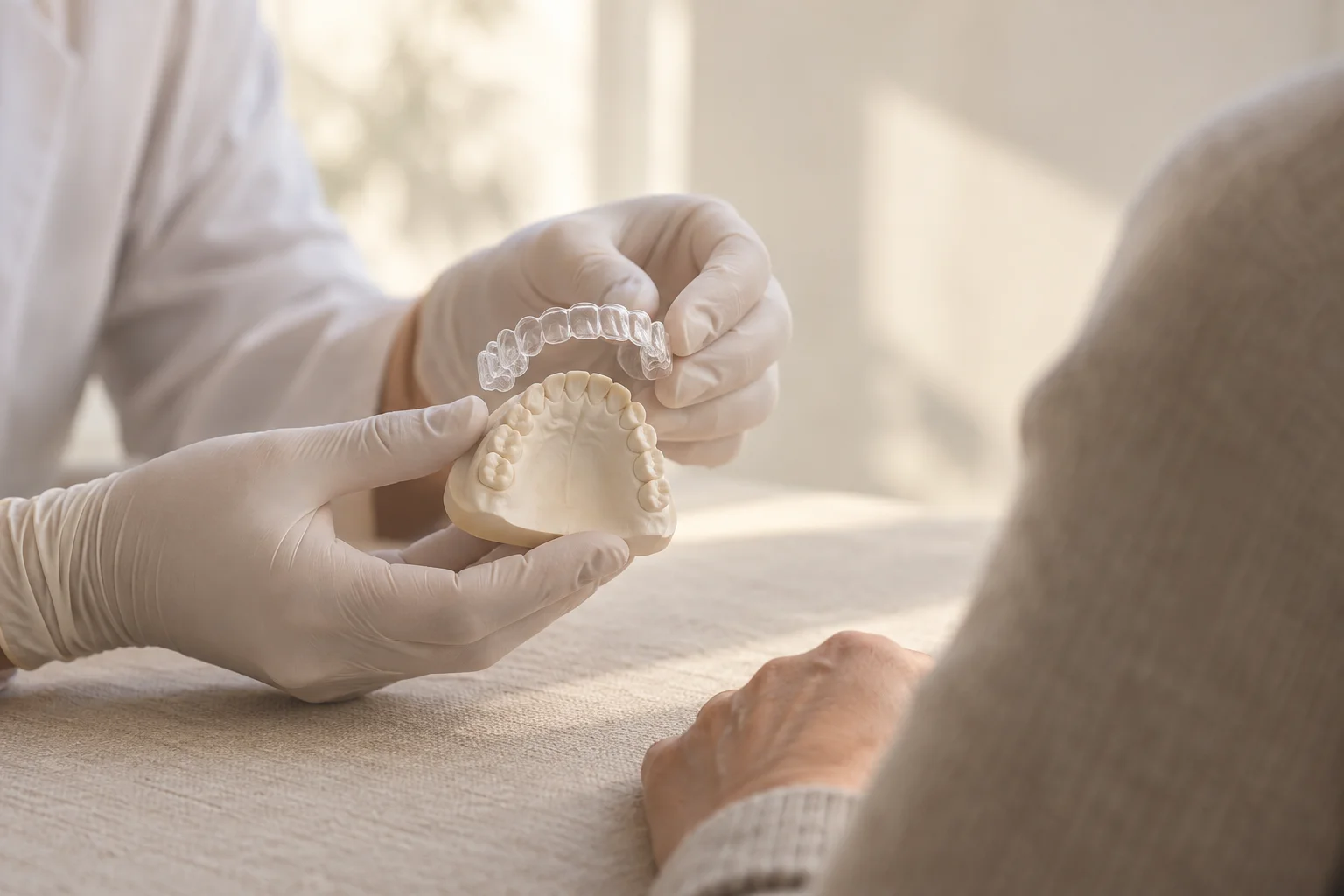
Step by step
Invisalign tooth straightening: the procedure in 6 steps
From the first consultation to the final result, every Invisalign treatment follows a structured process, individually planned and closely monitored. The YERIT guide Invisalign procedure explains the steps in greater detail.
1. Examination, findings and records
We start by discussing your wishes and examining tooth position, bite, teeth and gums. Any necessary pretreatment is clarified first. Additional records depend on the findings. An optical 3D scan records tooth surfaces; X-rays are different and are required only to answer a relevant clinical question. You then discuss your starting situation and goals with Doz.Dr.Dr. Yerit.
2. ClinCheck simulation
An individual ClinCheck simulation based on the 3D scan shows planned tooth movement step by step before the first aligner is made. However, a scoping review of 33 studies shows that the simulation tends to overestimate actual predictability; particularly for individual tooth rotations, the final result more often differs from the plan (Muro et al., 2023). This is precisely why check-ups matter: only then can actual progress be compared with the simulation.
3. Manufacturing the aligner series
Your personal series of clear aligners is manufactured from the approved simulation, each aligner for a particular phase of tooth movement.
4. Wearing and changing aligners
Aligners are usually worn around 20 to 22 hours daily and often changed every one to two weeks. Your personal wear and change schedule takes priority; do not alter it yourself.
5. Check-ups
At check-ups, we assess fit and actual tooth movement. Invisalign appointments are often six to eight weeks apart; your personal plan may differ. Overall duration also depends on findings, goals and progress. We can estimate this personally after examination; necessary adjustments may change it. When changes become visible depends on which teeth move first. No fixed number of weeks can be promised. Additional aligners can be planned if further corrections are needed. These rounds are called refinements. Clarify in the cost plan under which conditions they and extra appointments are included.
6. Retention phase
After active treatment, a retainer helps stabilise the achieved tooth position and reduce the risk of movement back.
Aftercare: the first days with a new aligner
Each aligner change can bring tightness as teeth move. Here is what to expect and when to contact us.
The first 24 hours
Pressure and tightness are expected during the first one to two days after each change and usually ease noticeably afterwards. Evening changes can therefore be helpful, placing the most intense period during sleep. A snug new aligner is intended. Speaking may initially feel unfamiliar. A review of seven studies with 332 patients describes adjustment usually after 7 to 14 days; some needed 30 to 60 days. Evidence certainty is low, so no fixed deadline can be promised (Ali Baeshen et al., 2023).
The first week
The entire plan is based on 20 to 22 hours of daily wear, removing aligners only to eat and brush. Drink only water with them in place; other drinks can stain or damage them. Brush before reinserting so nothing is trapped beneath them. Attachments remain on the teeth until treatment ends; do not lever them off.
When to call us
- The aligner no longer seats on a tooth and a visible gap remains, indicating that movement is no longer following the plan
- An attachment has come off or broken
- An edge persistently rubs your tongue or cheek
- Pressure pain does not ease after a week or increases again
- An aligner has broken or been lost
If an aligner is lost or damaged, contact your treating practice promptly. Do not independently move ahead or back in the sequence. The appropriate temporary solution depends on treatment progress. Keep your most recently worn aligners and bring a damaged aligner to the appointment.
In these situations, do not independently move to the next aligner or try to make up a skipped one. Call us on +43 1 410 13 52. A short appointment is often enough to get treatment back on track.