

Braces for Adults in Vienna: Requirements and Methods
Explore tooth correction in adulthood — individually planned according to your clinical findings.
Individual assessment
Healthy gums required
Duration based on findings
Usually self-funded
Braces for Adults Vienna
zahnspangen-erwachsene-wien
4.9★
Doctify rating
25+
Years of experience
Personal
In-practice consultation
1010 Vienna
Kärntner Straße 9
At a glance
Can you still have braces at 40?
Yes. According to the Austrian health portal, correction is possible in adulthood when gums and bone are healthy. Severe jaw discrepancies often require braces combined with jaw surgery.*
Are braces worthwhile for adults?
Yes, when misalignment affects chewing, speech or cleaning; appearance may be an additional reason. In an adult patient survey, 82 percent named appearance as their main motivation.*
Which braces suit adults?
This depends on misalignment rather than age. For non-extraction treatment, a meta-analysis of 15 studies found no statistically significant differences in assessed outcomes. Uncertain evidence does not establish general equivalence; where teeth were extracted, fixed braces performed better.*
How long does adult treatment take?
According to the Austrian health portal, comprehensive main orthodontic treatment usually takes around three to four years; smaller corrections are considerably shorter. Retention follows, with duration depending on the type of misalignment.*
Orthodontics in adulthood
Braces for adults in Vienna
Aged 35, 45 or 55 and wanting straighter teeth? Age alone is not the limit. Healthy gums and jawbone are decisive, which is why adult orthodontic treatment at our Vienna practice begins with assessment of these tissues.
The biological process of tooth movement is not fundamentally different in adults and adolescents; progress depends on individual findings and biological response. A survey of adult orthodontic patients found that 82 percent named appearance as their main motivation. Treatment duration, expected result, appliance type and costs mattered most to the decision (Wall et al., 2024).
Requirements for treatment in adulthood
The condition of the supporting tissues — gums, connective tissue and bone — matters more than age. With healthy support, tooth correction may be possible. Requirements include gums without acute inflammation, bone levels assessed from findings, sufficiently stable tooth support, no severe untreated periodontitis, realistic expectations and good oral hygiene.
When is additional assessment necessary?
Severe untreated periodontitis, uncontrolled diabetes affecting healing and bone metabolism, active bone diseases such as advanced osteoporosis or Paget’s disease, and certain medicines such as bisphosphonates require particular assessment. We clarify suitability with your GP or specialist in these situations.
Gums first, braces afterwards
If periodontitis is present, it is treated before teeth are moved. The European Federation of Periodontology guideline for advanced periodontitis includes orthodontic movement as a possible part of care, but only after active periodontal therapy and with frequent reviews during and after treatment (Herrera et al., 2022). Here, this means periodontitis treatment first, checking that gums remain free from inflammation, and braces afterwards.
Aligners or fixed braces?
A current meta-analysis of 15 studies involving 1,084 patients found no statistically significant differences in the assessed outcomes for treatment without extractions. Heterogeneous and partly uncertain evidence does not establish general equivalence; fixed appliances showed an advantage in more complex extraction cases (Alhafi et al., 2025). Another recent analysis found no relevant difference in pain between the methods (Johal et al., 2025).
Special situations
Dental implants: Implants cannot be moved, but natural teeth can. Carefully planned correction may therefore still be possible.
Previous orthodontic treatment: If teeth have moved again after earlier treatment, the scope and expected duration of another correction are planned from your current findings. YERIT explains more in its guide to braces for adults.
Aligners at work and with existing restorations
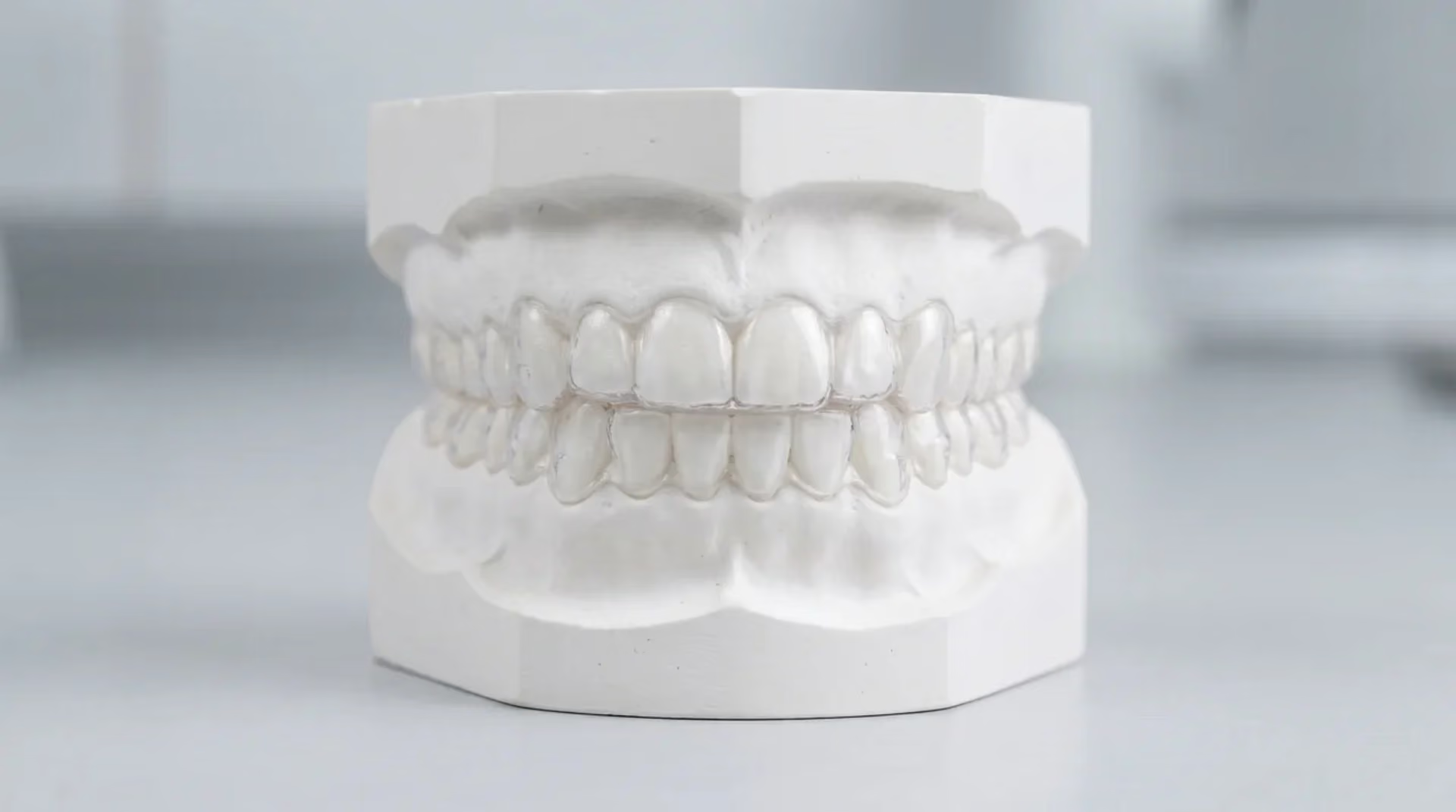
If you want discreet treatment, we discuss which method suits your findings and routine. Attachments or elastics may be noticeable even with clear trays. Speech may feel unfamiliar initially; no fixed adjustment period applies to everyone. Plan wear time, meals and cleaning according to your instructions. Clean trays daily with a soft toothbrush and clear water; avoid strongly abrasive or coloured toothpaste and hot water. Suitable cleaning tablets may be used additionally.
Existing crowns, bridges and implants must be included in planning. An implant cannot be moved orthodontically, and a bridge joins several teeth. Which natural teeth can move and how must therefore be clarified first. If new restorations are already planned, we coordinate the sequence of correction and restorative care.
Whitening or veneers are not an automatic next step after tooth straightening. If you want such changes and they are suitable, we discuss sequence; tooth position is often addressed first. YERIT provides an additional guide to Invisalign for adults.
A survey of 82 adults before aligner treatment describes expectations about effectiveness, duration, costs and long-term results (Nemec et al., 2026). It does not demonstrate actual lifelong effectiveness.
Treatment at the practice
Examination and findings: We examine teeth, bite and gums; X-rays show roots and jawbone. We also assess whether fillings, crowns or implants affect planning.
Planning: Findings and a digital scan form the treatment plan, specifying the suitable appliance, expected duration and any preliminary steps.
Treatment and reviews: According to the Austrian health portal, frequent reviews are needed during tooth movement. Fixed braces are adjusted; with aligners, progress is compared with the plan.
Retention: Afterwards, a retainer supports stabilisation; the wear plan and reviews remain important.
Costs: Your personal cost plan follows examination. Market reference ranges are on our prices overview. The individual plan considers misalignment, appliance, duration and agreed services. The page on braces costs in Vienna explains contributions and insurance.
Ceramic brackets or clear aligners can be discreet at work. Attachments may remain visible; adjustment and speech changes vary. We help you plan wear and cleaning around daily life.

average improvement in tooth alignment (PAR reduction) with fixed braces
According to a meta-analysis of 20 randomised studies involving 1,470 patients (Papageorgiou et al., 2024, European Journal of Orthodontics).
YOUR OPTIONS
TREATMENT OPTIONS COMPARED
We will discuss payment terms with you prior to treatment.
The indicative market prices in our price overview provide an initial guide. We will discuss which services are planned for you and the costs involved based on your examination findings and individual cost plan.
Advanced Dental Aesthetics & Implantology
Priv.Doz.Dr.Dr. K. Yerit
“Aesthetics is not a coincidence, but the result of precise planning and deep passion.”
At Smile4Life, we assess each case individually and discuss which options may be appropriate for you.
View profile →Scientific references
Institute for Implantology and Digital Dentistry Vienna
Deutsche Gesellschaft für Kieferorthopädie (DGKFO)
Österreichische Gesellschaft für Kieferorthopädie (ÖGKFO)
European Orthodontic Society (EOS)
Cochrane Oral Health
Yerit Practice – Dentist Vienna
Frequently asked questions
Frequently asked questions
Do you have a specific question about your diagnosis? Book a consultation appointment directly →
Questions about your treatment?
Discuss what matters to you and what the next steps look like with us.
Book your appointment nowYour orientation
Understanding what’s involved
In everyday life
Ceramic brackets or clear aligners can be discreet at work. Attachments may remain visible; adjustment and speech changes vary. We help you plan wear and cleaning around daily life.
Who this information is for
Important limitations
Our approach
SCIENTIFIC STUDIES
Papageorgiou SN et al. (2024). Occlusal outcome of orthodontic treatment: a systematic review with meta-analyses of randomized trials
A meta-analysis of 20 randomised studies involving 1,470 patients estimates average PAR reduction (Peer Assessment Rating) with fixed braces at 82.6 percent (95% confidence interval 70.8 to 94.4). Variation between studies is very high; the average is not an expectation for an individual case.
39607678
Alhafi ZM et al. (2025). Quality and stability of orthodontic treatment outcomes with clear aligners versus fixed appliances
A meta-analysis of 15 studies with 1,084 patients found no statistically established difference in the quality and duration measures examined between aligners and fixed appliances for non-extraction treatment. Varying studies and short follow-up limit the conclusions; general equivalence is not proven. Extraction cases showed a quality advantage for fixed appliances.
41127933
Johal A et al. (2025). Oral Health-Related Quality of Life, Pain and Side Effects in Adults Undergoing Different Orthodontic Treatment Modalities
A systematic review and meta-analysis finds no difference in short-term pain between adult aligner and fixed-brace treatment. Aligners may nevertheless be associated with less impairment of oral health-related quality of life.
41464384
Al Shammary NH (2024). Enhancing Orthodontic Renewal and Retention Techniques: A Systematic Review
The review addresses quality of life and psychosocial aspects of orthodontic treatment and retention. It describes favourable psychological changes after treatment and possible appliance-related burdens during wear. It does not establish a universally optimal retainer type, wear duration or replacement interval.
38659711
Aye ST et al. (2023). The prevalence of the failure of fixed orthodontic bonded retainers: a systematic review and meta-analysis
A meta-analysis of 34 studies involving 3,484 participants estimates overall fixed-retainer failure at around 35 percent, increasing markedly with follow-up from around 24 percent short term to around 54 percent long term. The authors rate evidence quality as low; no meaningful difference between bonding methods was found.
37824794
Herrera D et al. (2022). Treatment of stage IV periodontitis: The EFP S3 level clinical practice guideline
The European Federation of Periodontology S3 guideline for stage IV periodontitis includes orthodontic tooth movement among measures following completion of active periodontal therapy. Comprehensive diagnosis comes before planning, with frequent reviews during and after treatment (J Clin Periodontol 2022;49 Suppl 24:4–71, DOI 10.1111/jcpe.13639).
35688447

Digitally planned, carefully carried out
Digital planning describes the intended tooth movements. Reviews check how the teeth actually respond; the plan is adjusted when necessary.
More topics in this area
Deepen your knowledge – find all information regarding the treatment process, costs, and results.



Kärntner Straße 9
100 meters from Stephansplatz, Innere Stadt.


Partnerships & Memberships & References




