
Retainer Types in Vienna: Fixed Wire or Removable Tray?
Fixed wire or removable tray? Understanding differences in cleaning and wear helps you assess the recommendation for your teeth.
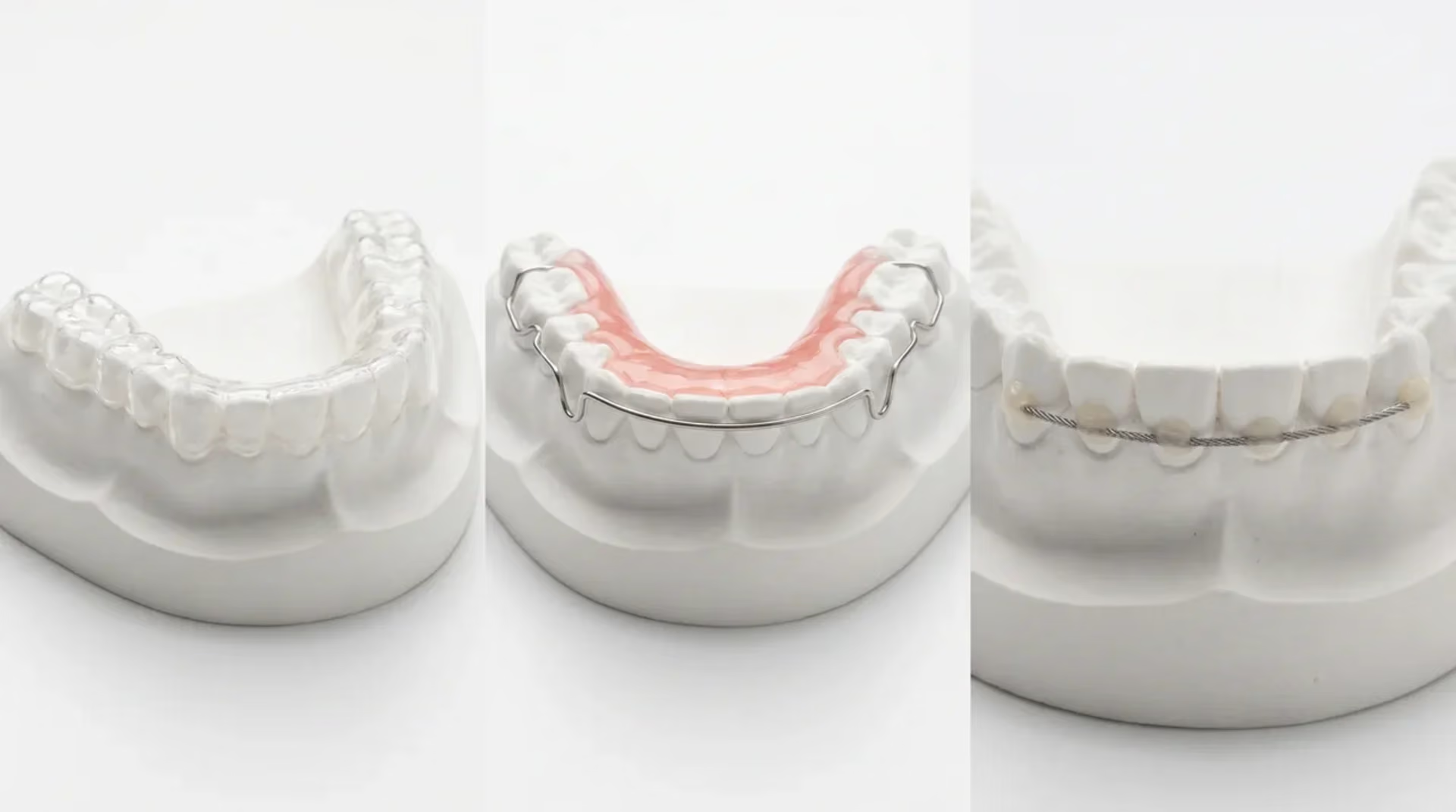
Wire behind the teeth
Removable tray
Differences explained
Chosen for your findings
Retainer Types Vienna
retainer-arten-wien
4.9★
Doctify rating
25+
Years of experience
Personal
In-practice consultation
1010 Vienna
Kärntner Straße 9
At a glance
Which types of retainers are available?
Fixed: a thin wire bonded behind the front teeth. Removable: clear plastic trays or Hawley retainers made from acrylic and wire. They are sometimes combined; a Cochrane review compared options in 47 studies.*
How long does a retainer wire last?
There is no fixed lifespan. A meta-analysis of 34 studies found that around one in three bonded retainers loosened or broke, rising to around one in two with long follow-up.* Regular checks help identify problems early.
Is a fixed or removable retainer better?
Neither is universally better. In one short study in the Cochrane review, full-time removable trays had more technical failures. These include breakage, loss or poor fit; a removable tray is not bonded. Evidence certainty is low and active aligner treatment was excluded. Bonded wires work without daily insertion; your findings remain decisive.*
Does a fixed retainer interfere with eating or speaking?
Usually very little: the wire sits behind the front teeth and remains during meals. In the Cochrane review, removable trays caused discomfort more often than bonded wires. Have a wire checked if it pokes or feels loose.*

Retainer types: what options are there?
Fixed and removable retainers may be used after tooth correction. Removable types include clear plastic trays and Hawley retainers with an acrylic base and wire. Their construction and handling differ.
Design alone does not determine suitability. Starting tooth position, bite and everyday life all matter. The page on retainers in Vienna explains the full path after braces. YERIT describes the types in its guide retainer types at a glance.
Fixed retainers: everyday advantages and disadvantages
A thin wire is bonded behind the front teeth. You do not need to insert it daily, but it still needs care: deposits can collect around the wire and bonding sites. Suitable floss or interdental brushes help; have their use demonstrated.
The wire may loosen or break. Reviews therefore matter even without pain. Contact us promptly if a bonding site loosens. How many teeth are included and whether a retainer fits the upper or lower jaw depend on findings.
Removable retainers: clear trays and Hawley
A clear retainer tray covers the teeth of the treated jaw and can be removed for eating and cleaning. The term Essix retainer is often used. Unlike an active aligner, it is intended to stabilise the existing position.
A Hawley retainer consists of an acrylic base and wire. It is also removable. Its visible wire and feel in the mouth differ from a clear tray. Which design is an option depends on the planned care.
For both, follow your individual instructions. A fixed number of hours is not a universal rule for every retention phase. Ask before reducing wear time.
Fixed wire or removable retainer: differences at a glance
| Question | Fixed wire | Removable retainer |
|---|---|---|
| How is it worn? | Remains bonded to the teeth | According to an individual wear plan |
| What matters for cleaning? | Cleaning around wire and bonding sites | Remove and clean the retainer separately |
| What can cause problems? | Loose bonds or a broken wire | Loss, wear or poor fit |
| How long does it last? | No fixed lifespan is promised | Replacement depends on condition and fit |
Which retainer is better for you?
The 2023 Cochrane review does not establish a fixed ranking of retention methods. The review by Husain and colleagues comparing clear trays and bonded wires also rates evidence certainty as very low. This does not guarantee that the types are equally appropriate for every person.
Discuss whether you can clean the retainer effectively, reliably wear a removable device, and whether a wire suits your bite. Ask how its condition and tooth position will be monitored. A combination is sometimes recommended, but not according to a fixed “lower wire, upper tray” rule.
What does a retainer cost?
Compare the planned scope: one or both jaws, manufacture, fitting, reviews and possible replacement. A claimed lifespan does not turn a higher purchase price into a lower annual cost.
Read more under retainer costs and cost planning. Design should be chosen according to clinical findings.
Wear time and cleaning: what should you plan for?
Fixed and removable retainers support long-term stabilisation after orthodontic treatment. Discuss wear duration with your dentist or orthodontist. A removable retainer helps only while worn; a fixed retainer still needs regular review despite being bonded.
Clean a removable retainer according to your instructions, for example gently with a toothbrush and cool water. Additional cleaning products must suit the material. For a wire behind the teeth, reaching around bonding sites matters. Ask for a practical demonstration.
Mention discomfort too. Pressure or altered speech may occur with a new device. A retainer that causes discomfort or fits poorly needs checking. No fixed adjustment period can be promised for everyone.
Help maintain the tooth position you worked towards.
YOUR OPTIONS
TREATMENT OPTIONS COMPARED
We will discuss payment terms with you prior to treatment.
The indicative market prices in our price overview provide an initial guide. We will discuss which services are planned for you and the costs involved based on your examination findings and individual cost plan.
Advanced Dental Aesthetics & Implantology
Priv.Doz.Dr.Dr. K. Yerit
“Aesthetics is not a coincidence, but the result of precise planning and deep passion.”
There is no single right retainer for everyone — the choice depends on tooth position, your jaw and everyday life.
View profile →Scientific references
Institute for Implantology and Digital Dentistry Vienna
Deutsche Gesellschaft für Kieferorthopädie (DGKFO)
Österreichische Gesellschaft für Kieferorthopädie (ÖGKFO)
European Orthodontic Society (EOS)
Cochrane Oral Health
Yerit Practice – Dentist Vienna
Frequently asked questions
Frequently asked questions
Do you have a specific question about your diagnosis? Book a consultation appointment directly →
Questions about your treatment?
Discuss what matters to you and what the next steps look like with us.
Book your appointment nowYour orientation
Understanding what’s involved
In everyday life
Who this information is for
Important limitations
Our approach
SCIENTIFIC STUDIES
Martin C et al. (2023). Retention procedures for stabilising tooth position after treatment with orthodontic braces
The Cochrane review compares retention methods after braces. Evidence is low to very low, and firm conclusions favouring one approach are not possible. Aligner studies were excluded.
37219527
Husain S et al. (2022). Vacuum-Formed Retainers Versus Lingual-Bonded Retainers: A Systematic Review and Meta-Analysis
The review comparing clear trays and bonded wires rates evidence certainty as very low. Several stability measures did not differ statistically significantly. This does not establish general equivalence for every clinical situation.
36594552
Bardideh E et al. (2023). CAD/CAM-based fixed retainers versus conventional fixed retainers: systematic review and network meta-analysis
A network meta-analysis of seven randomised trials considers CAD/CAM nickel–titanium retainers a promising short-term alternative, supported chiefly by lower plaque index. Evidence on long-term durability and failure is lacking, so the authors recommend individual decisions.
37471113
Adanur-Atmaca R et al. (2021). Effects of different lingual retainers on periodontal health and stability
A randomised trial involving 132 patients found the lowest gingival and tartar scores with CAD/CAM nitinol retainers, with a significant tartar difference from two comparison groups and at least comparable stability. After one year, however, none of the four groups showed clinically meaningful periodontal deterioration or relapse.
33587126
Aye ST et al. (2023). The prevalence of the failure of fixed orthodontic bonded retainers: a systematic review and meta-analysis
A meta-analysis of 34 studies involving 3,484 participants estimates overall fixed-retainer failure at around 35 percent, increasing markedly with follow-up from around 24 percent short term to around 54 percent long term. The authors rate evidence quality as low; no meaningful difference between bonding methods was found.
37824794
More topics in this area
Deepen your knowledge – find all information regarding the treatment process, costs, and results.


Kärntner Straße 9
100 meters from Stephansplatz, Innere Stadt.

Partnerships & Memberships & References




