Maryland Bridges in Vienna: Preserve Neighbouring Teeth
A bonded bridge can provide a fixed restoration for a small tooth gap. Whether it can be retained well in your case depends particularly on the neighbouring tooth and your bite.
Restore a tooth gap
Assess neighbouring teeth
Compare options
Consider ongoing care
Maryland Bridges Vienna
maryland-bruecke-wien
4.9★
Doctify rating
25+
Years of experience
Personal
In-practice consultation
1010 Vienna
Kärntner Straße 9
At a glance
How does a Maryland bridge work, and what are its limitations?
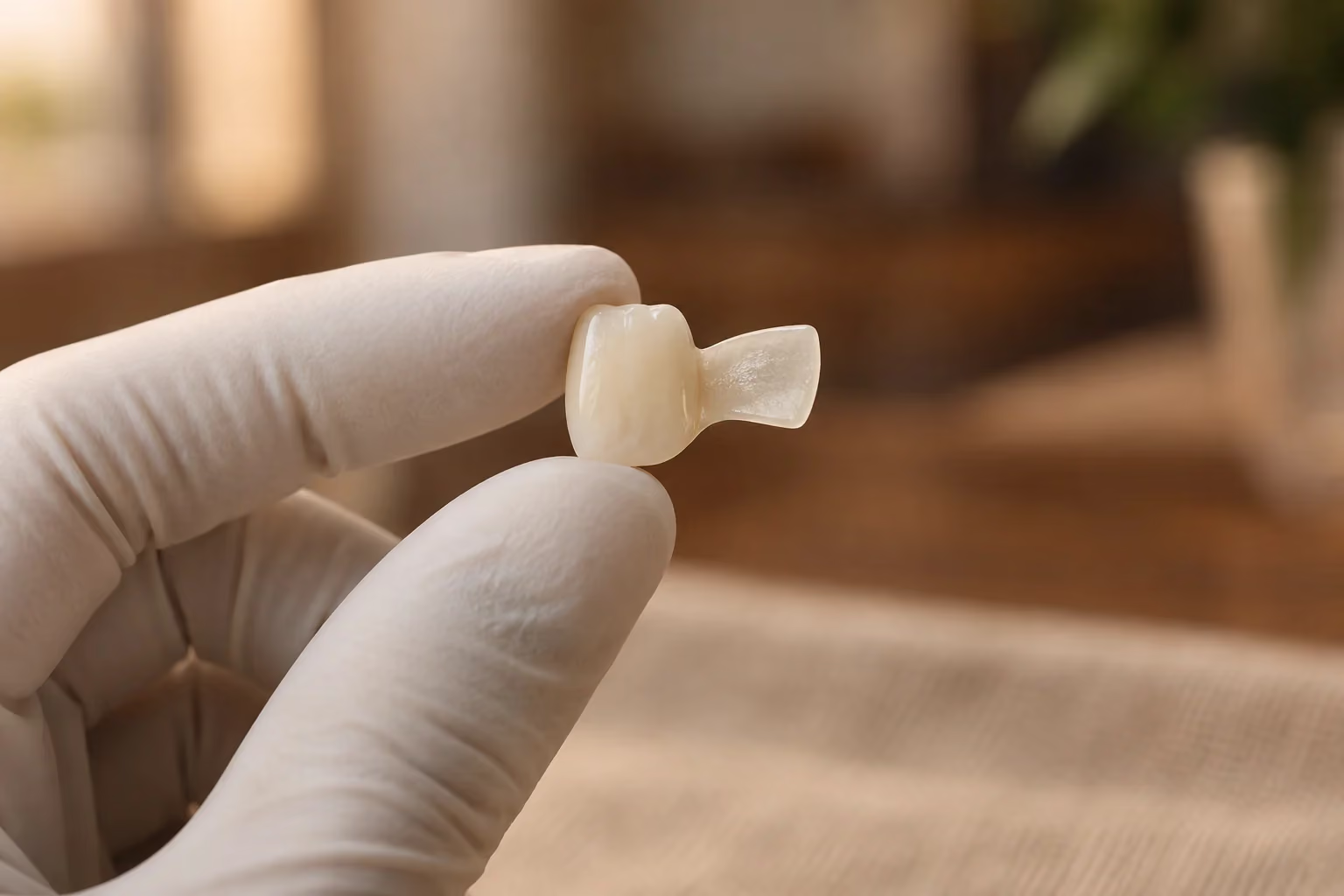
A Maryland bridge replaces a missing tooth and is usually attached to the back of a suitable neighbouring tooth with a bonding wing.
The most common problem is debonding: in a review of 2,300 bonded bridges, around one in seven debonded within five years.* It also does not suit every gap or bite. An intact bridge that has debonded can often be reattached.
How many appointments does a Maryland bridge need?
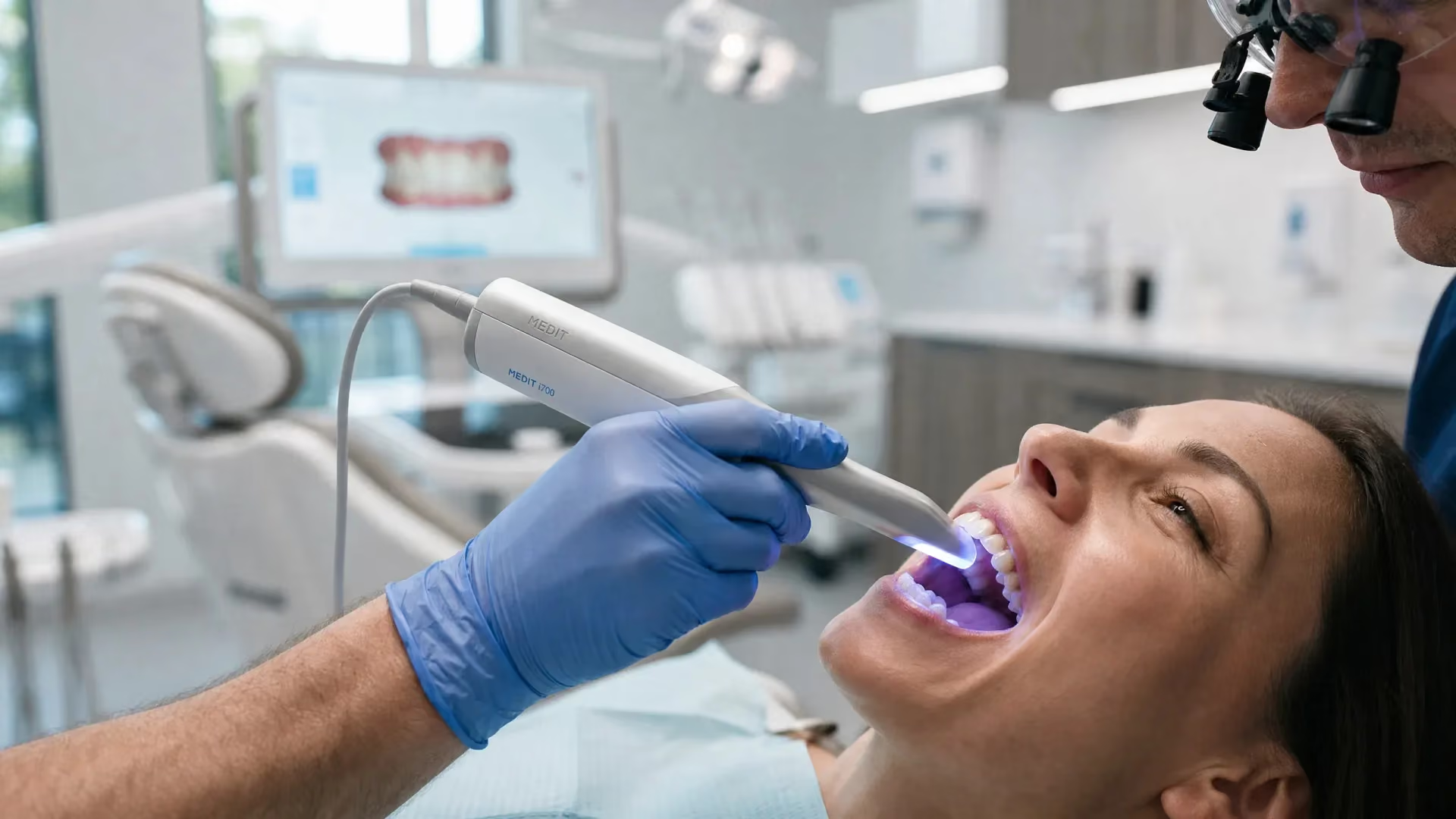
Usually only a few. Examination and planning come first, followed by preparation of the bonding surfaces and an impression or scan of the gap. After laboratory fabrication, the bridge is fitted and bonded. The number of appointments in your case depends on the findings.
When do we recommend a conventional bridge rather than a bonded bridge?
Particularly when the neighbouring teeth already have large fillings or need crowns. A crown-supported bridge may also be more appropriate if too little healthy enamel remains for the wing, the gap is too large or the bite puts heavy strain on the bond. We assess your clinical findings and bite to clarify what suits the gap.
Can a Maryland bridge be removed again?
Yes, but only at the practice; you cannot remove it yourself. Depending on the bond, it may need to be detached or cut through. If it has come off by itself, keep it: an intact bridge can often be bonded back in place.
How a Maryland bridge is attached
A Maryland bridge attaches the replacement tooth to a suitable neighbouring tooth by means of a wing. It is usually bonded to the back of that tooth. This differs from a conventional bridge, whose supporting teeth are crowned. Different materials and designs are available.
A single-wing design uses one supporting tooth. More wings do not automatically mean greater security: differences in tooth movement can put strain on the bond. The appropriate design is planned for the particular gap.
Who may be suitable?
A bonded bridge may be an option, particularly for a small gap with a neighbouring tooth that is sound enough to support it and has few existing restorations. It requires enough suitable outer tooth structure for bonding and room for the wing. Contacts during chewing and jaw movements also matter.
A large filling, an unfavourable tooth position or heavy loading may make selection more difficult. A Maryland bridge is therefore not a universal alternative to an implant. Conditions at the front of the mouth often differ from those for a gap among the back teeth.
Does the tooth need to be reduced?
The aim is to retain as much healthy tooth structure as possible. Some preparation may be necessary depending on the starting situation, material and design. “Without tooth reduction” should therefore not be taken as a firm promise. The professional society guidance on resin-bonded bridges describes this assessment.
A bonded bridge may be planned as a longer-term restoration or for an interim period. The appropriate goal depends on the situation. Any necessary implant planning remains a separate matter.
How long does a bonded bridge last?
Durability depends in part on the material, design, bonding and loading. A review of different bonded bridges reports frequent technical complications, particularly debonding. Study on PubMed.
A study of fibre-reinforced composite bridges reported a five-year rate of around 80 percent. It describes the designs studied and is not a general prognosis for every Maryland bridge. Study on PubMed. “Still functioning” also does not mean that no repair was ever needed.
Care and what to do if the bridge feels loose
Clean underneath the replacement tooth and around the wing as well. Suitable cleaning aids and how to use them should be demonstrated. Ordinary toothbrushing alone does not reach every part of the design.
If the bridge feels loose, your bite changes or you develop symptoms, have it checked. A partially debonded wing can go unnoticed. Whether reattachment is possible depends on the cause and the condition of the teeth and bridge. Do not glue it back yourself.
Maryland bridge costs in Vienna and alternatives
The cost of a Maryland bridge depends in part on its material, design and required preparation. The cost plan identifies the intended services. You can find initial guidance on the prices page. The average market prices listed there are non-binding market guide prices; a firm figure can only be determined after an examination. Your personal treatment costs are then clarified in an individual cost plan. The choice can be compared with a conventional dental bridge or a restoration on a single-tooth implant. ÖGK generally provides no subsidy for fixed restorations such as crowns and bridges. Exceptions apply in particular medical cases and require approval. Clarify any possible entitlement with your insurer before treatment begins. The ÖGK information on dental prostheses explains the requirements.
Maryland bridge, adhesive bridge and bonded bridge: the terminology
A Maryland bridge is also called an adhesive bridge or resin-bonded bridge; these terms describe the same minimally invasive, tooth-preserving type of restoration. It may have a single-wing or two-wing design: a two-wing version has a ceramic or all-ceramic framework supported by both neighbouring teeth, whereas a single-wing version uses only one supporting tooth. The dental examination determines which design suits the particular gap.
This type of bridge is particularly sought for front teeth and gaps at the front of the mouth because its bonding surface attaches to the enamel of the neighbouring teeth instead of requiring larger amounts of tooth structure to be removed for conventional crowns. This can keep the extent of restoration limited without unnecessarily burdening healthy teeth. YERIT provides a more detailed overview in its guide to the Maryland bridge.
YOUR OPTIONS
TREATMENT OPTIONS COMPARED
We will discuss payment terms with you prior to treatment.
The indicative market prices in our price overview provide an initial guide. We will discuss which services are planned for you and the costs involved based on your examination findings and individual cost plan.
Advanced Dental Aesthetics & Implantology
Priv.Doz.Dr.Dr. K. Yerit
“Aesthetics is not a coincidence, but the result of precise planning and deep passion.”
For a suitable tooth gap, a Maryland bridge can preserve tooth structure. The bonding surface on the neighbouring tooth and the bite are among the deciding factors.
View profile →Scientific references
Institute for Implantology and Digital Dentistry Vienna
Österreichische Gesellschaft für Zahn-, Mund- und Kieferheilkunde (ÖGZMK)
Deutsche Gesellschaft für Zahnärztliche Prothetik
European Prosthodontic Association (EPA)
Academy of Prosthodontics
Yerit Practice – Dentist Vienna
Frequently asked questions
Frequently asked questions
Do you have a specific question about your diagnosis? Book a consultation appointment directly →
Questions about your treatment?
Discuss what matters to you and what the next steps look like with us.
Book your appointment nowYour orientation
Planned for the long term, with regular care and check-ups.
Understanding what’s involved
Appointments and treatment requirements depend on your examination findings and the chosen procedure.
In everyday life
Who this information is for
For a tooth gap with suitable supporting neighbouring teeth and an appropriate bite.
Important limitations
A restoration needs suitable supporting teeth and an appropriate bite. Disease and potentially less invasive alternatives are assessed beforehand.
Our approach
The restoration is planned around your examination findings. Options, limitations and any preliminary treatment all form part of the decision.
SCIENTIFIC STUDIES
The restoration is planned around your examination findings. Options, limitations and any preliminary treatment all form part of the decision.
Thoma et al. (2017)
Resin-bonded bridges can function long term. Debonding or repair remains possible. In the review, single-wing resin-bonded bridges showed more favourable results than those with several retaining wings. Heterogeneous observational studies; group values are not an individual longevity promise. The findings do not apply to conventional bridges.
28191679
Romandini P et al. (2026)
A systematic review of 41 studies on tooth-supported multi-unit bridges. Estimated five-year survival was 91.3 percent for metal-ceramic and 92.9 percent for veneered zirconia; other material groups achieved 82.5 to 88.4 percent. Overall, 71 percent were free of complications after five years. These group results are not an individual lifespan guarantee and do not apply to removable dentures.
41650383
More topics in this area
Deepen your knowledge – find all information regarding the treatment process, costs, and results.




Kärntner Straße 9
100 meters from Stephansplatz, Innere Stadt.

Partnerships & Memberships & References