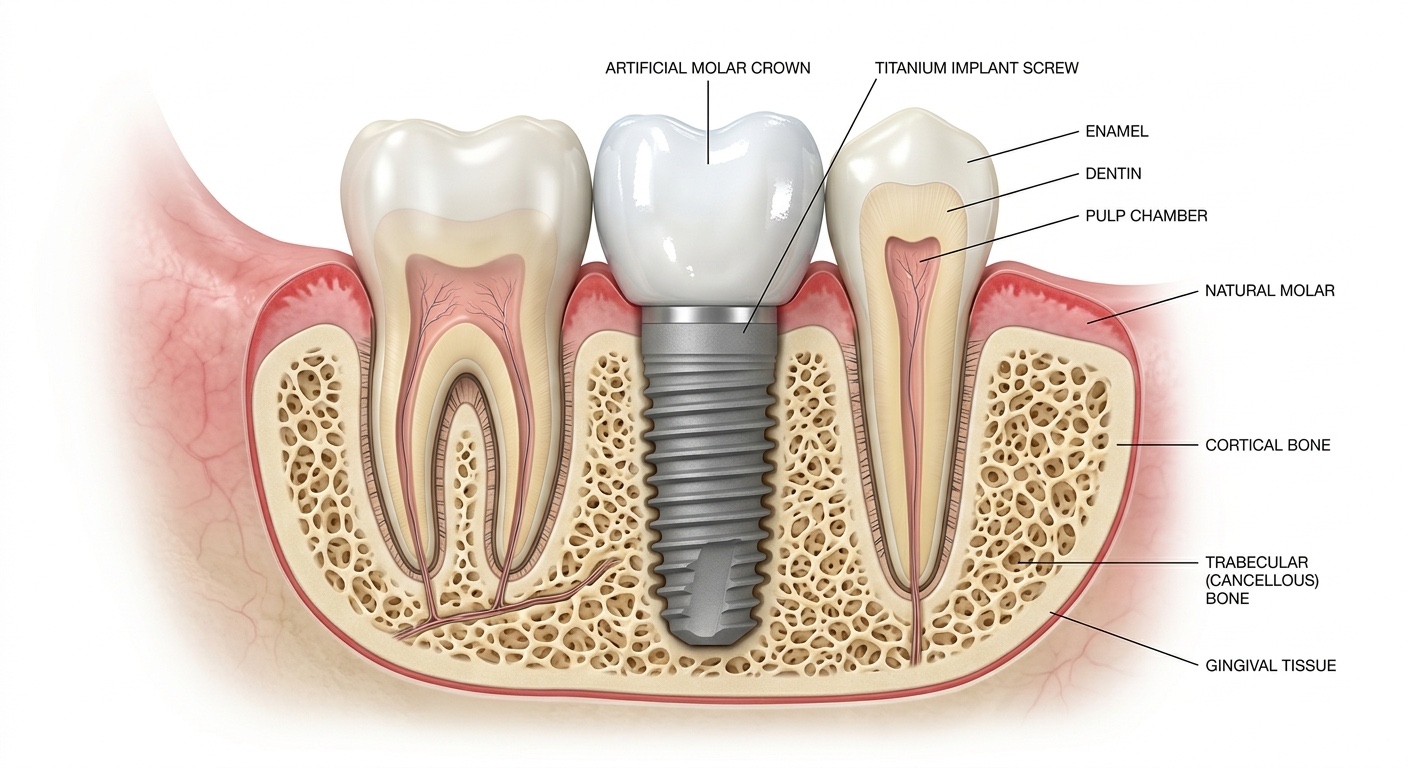

A missing tooth may affect chewing, speech and appearance. Your dentist may have discussed two common replacement options, an implant or a bridge. Which may suit your gap?
Both approaches have advantages and limitations, and the choice depends on your situation. This article explains how they differ, long-term costs and points to discuss before deciding.
What Is the Difference Between an Implant and a Bridge?
Understanding how each option works helps you make an informed decision.
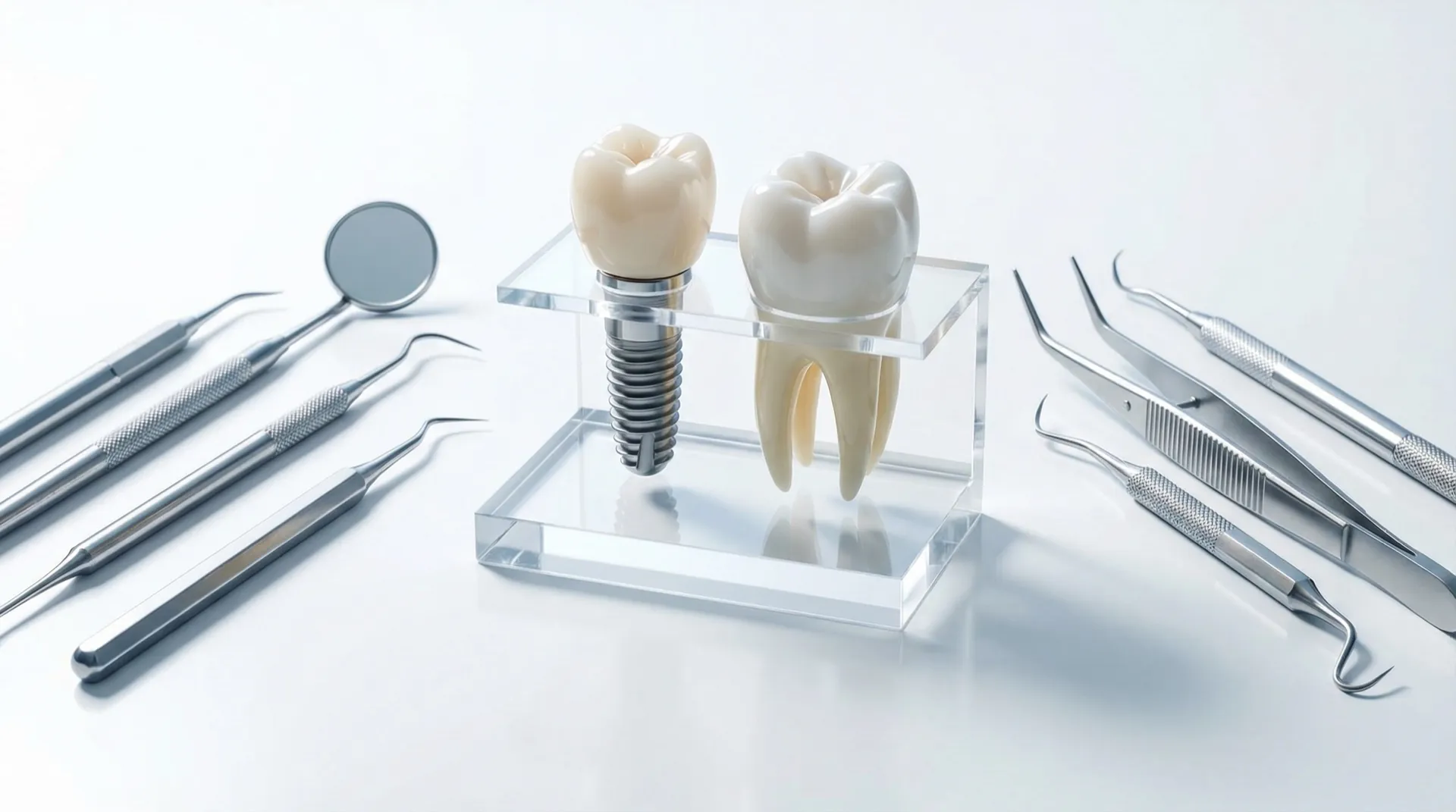
A dental implant is an artificial root made from titanium or ceramic, placed directly in the jawbone. During a healing phase of several months, it integrates with the bone. A crown is then attached to replace the visible tooth and its function.
A conventional dental bridge is supported by neighbouring teeth, which are usually reduced and fitted with crowns. A bridge unit between them replaces the missing tooth. Adhesive bridges are another option, with different requirements and bonding methods.
The central difference is that an implant supports itself without using neighbouring teeth as supports. A conventional bridge uses neighbouring teeth, which are altered for that purpose.
Advantages and Limitations of Implants
Implants are a high-quality tooth-replacement option, but have strengths and limitations.
Possible advantages:
- Neighbouring teeth do not require reduction
- The implant transfers chewing forces to bone, but does not prevent every bone change
- With good care, the restoration may last many years
- Chewing can feel close to a natural tooth
- The restoration can blend with natural teeth
- It can be cared for much like a natural tooth
Limitations:
- Placement involves minor surgery
- Treatment takes several months, including healing
- Costs are higher than for a bridge
- There may be insufficient bone, sometimes requiring grafting
- Certain medical conditions may rule out an implant
When May Implants Be the Preferred Option? Implants are particularly relevant if neighbouring teeth are healthy and unfilled, you want a long-term replacement and sufficient jawbone is available.
Advantages and Limitations of Bridges
Bridges have been used for decades, with their own strengths and limitations.
Possible advantages:
- Quicker treatment, usually 2–3 weeks
- No surgery required
- Lower cost than implants
- Possible even with limited jawbone
- Under ÖGK, bridges are generally private services; specific approval rules apply to medically justified exceptions
Limitations:
- Healthy neighbouring teeth require reduction
- These teeth become more vulnerable to decay and other problems
- Bone beneath the gap gradually recedes
- Longevity depends on supporting teeth, design and care, among other factors
- Problems may require replacement of the whole bridge
When May a Bridge Be More Suitable? A bridge may be appropriate if neighbouring teeth already need large fillings or crowns, a quicker option is required, budget is limited or health reasons weigh against surgery.
How Do Implant and Bridge Costs Compare?
Cost depends on the findings, material and services included. You receive a personal cost plan after examination and before treatment. Typical market guides can help with orientation but do not replace this individual plan.
Average Vienna market prices on our prices page provide initial guidance. An implant generally requires more initial expenditure than a bridge because surgery and usually more appointments are involved.
Cost alone should not determine the decision. For both options, long-term costs also depend on care, checks and possible repairs or replacement. Disease in a bridge’s supporting tooth may require a new bridge; an implant or its crown may also need further treatment. Clarify any insurance contribution directly with your insurer based on your findings; your personal cost plan follows examination at our practice.
What Happens to the Jawbone?
An important, sometimes overlooked factor is the effect on bone.
When a tooth is missing, its loading of the local bone is missing too. Without that stimulation, bone gradually recedes. This is a natural process after tooth loss.
A bridge does not stop this. It rests above the gums while the underlying bone receives no direct loading. Bone may thin over the years and complicate later implant placement. In some cases, bone grafting is then needed before an implant can be placed.
An implant acts as an artificial tooth root, transferring chewing forces directly to bone. Loading may help maintain it, but bone changes and inflammatory loss remain possible. An implant does not guarantee that all bone loss stops.
For younger patients, the long-term effect on bone is particularly relevant. Preserving it may help avoid later problems.
Contents

Your dental consultation in Vienna
Discuss which treatment may suit your teeth and clinical findings.
Learn morezahnimplantate-wien