
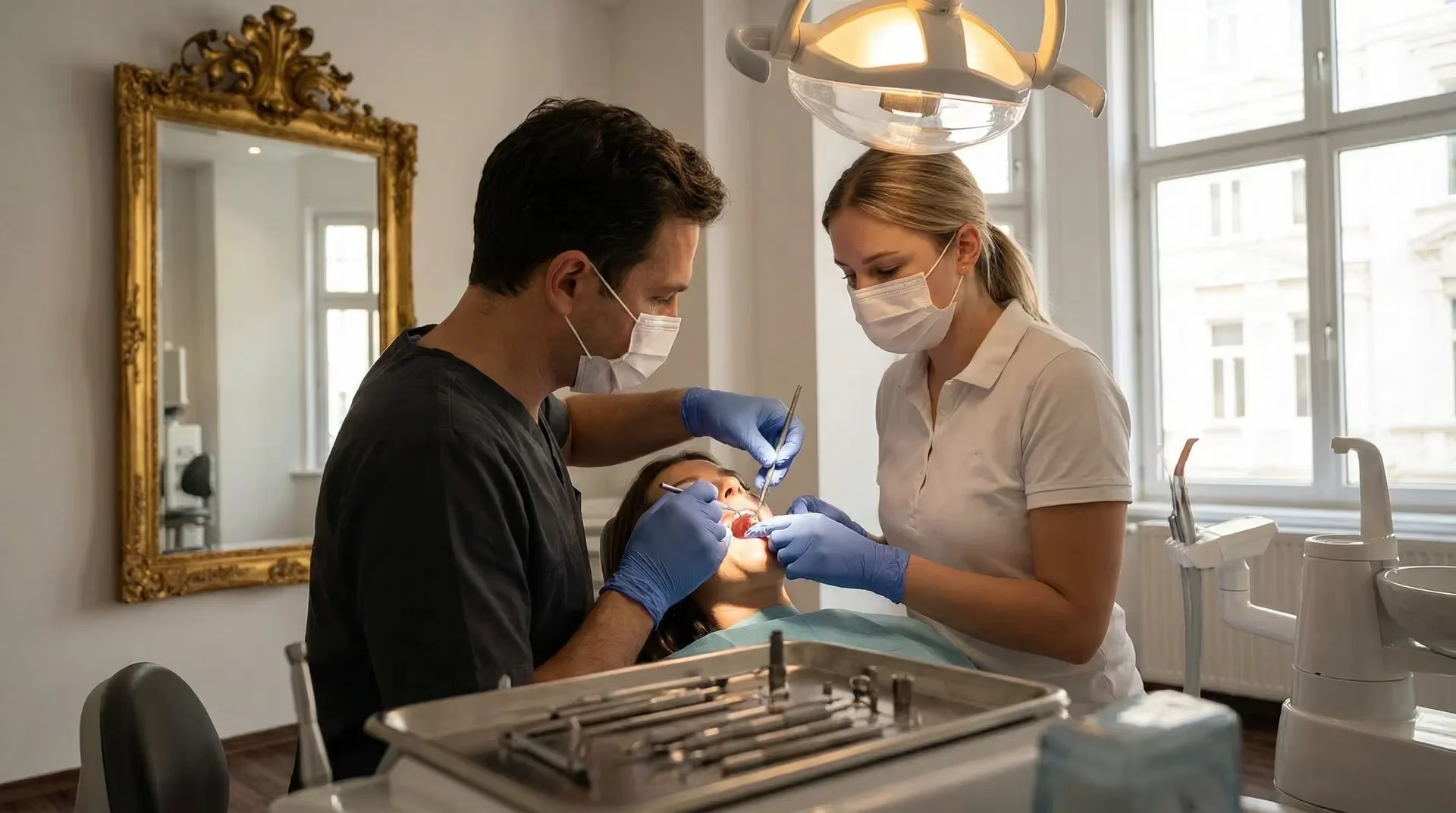
Dental Emergency in Vienna: Where to Go with Toothache?
For difficulty breathing, impaired consciousness or rapidly increasing swelling in the floor of the mouth or neck: call 144 immediately. For urgent dental symptoms, contact an available dental practice or the current emergency dental service.
Recognise urgency
Find emergency services
Assess a dental injury
Call the practice
Emergency Dentist Vienna
zahnarzt-notfall-wien
4.9★
Doctify rating
25+
Years of experience
Personal
In-practice consultation
1010 Vienna
Kärntner Straße 9
At a glance
Where should I go with acute toothache in Vienna?
During practice hours, first call your own dental practice and describe your symptoms. On Saturdays, Sundays and public holidays, the University Clinic of Dentistry Vienna's emergency outpatient clinic is open from 8 to 12, including for injuries.*
Where should I go with extreme toothache at night?
The Vienna Dental Chamber's emergency service search and +43 1 512 20 78 provide current information on practices on duty; check the specified date and time.* If you have difficulty breathing, difficulty swallowing or rapidly increasing swelling, call the emergency number 144 immediately.
Is a dental infection an emergency?
Swelling, fever or pus makes it urgent: seek prompt dental assessment. For difficulty breathing, impaired consciousness, rapidly increasing swelling in the floor of the mouth or neck, or dangerous swallowing difficulties, call 144 immediately.*
Assess urgency first, then decide the next steps
First establish how urgent it is
If a tooth has been knocked out or swelling is increasing rapidly, do not wait for a callback: contact an available emergency service.
Then discuss appropriate help
Examination establishes which treatment addresses the cause. Emergency care and further steps depend on the clinical findings.
Emergency dentist in Vienna: what help do you need now?
If you have difficulty breathing, impaired consciousness or rapidly increasing swelling in the floor of the mouth or neck, call 144 immediately. Difficulty swallowing together with swelling can also be dangerous: call 144 rather than waiting for a dental appointment. Fever or markedly restricted mouth opening with dental symptoms requires urgent assessment. If you are unsure whether you face a medical emergency, 144 can also help.
Persistent severe toothache, new swelling, pus or a dental injury should be assessed promptly by a dentist. A knocked-out permanent tooth is particularly time-sensitive. Persistent bleeding after a procedure also requires professional help; call 144 for heavy bleeding or circulatory problems.
Toothache, dental injury or an abscess?
With toothache, the first step is to identify the cause. Pain severity alone does not show which treatment is needed. If a crown or filling falls out and the tooth hurts, mention this when calling.
After a dental injury, even a tooth that appears firmly in place may be damaged. Handle a knocked-out tooth only by its crown, keep it moist and seek help immediately. Do not reinsert a baby tooth.
Painful swelling or pus may indicate a dental abscess. Do not squeeze or open the area yourself. Breathing or swallowing difficulties make the situation particularly urgent.
Emergency dental services in Vienna: at night and at weekends
Our practice hours are Monday, Tuesday, Thursday and Friday 09–17 and Wednesday 09–19; the practice is closed at weekends. Visits are by appointment. Smile4Life is not a 24-hour emergency service. Call Smile4Life on +43 1 410 13 52 and describe your symptoms. This helps establish whether and when care is possible at the practice. If a tooth has been knocked out or swelling is increasing rapidly, do not wait for a callback: contact an available emergency service.
If no dental practice can be reached, find current emergency dental services in Vienna through the Dental Chamber's emergency service search or on +43 1 512 20 78. The health advice service 1450 assists with health questions; in an emergency, it does not replace the ambulance service on 144.
The University Clinic of Dentistry Vienna lists the following hours for its emergency outpatient clinic with trauma care: Monday to Friday 08–14 and weekends and public holidays 08–12 (clinic information accessed on 15.11.2026). Registration is at Central Admissions: Monday to Friday from 07:30 and weekends and public holidays from 07:45, until the respective treatment hours end; telephone +43 1 40070-2001. The clinic is at Sensengasse 2a, 1090 Vienna. Check the clinic website for current changes before travelling. These registration and treatment hours belong to the University Clinic of Dentistry and are not Smile4Life's opening hours. The YERIT guide explains urgency and appropriate action in a dental emergency: Dental emergencies: urgency and appropriate action.
What the appointment establishes
Examination establishes the cause of your symptoms and the measures needed. Depending on the findings, tooth tests and appropriate X-rays may help. A three-dimensional scan is not automatically necessary. Emergency care and treatment of the cause may take place in the same appointment or in several steps.
Painkillers may help bridge the time until treatment. Which medicine is suitable for you depends, among other things, on existing conditions, other medicines, allergies and possible pregnancy. Ask your dental practice or pharmacy and follow the package leaflet. Different rules apply to children. Do not combine medicines on your own or place a painkiller tablet directly on a tooth or gum.
An antibiotic does not remove the cause in the tooth. For many localised problems, dental treatment is the priority. Whether an antibiotic is also needed depends on the spread of infection, your general health and whether immediate treatment is possible. Fever is not the only basis for this decision. Do not take leftover antibiotics on your own.
Have your medication list and information about allergies, existing conditions and previous procedures ready. After an accident, the time, circumstances and how the tooth has been stored are important. Do not stop prescribed medicines, particularly blood thinners, on your own.
Our pricing page provides average market prices as a non-binding guide. The costs of your treatment are established after examination in an individual cost plan. A guide price is not a personal quotation.
YOUR CONCERNS
What is on your mind?
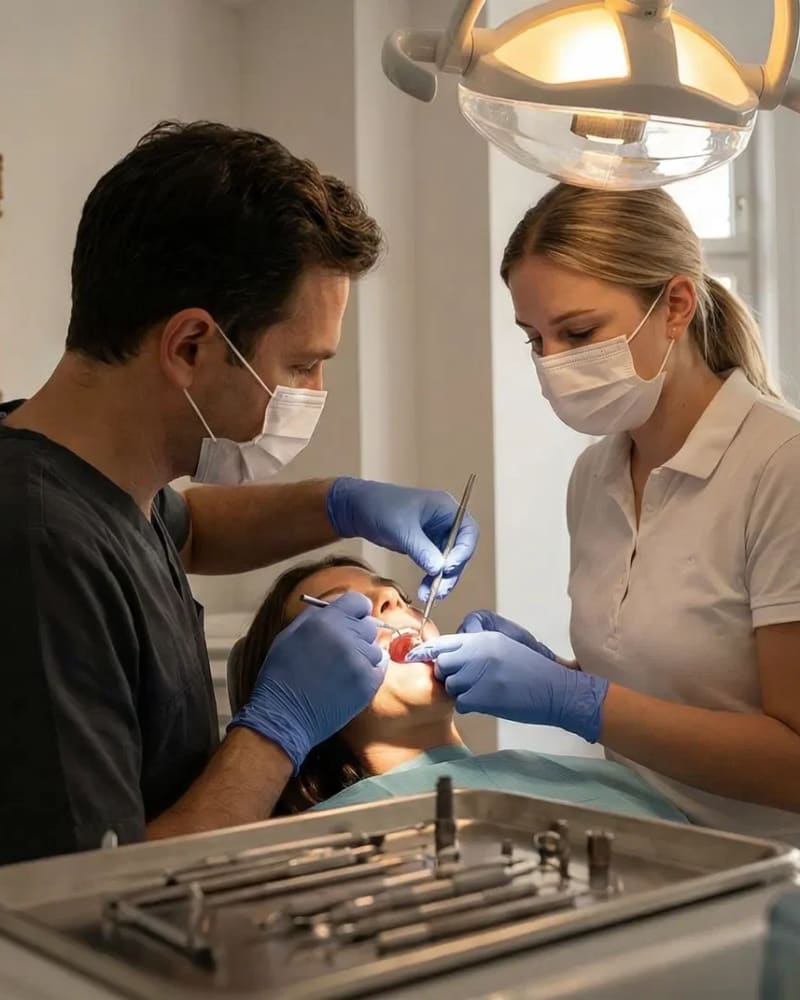
Dental injury
Swelling or pus
SUITABILITY CHECK
Is this treatment right for you?
YOUR OPTIONS
TREATMENT OPTIONS COMPARED
We will discuss payment terms with you prior to treatment.
The indicative market prices in our price overview provide an initial guide. We will discuss which services are planned for you and the costs involved based on your examination findings and individual cost plan.
Advanced Dental Aesthetics & Implantology
Priv.Doz.Dr.Dr. K. Yerit
“Aesthetics is not a coincidence, but the result of precise planning and deep passion.”
In an emergency, the most important decision is not what to give, but what to examine first. A painkiller without assessment merely postpones the problem for a few hours.
View profile →Scientific references
Institute for Implantology and Digital Dentistry Vienna
Medizinische Universität Wien
International Association of Dental Traumatology (IADT)
Österreichische Gesellschaft für Mund-, Kiefer- und Gesichtschirurgie (ÖGMKG)
Österreichische Zahnärztekammer
Yerit Practice – Dentist Vienna
Excellence
Why Smile4Life
Contact us directly
Call to establish what care is possible.
Describe symptoms clearly
Onset, progression, swelling and accident details help assessment.
Discuss further steps
Treatment and follow-up depend on your clinical findings.
Frequently asked questions
Frequently asked questions
Do you have a specific question about your diagnosis? Book a consultation appointment directly →
Questions about your treatment?
Discuss what matters to you and what the next steps look like with us.
Book your appointment nowYour orientation
Next steps depend on your symptoms and clinical findings.
Understanding what’s involved
Examination, appropriate initial care and, where needed, further appointments and follow-up.
In everyday life
Have your medication list and important previous findings ready. Seek help again if symptoms worsen.
Who this information is for
For people with acute dental symptoms, swelling or a dental injury who need prompt dental assessment.
Important limitations
If you have difficulty breathing, impaired consciousness or rapidly increasing swelling in the floor of the mouth or neck, call 144 immediately. Difficulty swallowing together with swelling can also be dangerous: call 144 rather than waiting for a dental appointment. Fever or markedly restricted mouth opening with dental symptoms requires urgent assessment. If you are unsure whether you face a medical emergency, 144 can also help.
Our approach
A clear assessment helps you discuss the next steps. Treatment choice depends on the cause, urgency and individual circumstances. Medicines do not replace treatment of the cause.
SCIENTIFIC STUDIES
A clear assessment helps you discuss the next steps. Treatment choice depends on the cause, urgency and individual circumstances. Medicines do not replace treatment of the cause.
Green VG et al. (2024). Evidence-based clinical practice guidelines for the management of acute dental pain
This summary applies the acute dental pain guideline to emergency departments and settings without immediately available dental treatment. It begins by quantifying dental emergencies: in the USA, someone attends an emergency department for a dental concern every 15 seconds on average. Its 18 recommendations and six practice statements retain the original guideline's hierarchy — NSAIDs with or without paracetamol first, opioids only as a secondary option — with a warning not to delay subsequent dental treatment (American Journal of Emergency Medicine, 2024).
39764906
Carrasco-Labra A et al. (2024). Evidence-based clinical practice guideline for the pharmacologic management of acute dental pain in adolescents, adults, and older adults
The ADA guideline assesses medicines for acute toothache and after extraction in adolescents and adults. Non-opioid medicines take priority for suitable patients. Selection and combinations depend on individual contraindications; painkillers do not replace treatment of the cause.
38325969
Lockhart PB et al. (2019). Evidence-based clinical practice guideline on antibiotic use for the urgent management of pulpal- and periapical-related dental pain and intraoral swelling
The ADA guideline addresses certain acute conditions inside the tooth and at the root tip in immunocompetent adults. Dental treatment often takes priority. Antibiotic decisions consider diagnosis, systemic signs and availability of immediate treatment; the recommendation is not a general ban on antibiotics.
31668170
Fouad AF et al. (2020). International Association of Dental Traumatology guidelines for the management of traumatic dental injuries: 2. Avulsion of permanent teeth
The IADT guideline addresses knocked-out permanent teeth. It describes immediate help, suitable moist storage, possible replantation and follow-up. Time and storage affect prognosis; tooth preservation cannot be guaranteed.
32460393
Müller DD et al. (2020). Survival and complication analyses of avulsed and replanted permanent teeth
This Munich university clinic analysis followed 49 replanted permanent teeth in 36 patients for an average of 3.5 years, treated under IADT guidelines. It places expectations in context: 26.5 per cent healed functionally. Replacement resorption occurred in 51.0 per cent, with the root gradually replaced by bone; 22.5 per cent developed inflammatory resorption and were lost after an average of 1.7 years. Replantation remains appropriate — it often retains the tooth for years and preserves its place in the jaw — but is not a guarantee (Scientific Reports, 2020).
32071357
Loperfido A et al. (2023). Management of Deep Neck Space Infections: A Large Tertiary Center Experience
This analysis of 85 deep neck infections over 16 years at a specialist hospital in Rome shows their origins: 70 per cent arose from a tooth. Treatment involved surgery and antibiotics; 80 per cent required a unilateral and 20 per cent a bilateral neck incision, seven patients needed a tracheostomy, and 18 per cent needed repeat surgery. Survival was 96.5 per cent — also showing that the condition can be fatal. The authors emphasise surgical drainage as early as possible (Cureus, 2023).
36938157
Notdienst – Universitätszahnklinik Wien (Medizinische Universität Wien)
The University Clinic of Dentistry Vienna lists treatment hours for its emergency outpatient clinic with trauma care as Monday to Friday 08–14 and weekends and public holidays 08–12. Central Admissions has different hours: Monday to Friday 07:30–14 and weekends and public holidays 07:45–12. Check the clinic website for changes before travelling. This information applies to the clinic, not Smile4Life (department page „Notambulanz mit Traumaversorgung“, accessed 15.11.2026).
More topics in this area
Deepen your knowledge – find all information regarding the treatment process, costs, and results.
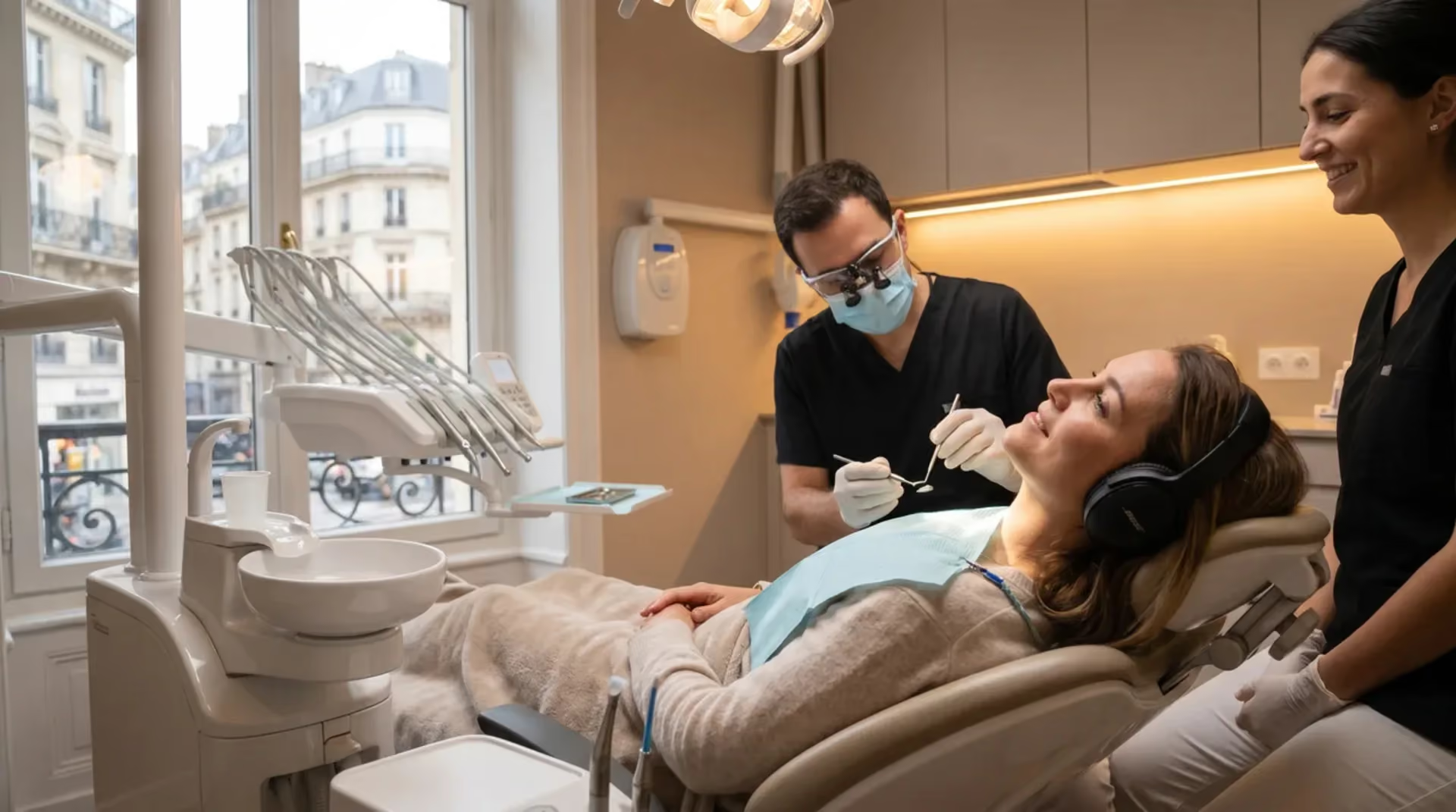
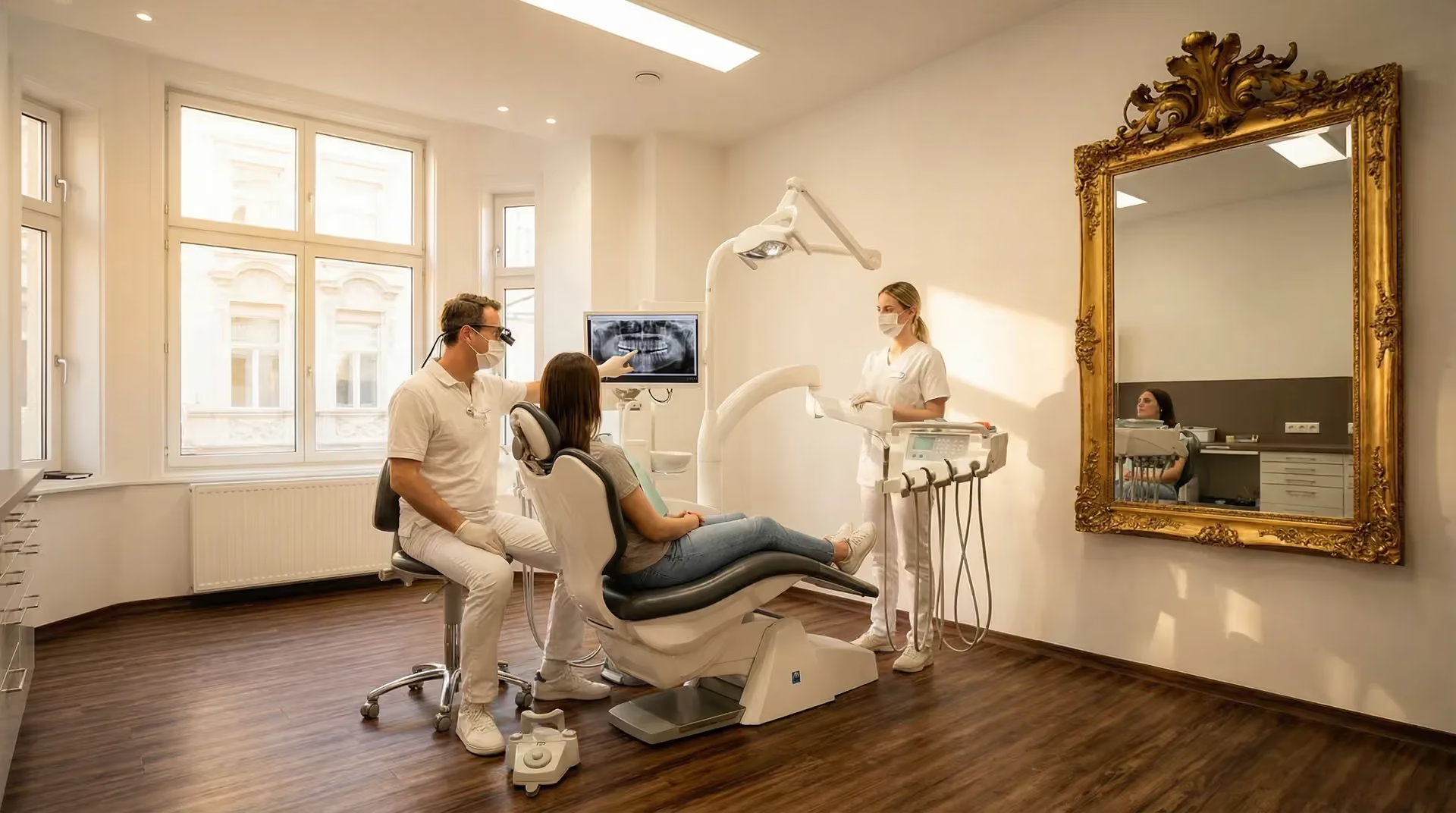


Kärntner Straße 9
100 meters from Stephansplatz, Innere Stadt.
Partnerships & Memberships & References




