
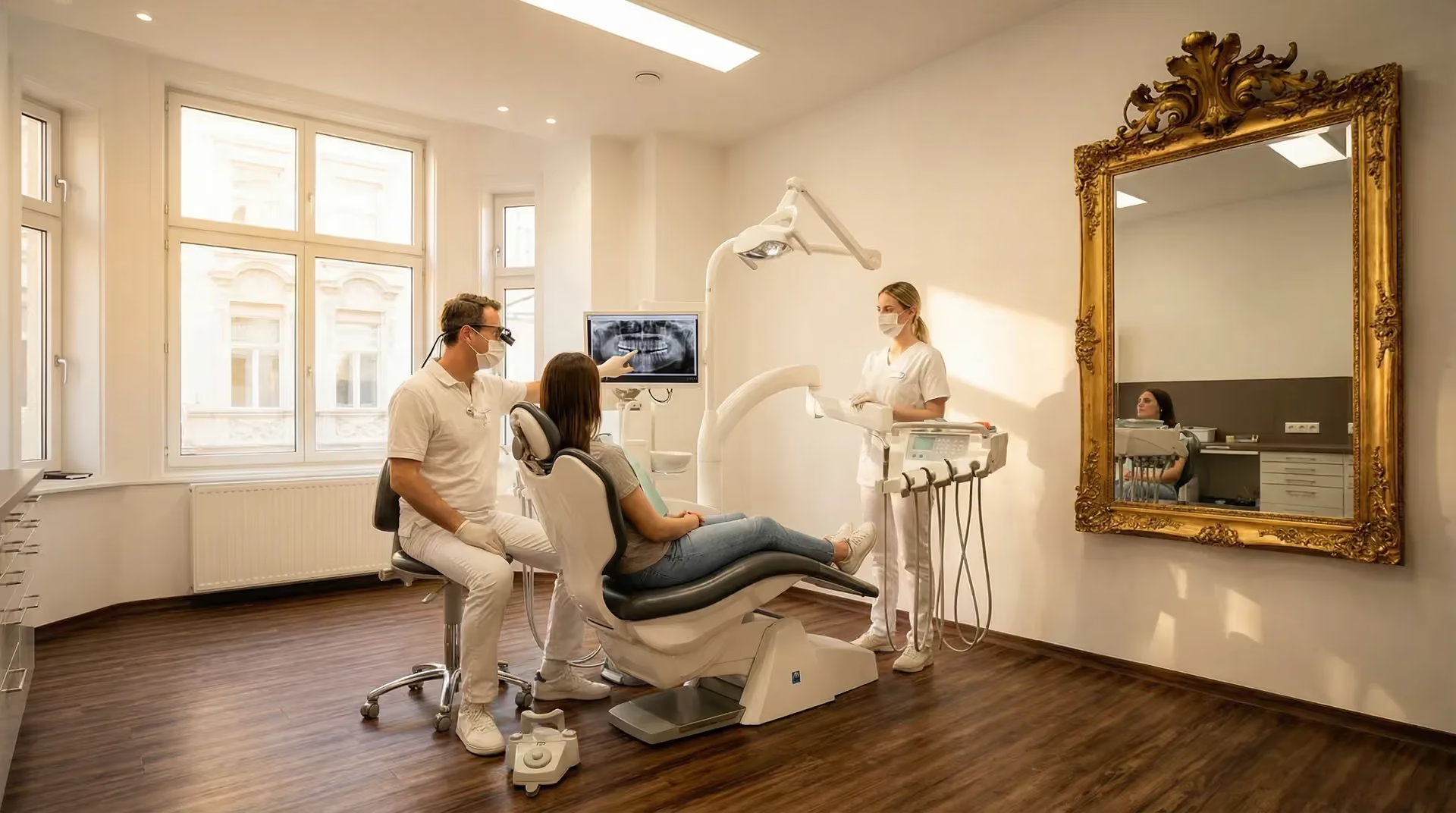
Dental Injury in Vienna: Protect the Tooth and Find Help Immediately
Has a permanent tooth been knocked out? Seek dental help immediately. Handle the tooth only by its crown and keep it moist if it cannot be safely reinserted. Never reinsert a baby tooth.
Handle only by the crown
Keep the tooth moist
Identify baby teeth
Seek help immediately
Dental Injury Vienna
zahnunfall-wien
4.9★
Doctify rating
25+
Years of experience
Personal
In-practice consultation
1010 Vienna
Kärntner Straße 9
At a glance
What should I do with a knocked-out permanent tooth?
Arrange dental help immediately. Handle the tooth only by its crown; do not scrub or disinfect it. Obtain guidance on replanting it as soon as possible. If this cannot be done safely, place the tooth immediately in a tooth-preservation kit within reach or in milk. Moist storage does not make waiting safe.*
Can a knocked-out baby tooth be reinserted?
No. Never reinsert a baby tooth. If you are unsure which type of tooth it is, ask a dentist immediately and bring the tooth you found. Loose, displaced or broken teeth also need prompt examination.
Where can I find immediate help after a dental injury?
Contact an available dental practice or use the Dental Chamber's current emergency service search. Do not wait for a callback if a tooth has been knocked out. For a serious accident, impaired consciousness, breathing problems or heavy bleeding, call 144.
What matters immediately after the accident?
After a dental injury, first check whether the injured person is responsive and breathing normally. Call 144 for impaired consciousness, breathing problems, heavy bleeding or a serious accident. Caring for the person takes priority over the tooth.
A knocked-out permanent tooth needs immediate dental help. A displaced, loose or broken tooth should also be examined promptly. Severe pain, exposed tooth tissue or a changed bite makes assessment particularly urgent.
A permanent tooth has been knocked out: the first steps
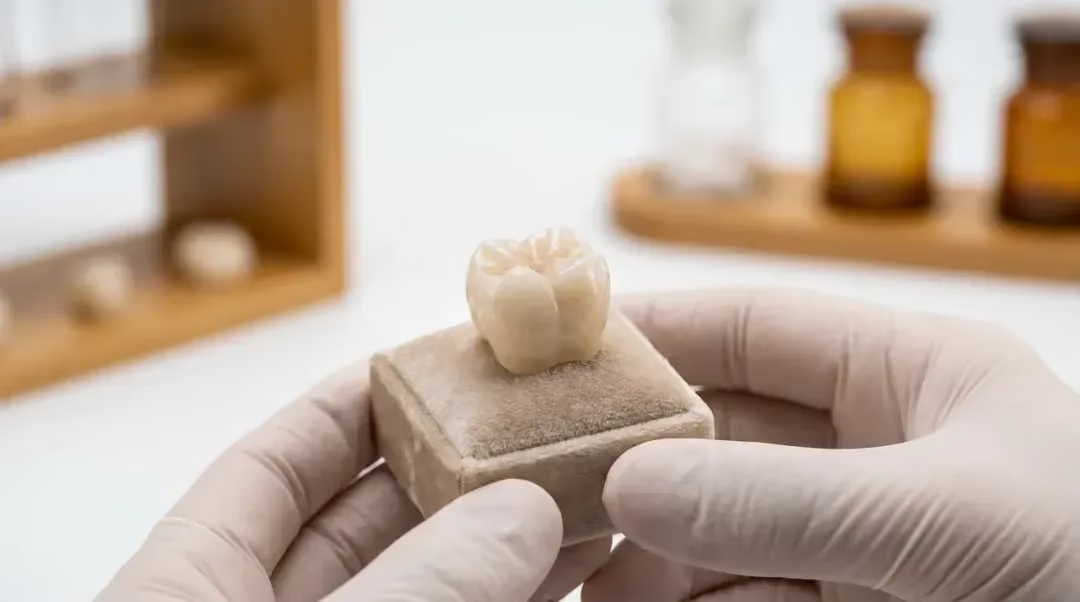
Find the tooth and handle it only by its crown — the visible white part. Avoid touching the root. Do not scrub, disinfect or wrap it in a tissue. If dirty, it may be gently rinsed with milk or saline solution.
The IADT first-aid guideline recommends replanting a tooth known to be permanent as soon as possible, if the situation allows. Obtain immediate guidance from an available emergency dental service. If you are uncertain, the person cannot cooperate or is unconscious, do not attempt this yourself; never reinsert a baby tooth.
If the tooth cannot be safely reinserted, immediately place it in a tooth-preservation kit if one is within reach; otherwise, use milk. Use a clean container. Do not store the tooth loose in the mouth of a child or a drowsy person: it could be swallowed or inhaled.
Arrange care at the same time. Moist storage protects the tooth during transport; it does not make waiting safe. Neither a particular number of minutes nor a transport medium guarantees that the tooth will be preserved.
Only a piece has broken off, or the tooth is still firm?
Keep any fragment you find and, if possible, bring it along moist. Handle it only on the outside; cold UHT milk or saline solution can be used for moist transport. Avoid putting pressure on the tooth meanwhile. Sometimes the fragment can be used in treatment. Do not glue it back yourself. A tooth may have root or internal injuries even if it remains firmly in place.
How long does a reattached tooth fragment last?
A reattached fragment may last for years, but a fixed lifespan cannot be given. The fracture pattern, remaining tooth structure and loading matter; follow-up establishes whether a filling or crown is needed later.
If the tooth has moved or your bite feels different, do not try to force it back into place. Have it examined. Even initially mild symptoms do not rule out injury.
What applies to baby teeth?
A knocked-out baby tooth is not reinserted. If you are unsure whether the tooth is a baby tooth or a permanent tooth, clarify this immediately by telephone or in person. Keep the tooth you found and bring it along.
If a tooth is missing after an accident, it is also necessary to check whether it was knocked out or pushed into the jaw. The child therefore needs examination. Call to establish which available service can treat your child.
Examination, treatment and follow-up
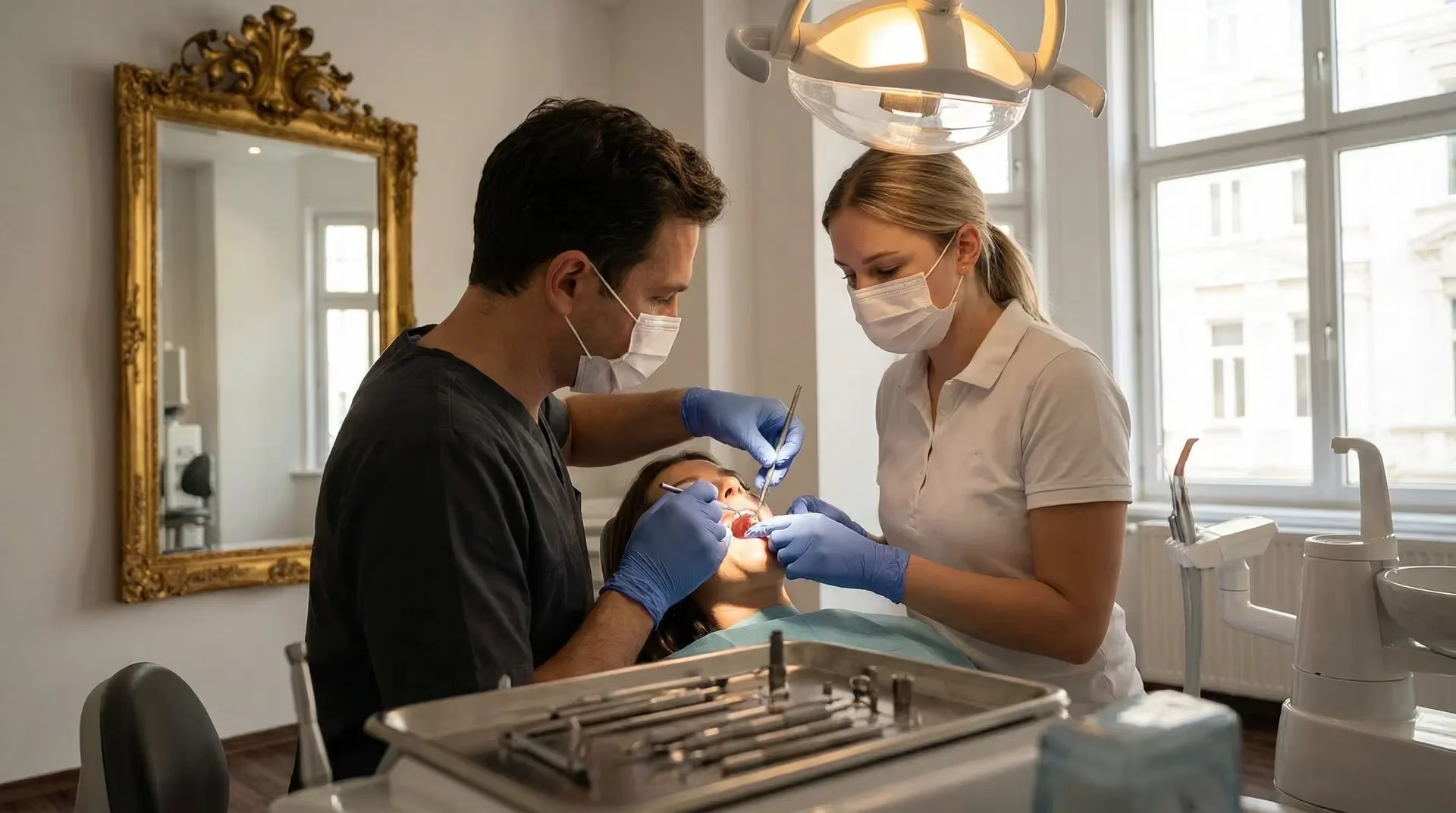
Examination assesses the teeth, bite, gums and possible accompanying injuries. Appropriate X-rays may be necessary. Depending on the injury, a tooth is treated, repositioned or temporarily stabilised with a splint. Tetanus protection and any need for medicines are assessed individually.
Follow-up is part of treatment. Changes inside the tooth or at the root may become apparent only later. Whether root canal treatment becomes necessary depends on progress and the tooth's stage of development. Attend the agreed follow-up appointments even if you are no longer in pain.
After a knocked-out permanent tooth has been replanted, the IADT guideline recommends a flexible splint for about two weeks; if the jawbone is also fractured, a more rigid splint remains for about four weeks. If root development is complete, the guideline states that root canal treatment begins within two weeks of replantation (Fouad et al., 2020).
This advice concerns aftercare following replantation. Your treatment team determines the products and their use according to the injury, age, ability to rinse safely and intolerances. For the first two weeks, the guideline specifies a soft diet, brushing with a soft toothbrush after every meal, a chlorhexidine mouth rinse twice daily (0.12 %) and avoiding contact sports. Follow-up with X-rays takes place after two weeks, when the splint is removed, after four weeks, after three and six months, after one year and then annually for at least five years. Intervals are shorter for teeth with an open root tip (Fouad et al., 2020).
For later sports activities, a suitable mouthguard may reduce injury risk. Ask when it is appropriate to resume sport after your particular injury.
Dental injury in Vienna: available help
Call Smile4Life on +43 1 410 13 52 and describe your symptoms. This helps establish whether and when care is possible at the practice. If a tooth has been knocked out or swelling is increasing rapidly, do not wait for a callback: contact an available emergency service.
If no dental practice can be reached, find current emergency dental services in Vienna through the Dental Chamber's emergency service search or on +43 1 512 20 78. The health advice service 1450 assists with health questions; in an emergency, it does not replace the ambulance service on 144.
General routes to care and medical warning signs are also explained under Emergency Dentist Vienna. For further information on the first steps after a dental injury, see the YERIT guide Dental injuries: first aid.
Our pricing page provides average market prices as a non-binding guide. The costs of your treatment are established after examination in an individual cost plan. A guide price is not a personal quotation.
Examination, appropriate initial care and, where needed, further appointments and follow-up.
YOUR OPTIONS
TREATMENT OPTIONS COMPARED
We will discuss payment terms with you prior to treatment.
The indicative market prices in our price overview provide an initial guide. We will discuss which services are planned for you and the costs involved based on your examination findings and individual cost plan.
Advanced Dental Aesthetics & Implantology
Priv.Doz.Dr.Dr. K. Yerit
“Aesthetics is not a coincidence, but the result of precise planning and deep passion.”
Prompt dental assessment is important after a dental injury. A knocked-out permanent tooth should be examined as soon as possible.
View profile →Scientific references
Institute for Implantology and Digital Dentistry Vienna
Medizinische Universität Wien
International Association of Dental Traumatology (IADT)
European Society of Endodontology (ESE)
Österreichische Gesellschaft für Mund-, Kiefer- und Gesichtschirurgie (ÖGMKG)
Yerit Practice – Dentist Vienna
Frequently asked questions
Frequently asked questions
Do you have a specific question about your diagnosis? Book a consultation appointment directly →
Questions about your treatment?
Discuss what matters to you and what the next steps look like with us.
Book your appointment nowYour orientation
Next steps depend on your symptoms and clinical findings.
Understanding what’s involved
Examination, appropriate initial care and, where needed, further appointments and follow-up.
In everyday life
Have your medication list and important previous findings ready. Seek help again if symptoms worsen.
Who this information is for
For people with acute dental symptoms, swelling or a dental injury who need prompt dental assessment.
Important limitations
If you have difficulty breathing, impaired consciousness or rapidly increasing swelling in the floor of the mouth or neck, call 144 immediately. Difficulty swallowing together with swelling can also be dangerous: call 144 rather than waiting for a dental appointment. Fever or markedly restricted mouth opening with dental symptoms requires urgent assessment. If you are unsure whether you face a medical emergency, 144 can also help.
Our approach
SCIENTIFIC STUDIES
Fouad AF et al. (2020). International Association of Dental Traumatology guidelines for the management of traumatic dental injuries: 2. Avulsion of permanent teeth
The IADT guideline addresses knocked-out permanent teeth. It describes immediate help, suitable moist storage, possible replantation and follow-up. Time and storage affect prognosis; tooth preservation cannot be guaranteed.
32460393
Bourguignon C et al. (2020). International Association of Dental Traumatology guidelines for the management of traumatic dental injuries: 1. Fractures and luxations
The IADT guideline covers fractures and loose or displaced permanent teeth. Examination, imaging, care and follow-up depend on the injury. Even apparently minor damage may need closer examination.
32475015
Day PF et al. (2020). International Association of Dental Traumatology guidelines for the management of traumatic dental injuries: 3. Injuries in the primary dentition
The IADT guideline distinguishes injuries to baby teeth from injuries to permanent teeth. Knocked-out baby teeth are not replanted. Examination identifies accompanying injuries and further follow-up needs.
32458553
Müller DD et al. (2020). Survival and complication analyses of avulsed and replanted permanent teeth
This Munich university clinic analysis followed 49 replanted permanent teeth in 36 patients for an average of 3.5 years, treated under IADT guidelines. It places expectations in context: 26.5 per cent healed functionally. Replacement resorption occurred in 51.0 per cent, with the root gradually replaced by bone; 22.5 per cent developed inflammatory resorption and were lost after an average of 1.7 years. Replantation remains appropriate — it often retains the tooth for years and preserves its place in the jaw — but is not a guarantee (Scientific Reports, 2020).
32071357
Lee ZJ et al. (2024). Modified Hank's Balanced Salt Solution as a Storage Medium for Avulsed Teeth: In Vitro Assessment of Periodontal Fibroblast Viability
This laboratory study compares six storage solutions by how long they keep periodontal ligament cells alive — the cells on which a replanted tooth's reattachment depends. All tested media maintained cell viability for 3 to 24 hours; saline enriched with vitamin C performed better than standard saline. Cultured cells were studied, not clinical replantation success. The results establish neither a general ranking of commercial tooth-preservation products nor that a dry-stored tooth has no treatment prospect (Dental Traumatology, 2024).
39578673
Krastl G et al. (2021). Endodontic management of traumatized permanent teeth: a comprehensive review
This comprehensive review by a German-speaking expert group — the basis for the European Society of Endodontology position statement — addresses what happens to the tooth nerve after dental injury. It explains when the nerve may recover, when it dies and when root canal treatment must begin. The type of injury and stage of root development are decisive. No general waiting period of weeks or months can be derived from this. Follow-up after dental injury is therefore part of treatment rather than an optional addition (International Endodontic Journal, 2021).
33683731
More topics in this area
Deepen your knowledge – find all information regarding the treatment process, costs, and results.

Kärntner Straße 9
100 meters from Stephansplatz, Innere Stadt.
Partnerships & Memberships & References




