Types of Dentures in Vienna: Compare Partial and Complete Dentures
Partial, complete or a particular type of retention: compare the differences and prepare your decision.
Understand the differences
Compare retention
Consider care
Prepare your questions
Types of Dentures Vienna
zahnprothesen-arten-wien
4.9★
Doctify rating
25+
Years of experience
Personal
In-practice consultation
1010 Vienna
Kärntner Straße 9
At a glance
Which types of dentures are available?
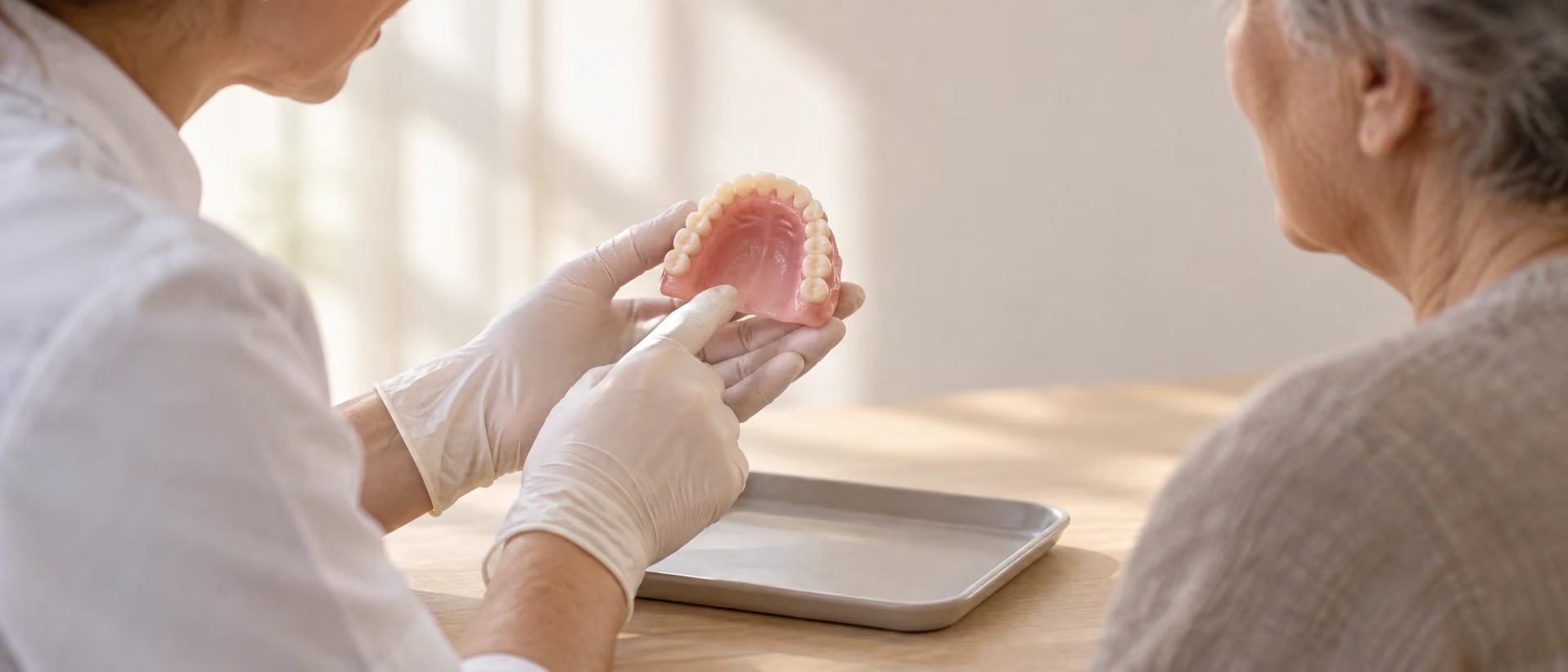
Partial dentures replace missing teeth; complete dentures replace all teeth in one jaw. Clasps, telescopic crowns or implants can provide retention depending on the findings. Implant-retained does not automatically mean fixed.
A partial denture often feels bulky initially, and speaking and chewing take practice. Clasps may be visible and cause sore spots; the denture and remaining teeth need thorough daily cleaning. It can, in return, be extended, relined and usually repaired.
How are partial dentures retained?
Usually by clasps on natural teeth; these sometimes receive a crown designed to support the clasp. Attachments or telescopic double crowns provide clasp-free retention, with the inner part fixed to the tooth. Implants can also provide retention in suitable cases.
What is an immediate denture?
A denture made before tooth extraction and inserted immediately afterwards so you do not spend time without teeth. Because jawbone and gums shrink during healing, it usually needs relining over the following months or later replacement by the final denture.
Types of dentures: partial, complete and implant dentures
Partial dentures replace some teeth; complete dentures replace all teeth in one jaw. Within these groups, designs and retention vary. A telescopic denture is usually a special type of partial denture, not a mixture of partial and complete dentures.
Choosing depends on how the denture can be supported in your mouth and what treatment of natural teeth would be needed. This overview helps you prepare questions for examination. It cannot replace a personal recommendation. The YERIT guide Types of dentures explains the differences in detail.
Comparing denture types
| Design | Starting situation and retention | Points to consider |
|---|---|---|
| Partial denture with clasps | Remaining natural teeth provide retention. | Clasps may be visible; supporting teeth need careful cleaning. |
| Cast-metal partial denture | Partial denture with a metal framework, often with clasps. | Framework and attachments must suit the remaining teeth. |
| Complete denture | All teeth in one jaw are missing. The denture rests on the mucosa. | Fit, jaw shape and adaptation affect retention. |
| Telescopic denture | Double crowns on suitable natural teeth retain the removable restoration. | Supporting teeth are prepared for crowns; care and maintenance are part of treatment. |
| Implant-retained removable denture | Implants provide additional retention points. | Implants require separate planning; the denture and attachment components need cleaning and checks. |
Clasps or telescopic crowns: what does this mean for natural teeth?
Clasp dentures use retaining components around suitable natural teeth. Cast-metal describes the metal framework’s construction. A cast-metal partial denture can therefore also be a clasp denture.
A telescopic denture is retained by double crowns: inner crowns are fixed to prepared teeth, and matching outer components belong to the removable denture. This can provide retention without visible clasps. Tooth preparation and space requirements must be considered. KZBV explains clasp and telescopic dentures. Its information about German statutory cover does not apply to Austria.
Complete dentures in the upper or lower jaw
A complete denture replaces the teeth of a fully edentulous jaw. Its fit depends on adaptation to the tissues and interaction with movements in the mouth. Upper and lower jaws offer different conditions; retention in one cannot simply be assumed for the other.
A conventional upper complete denture covers the palate; this surface contributes to suction and retention. A thin-palate or palate-free complete denture therefore usually needs extra support, for example implants. This preference belongs in planning but cannot be promised for every clinical situation.
For an upper partial denture, the design depends on where natural teeth remain. If enough suitable supporting teeth are present, the framework can be narrower than a full palatal plate.
Manufacture at the practice begins with impressions. For an edentulous jaw, conventional impressions are often preferable because an intraoral scanner captures mobile mucosa and the denture border less well. At try-in, you and your clinician check the bite, tooth position and lip appearance before completion. Follow-up visits after fitting address sore spots and adjust the fit.
Implant-supported does not automatically mean fixed
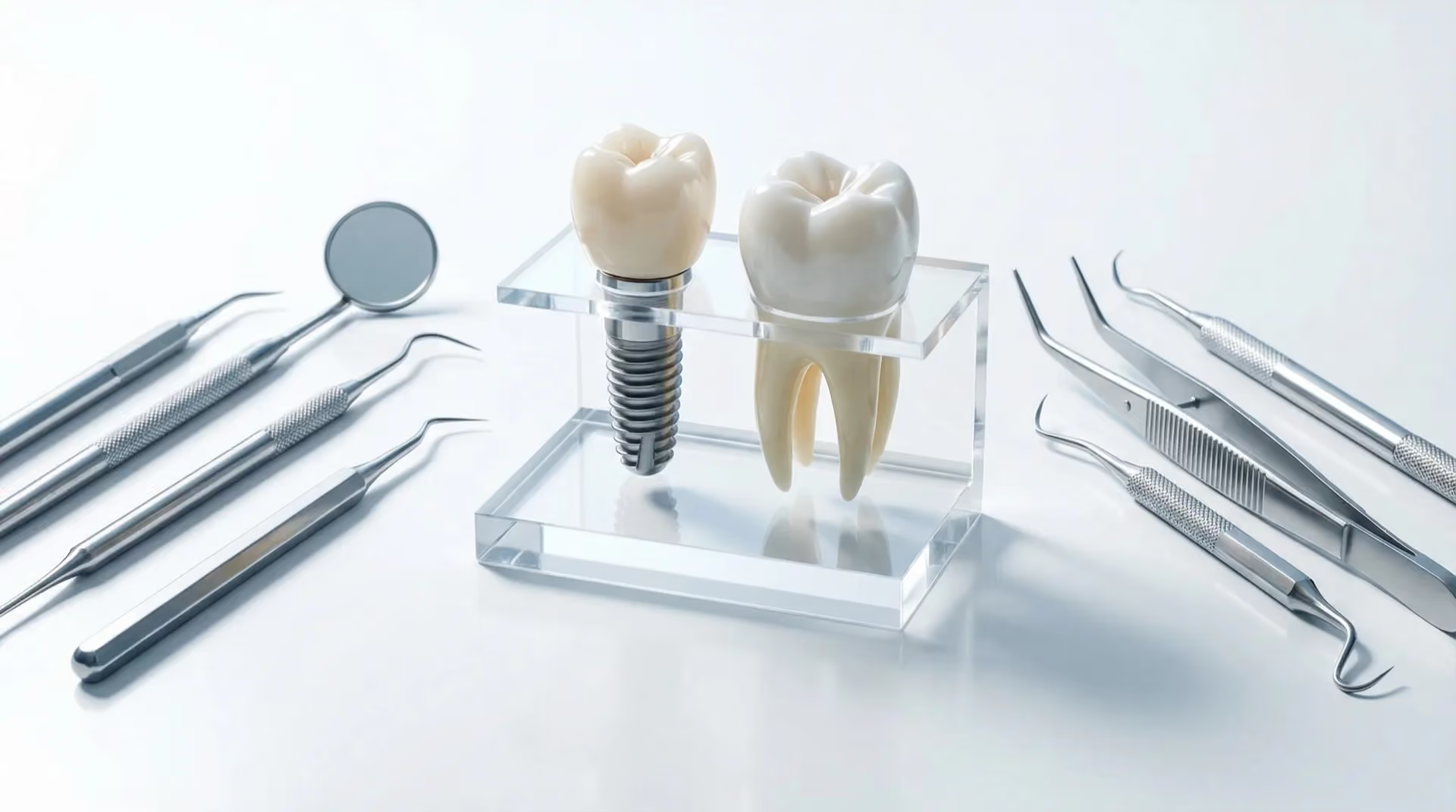
A denture can click onto implants and still be removable by you. The implants remain in the jaw; the denture is removed for cleaning. Screw-retained fixed tooth replacement is different. An example is a fixed All-on-4 concept.
Additional retention can improve stability. The extent of benefit depends on the starting situation, design and expectations. The review by Duong and colleagues considers different fixed and removable implant restorations; it does not establish general superiority for every person.
How important are material and manufacture?
Material and framework must suit the planned restoration. “Modern”, “digital” or a brand name alone cannot establish whether a denture is more suitable for you. Also ask about adjustment, cleaning and later repair possibilities.
For a flexible partial denture, such as nylon offered under the brand name Valplast, support and retention also need assessment. Before deciding, clarify whether additions, relining and repairs are possible for the specific design. Compare these points with other denture types.
Bring existing findings for known intolerances. A wish for metal-free tooth replacement must be assessed alongside retention and strength requirements. This overview does not promise that any particular material or product is offered at the practice.
Care, comfort and ongoing support in everyday life
Every denture, whether a partial denture with metal clasps, an implant-supported denture or an acrylic complete denture, needs daily cleaning with separate toothbrushes for the denture and remaining natural teeth. Removable tooth replacement is taken out for cleaning; screw-retained fixed implant restorations remain in place and are cleaned with special interdental brushes.
Comfort and secure retention depend on manufacture: accurate impressions capture remaining teeth and toothless jaw areas covered by mucosa. Whether clasps, crowns or implants retain the denture depends on its design and your findings. Dental implants act as artificial tooth roots and provide additional retention where several teeth are missing. Your dentist at Smile4Life discusses which design suits your findings and the initial adjustment needed for chewing and speaking with your new restoration.
What do the differences mean for costs?
Telescopic crowns or implant retention involve different treatment steps from simple clasp retention, and therefore a different cost plan, which you receive after examination. Market guide prices on the price page provide initial guidance. Costs depend on findings and treatment scope. A written treatment and cost plan is provided in certain cases or on request under § 18 ZÄG; the denture cost overview explains cost planning and insurance clarification.
Which questions help you choose?
Which natural teeth can be retained? Does a tooth need preparation? How can you insert and remove the denture? Can you clean all important areas? What happens if your clinical situation changes later?
Discuss these points based on your examination. For next steps, the denture overview for Vienna takes you from assessment to manufacture. Discuss suitable options. Please call our practice if you would like to arrange a personal consultation beforehand.
A suitable solution starts with your wishes and an examination.
YOUR OPTIONS
TREATMENT OPTIONS COMPARED
We will discuss payment terms with you prior to treatment.
The indicative market prices in our price overview provide an initial guide. We will discuss which services are planned for you and the costs involved based on your examination findings and individual cost plan.
Advanced Dental Aesthetics & Implantology
Priv.Doz.Dr.Dr. K. Yerit
“Aesthetics is not a coincidence, but the result of precise planning and deep passion.”
Choosing removable or fixed tooth replacement depends on your individual starting situation. There is no universally right answer, only an option that suits you.
View profile →Scientific references
Institute for Implantology and Digital Dentistry Vienna
Österreichische Gesellschaft für Zahn-, Mund- und Kieferheilkunde (ÖGZMK)
Deutsche Gesellschaft für Zahnärztliche Prothetik
European Prosthodontic Association (EPA)
Academy of Prosthodontics
Yerit Practice – Dentist Vienna
Frequently asked questions
Frequently asked questions
Do you have a specific question about your diagnosis? Book a consultation appointment directly →
Questions about your treatment?
Discuss what matters to you and what the next steps look like with us.
Book your appointment nowYour orientation
An understandable comparison helps you make a personal choice.
Understanding what’s involved
In everyday life
Who this information is for
Important limitations
Our approach
SCIENTIFIC STUDIES
Sousa LC et al. (2025)
A review of nine clinical comparative studies examined digitally and conventionally manufactured implant-retained overdentures. Overall, the groups studied showed fewer prosthetic complications and similar or better patient-reported outcomes with digital manufacture. This does not establish general superiority for every partial or complete denture, or promise a result for a practice’s own workflow.
41318332
Almufleh B et al. (2023)
A review of clinical comparisons of removable partial dentures found higher patient satisfaction with digital manufacture in two studies. The pooled fit analysis, by contrast, favoured conventional frameworks; both methods were clinically acceptable. The limited evidence does not establish general superiority of digital precision.
37930081
Duong HY et al. (2022)
This review examines oral-health-related quality of life with fixed and removable implant restorations. The different comparison groups do not support a general statement that implants are superior to every conventional complete denture or that all restorations are equivalent.
35103325
Tekpınar L & Yiğit V (2024)
A Turkish Markov cost model compared single implant crowns with tooth-supported fixed bridges using costs from 2021 over a modelled period of 20 years. The implant restoration cost more in the model and had a higher quality-adjusted prosthesis benefit. This establishes neither a price for Vienna nor personal cost savings.
38340673
More topics in this area
Deepen your knowledge – find all information regarding the treatment process, costs, and results.

Kärntner Straße 9
100 meters from Stephansplatz, Innere Stadt.

Partnerships & Memberships & References