
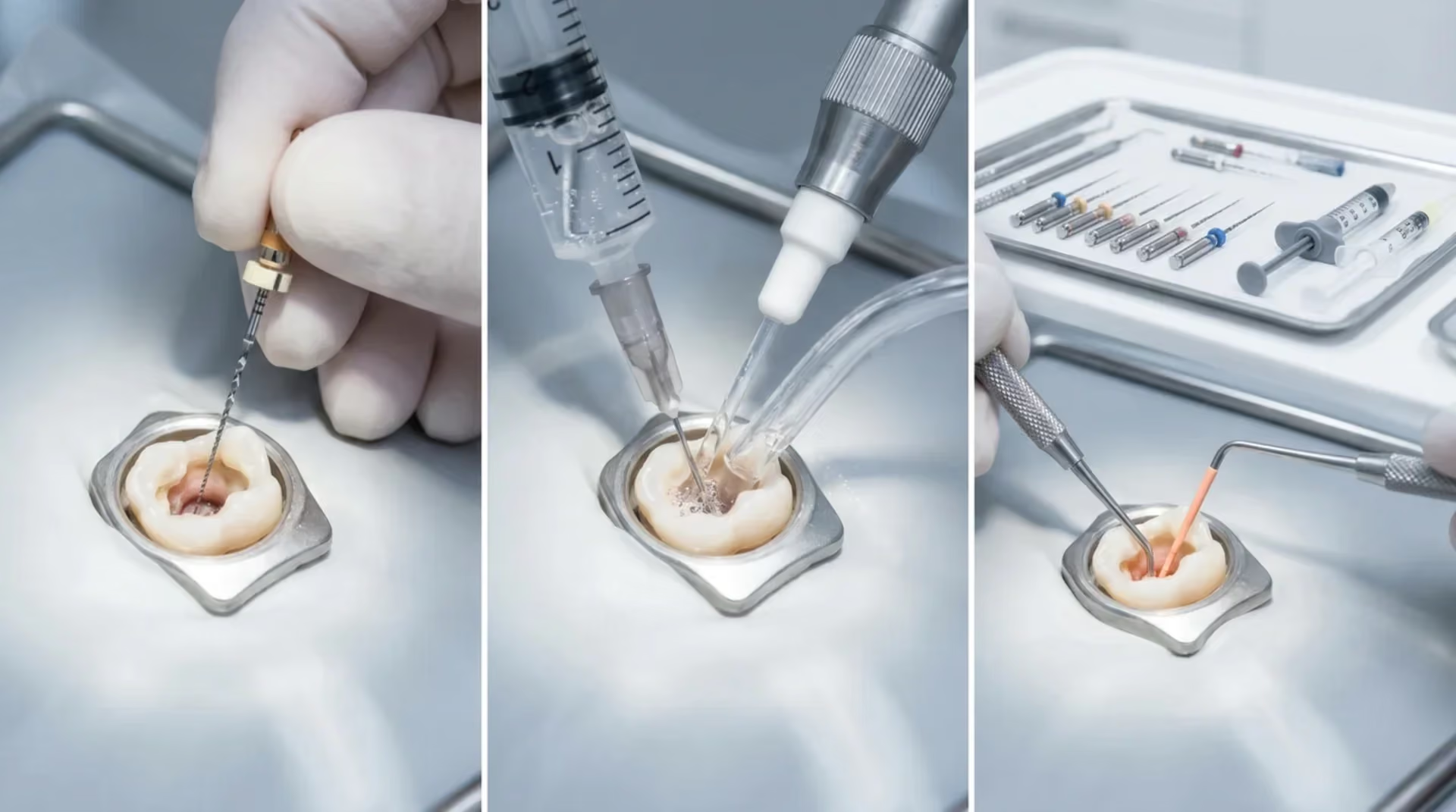
Root Canal Treatment: From Examination to Restoration
Knowing what happens next makes preparation easier. Follow the steps from the first assessment to restoration of the treated tooth.
Understand the steps
Plan your appointments
Discuss anaesthesia
Restore the tooth afterwards
Root Canal Treatment Procedure Vienna
wurzelbehandlung-ablauf-wien
4.9★
Doctify rating
25+
Years of experience
Personal
In-practice consultation
1010 Vienna
Kärntner Straße 9
At a glance
What happens at the first root canal appointment?
First, the tooth is examined with a cold test and X-ray. Under local anaesthesia, it is opened, diseased pulp is removed from all canals, and the canals are measured, cleaned and disinfected. A root filling or dressing follows.*
How many appointments does root canal treatment need?
One or several, depending on the findings. The number and shape of canals and severity of inflammation are decisive. If treatment is divided, a medicated dressing beneath a temporary seal may protect the cleaned canal system until the next appointment.*
What should you avoid after root canal treatment?
Do not chew or drink anything hot while the anaesthetic is working; you could bite your cheek or lip without noticing. Avoid hard foods on the tooth until its final filling or crown.
Is the nerve always removed during root canal treatment?
“Removing the nerve” is a simplification: diseased or dead pulp is removed, and this contains blood vessels and connective tissue as well as nerves. If it has already died, no living nerve is being removed; the findings determine whether any parts can be preserved.
The procedure at a glance
From assessment and anaesthesia through access, canal cleaning and disinfection to filling, restoration and checks.
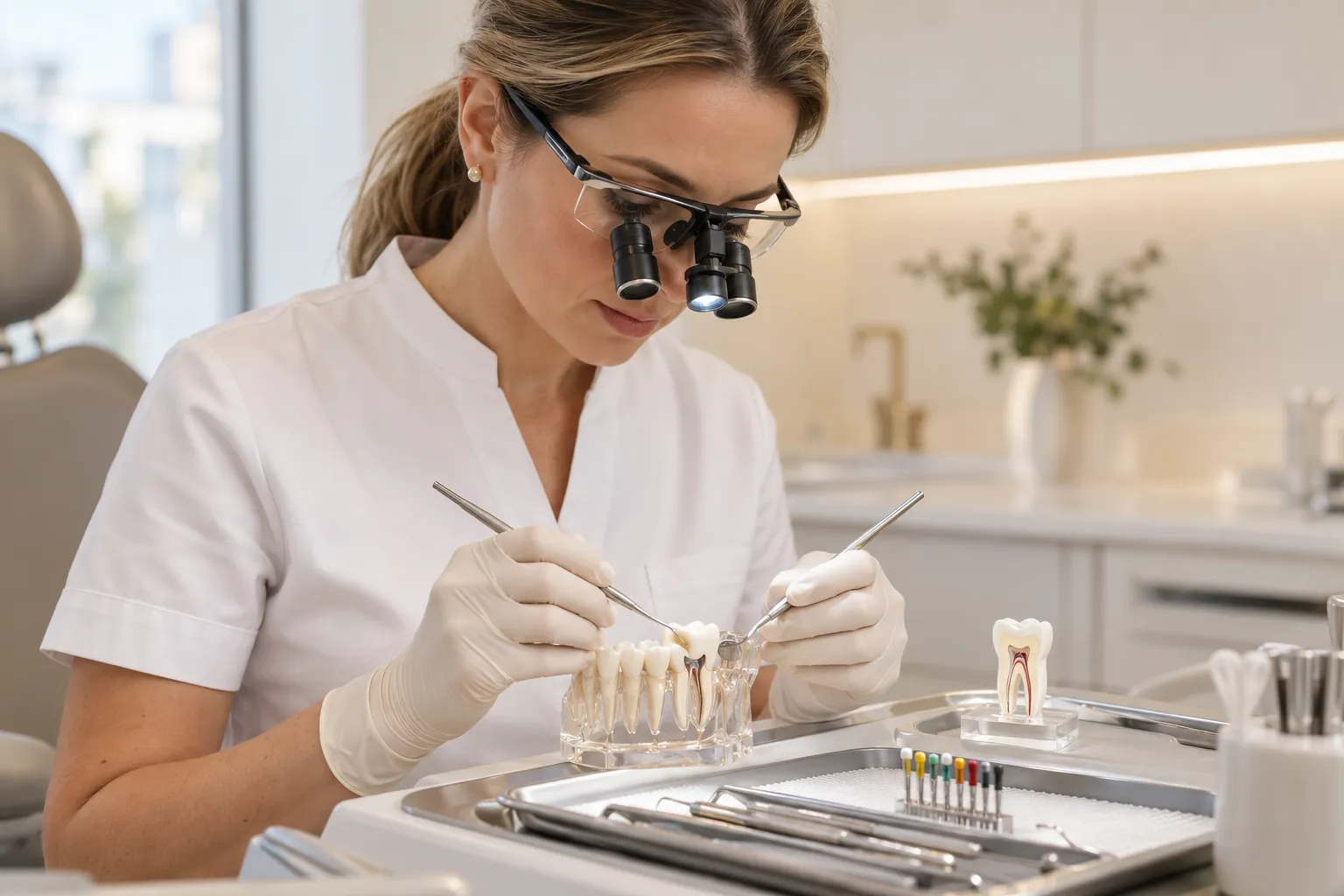
Root canal treatment procedure: examination and planning
Root canal treatment treats severely inflamed or dead pulp inside a tooth. The tissue is removed and the canal system cleaned and disinfected to treat the infection. It begins by asking why the tooth is causing symptoms or looks abnormal on an X-ray. The dentist examines the tooth and surrounding area, checks its response to suitable tests and assesses existing or required X-rays. The possibility of restoring it afterwards is also considered.
Explain beforehand which medication you take and whether you have known allergies or other health considerations. Mention any treatment anxiety. Before starting, clarify what is planned and how to signal for a break. Read more about deciding for or against treatment under root canal treatment in Vienna.
Anaesthesia and access to the root canals
Local anaesthesia should make treatment manageable. Tell the team immediately if you feel pain so the anaesthetic and further procedure can be adjusted. Pressure, sounds or vibration cannot always be eliminated completely.
A rubber dam isolates the tooth from saliva and protects the mouth during treatment. The root canals are located through an opening in the crown. The access should provide sufficient visibility while preserving as much healthy tooth structure as possible. Particularly small does not automatically mean particularly good.
Cleaning, disinfection and root filling
The canal lengths are determined. Fine instruments prepare the canals, and rinsing solutions help clean and disinfect them. Curved, narrow or branched canals can make treatment more complex. During retreatment, existing filling material may need removing first.
When the conditions for completion are met, the prepared canals are filled with suitable material. The access opening receives a tight seal. Treatment therefore comprises several coordinated steps, rather than simply removing the nerve.
How long does root canal treatment take, and how many appointments are needed?
Depending on the situation, treatment may take one or several appointments. Duration cannot be determined from the number of teeth alone: canal number, difficult anatomy, previous treatment and findings all matter. Ask about the time needed for your specific appointment.
If treatment is divided between visits, a medicated dressing may be placed and the tooth sealed temporarily. A dressing, for example calcium hydroxide, is not required for every root canal treatment. A standard two-week waiting period is not appropriate for every tooth either. The ESE guideline explicitly supports single-visit treatment without an intermediate dressing for certain findings.
What should you observe after root canal treatment?
Wait until the anaesthetic wears off before chewing, to avoid unknowingly biting your lip or cheek. Follow personal instructions about eating and the filling material used. A temporarily restored tooth should not be heavily loaded before its final restoration. Continue cleaning your teeth carefully.
Some pressure sensitivity may occur after treatment. Tell the practice about severe or increasing symptoms, swelling, a noticeably high bite or a lost temporary filling. Specific reasons for contacting the practice are explained under pain after root canal treatment.
The root-treated tooth: restoration and checks
Filled canals alone do not make a severely damaged tooth strong enough for use. The suitable filling, partial crown or crown depends mainly on remaining tooth structure and loading. A crown is not automatically required for every root-treated tooth.
Agreed checks help assess progress. Also discuss which steps are included in the cost plan and which later restoration needs additional planning. Guidance is available under root canal treatment costs and ÖGK reimbursement. The YERIT guide to the treatment procedure also explains root canal treatment.
The work involved depends on the tooth, its root canals and possible previous treatment.
YOUR OPTIONS
TREATMENT OPTIONS COMPARED
We will discuss payment terms with you prior to treatment.
The indicative market prices in our price overview provide an initial guide. We will discuss which services are planned for you and the costs involved based on your examination findings and individual cost plan.
Advanced Dental Aesthetics & Implantology
Priv.Doz.Dr.Dr. K. Yerit
“Aesthetics is not a coincidence, but the result of precise planning and deep passion.”
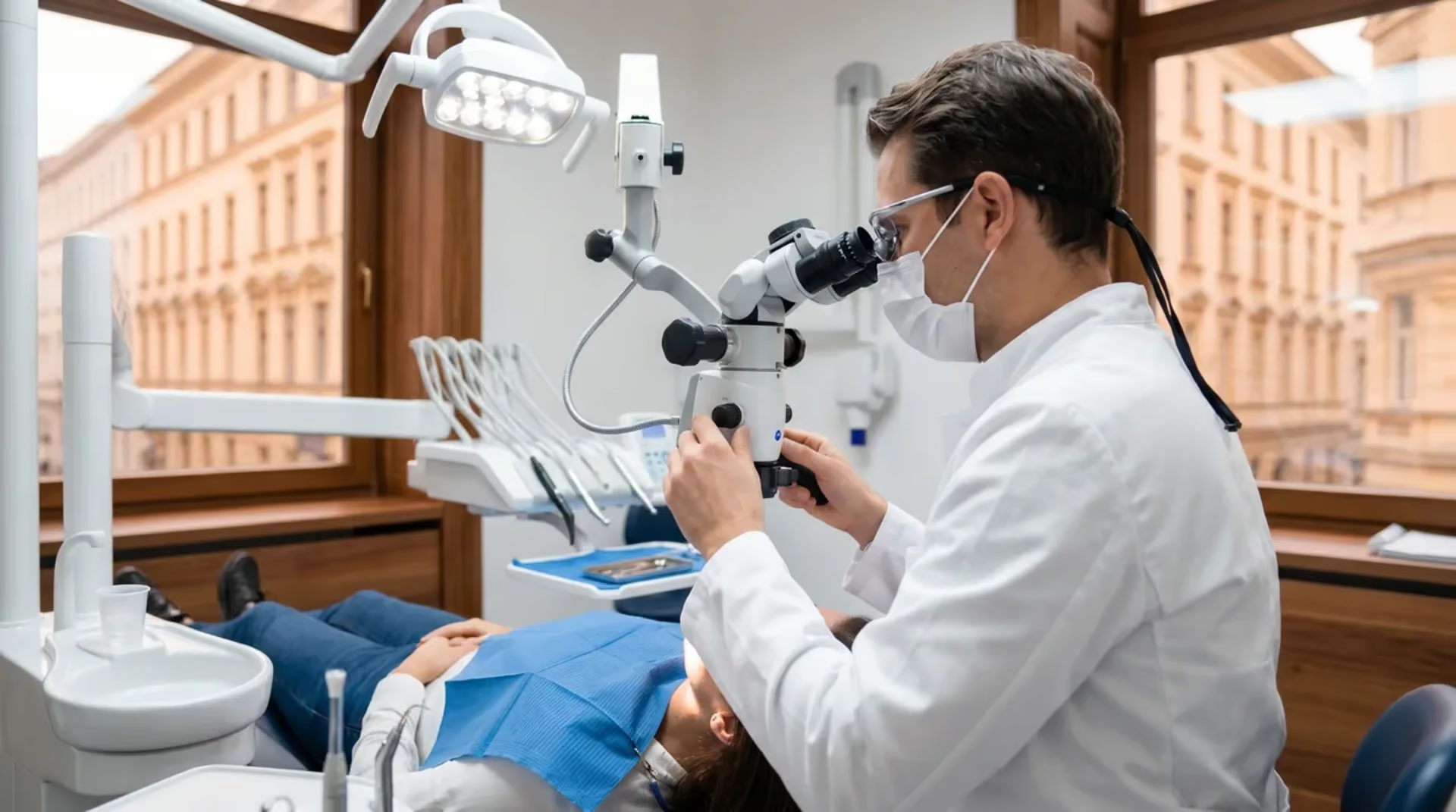
We explain the examination, treatment and restoration of your tooth. At Smile4Life, we work manually with magnifying loupes.
View profile →Scientific references
Institute for Implantology and Digital Dentistry Vienna
Österreichische Gesellschaft für Endodontologie (ÖGEndo)
European Society of Endodontology (ESE)
Deutsche Gesellschaft für Zahnerhaltung (DGZ)
American Association of Endodontists (AAE)
Yerit Practice – Dentist Vienna
Frequently asked questions
Frequently asked questions
Do you have a specific question about your diagnosis? Book a consultation appointment directly →
Questions about your treatment?
Discuss what matters to you and what the next steps look like with us.
Book your appointment nowYour orientation
A clear procedure helps you plan treatment.
Understanding what’s involved
One or several appointments may be necessary. The tooth, canal system and findings determine the work involved.
In everyday life
Allow time after treatment for the anaesthetic to wear off. Protect the tooth from heavy chewing forces while it has a temporary restoration.
Who this information is for
For anyone advised to have root canal treatment who wants to plan treatment and the time afterwards more confidently.
Important limitations
The procedure is adapted if examination or treatment reveals different findings. A severely damaged tooth cannot always reasonably be retained.
Our approach
Clear steps help you raise questions in good time. Planning follows the findings and is adapted when needed.
SCIENTIFIC STUDIES
Clear steps help you raise questions in good time. Planning follows the findings and is adapted when needed.
Burns LE et al. (2022). Outcomes of primary root canal therapy: An updated systematic review
The 2022 systematic review reported 82.0 percent success after initial root canal treatment using strict healing criteria and 92.6 percent using less strict criteria. The varied studies, often limited in quality, do not allow an individual prognosis or a statement about lifelong longevity.
35334111
de-Figueiredo FED et al. (2020). Apical periodontitis healing and postoperative pain following endodontic treatment
A randomised study of 120 non-vital front teeth with apical periodontitis compared a reciprocating single-file technique with manual preparation. Acute flare-ups occurred in approximately 3 percent; radiographically assessed healing after twelve months was 73 to 78 percent depending on the protocol. These are findings from this study population, not a general success rate.
32012166
Ballester B et al. (2021). Current strategies for conservative endodontic access cavity preparation
The review assessed conservative access cavities mainly through laboratory studies. Indications of better fracture resistance depended, among other things, on preserved marginal ridges. Because of low-level evidence, these findings do not establish a general clinical advantage for making the access cavity as small as possible.
34623506
Multari S et al. (2024). Endodontic Treatment of Chronic Apical Periodontitis Ameliorates Systemic Inflammation
In 27 patients with chronic apical periodontitis, root canal treatment demonstrably reduced pro-inflammatory cytokines (IL-1, IL-6, IL-8) in the blood and significantly improved the insulin responsiveness of cells in a laboratory experiment.
38821264
Huynh R et al. (2023). Evaluating the stress of root canal treatment in patients and dentists
A systematic review found that patients experience root canal treatment as more psychologically stressful than other routine dental treatments. Careful, understandable information before treatment is recommended as an important factor in reducing this burden.
37357152
Torabinejad M et al. (2007). Outcomes of root canal treatment and restoration, implant-supported single crowns, fixed partial dentures, and extraction without replacement
A 2007 review of 143 heterogeneous studies found similar long-term survival rates for root-treated restored teeth and implant-supported single crowns. Direct comparisons were very rare; different success criteria and observation periods limit comparison. The analysis does not establish general equivalence or economic superiority of either procedure; economic data were largely absent.
17936128
Gesundheitsportal: Wurzelbehandlung und Wurzelspitzenresektion
Before root canal treatment, vitality is tested with cold spray and the tooth is X-rayed; several dental visits are usually needed. An apicoectomy may help preserve the tooth if previous root canal treatment has not resolved the inflammation (gesundheit.gv.at, accessed 03.11.2026).
More topics in this area
Deepen your knowledge – find all information regarding the treatment process, costs, and results.


Kärntner Straße 9
100 meters from Stephansplatz, Innere Stadt.
Partnerships & Memberships & References