
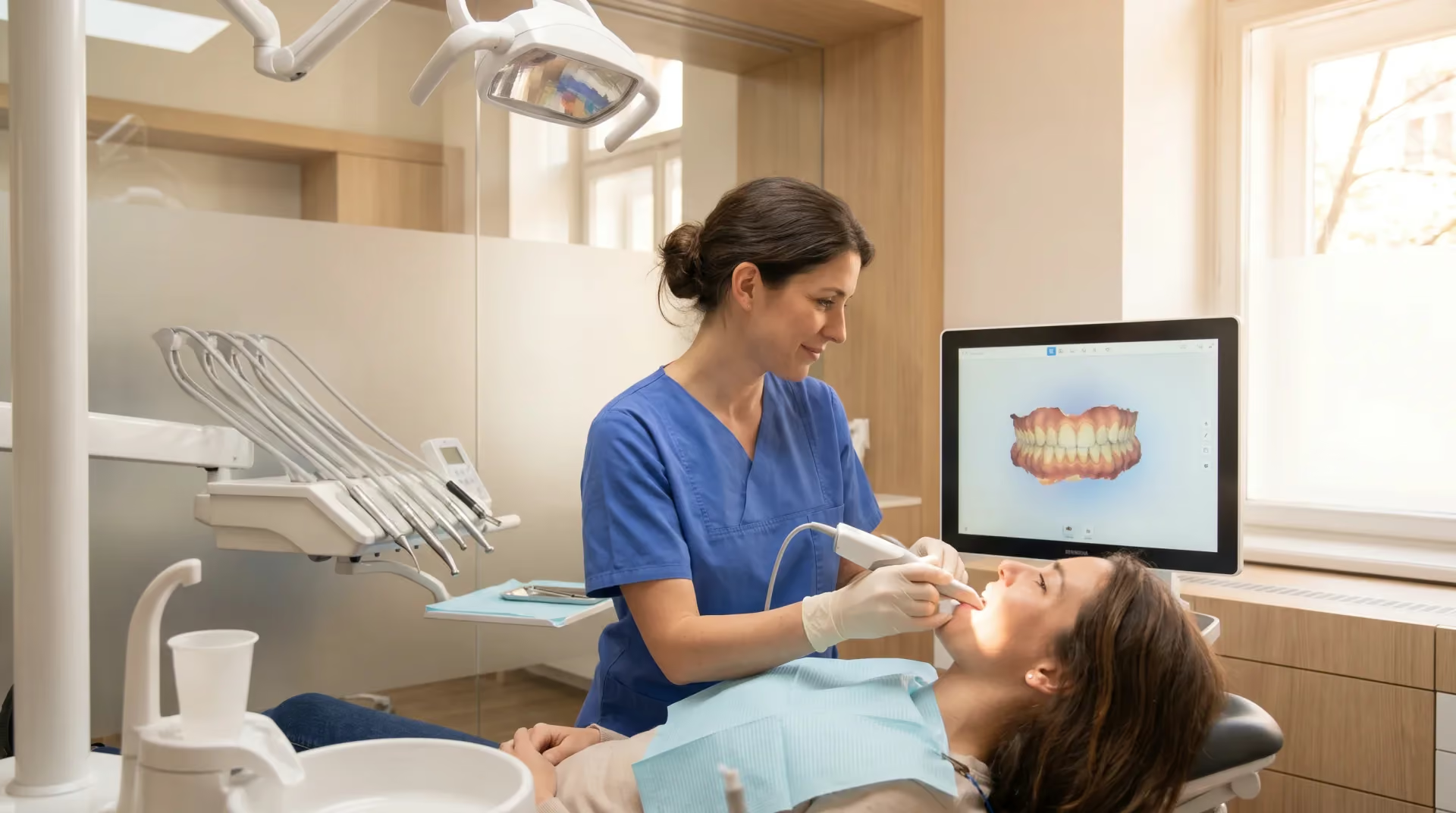
Smile Makeover Procedure in Vienna: Sequence and Time
Want to know what to expect? A clear plan explains suitable steps, how they fit together and what to clarify before starting.
Discuss wishes
Examine the starting situation
Understand the sequence
Plan timing together
Smile Makeover Procedure Vienna
smile-makeover-ablauf-wien
4.9★
Doctify rating
25+
Years of experience
Personal
In-practice consultation
1010 Vienna
Kärntner Straße 9
At a glance
How does a smile makeover work?
Examination and wishes come first. Sequence then follows findings: disease takes priority; planned position or colour changes are coordinated with restorations. Existing ceramic does not whiten with bleaching. Agreed steps follow.
How long does a smile makeover take?
From a few visits to several months. Necessary gum treatment, orthodontic changes or surgery may determine the pace through healing periods; crowns or veneers follow afterwards.
How many appointments does a smile makeover need?
There is no fixed number. Beyond examination and planning, veneers or crowns need preparation, try-in and bonding visits; orthodontics or surgery add further checks.
Does a smile makeover have to combine treatments?
No. It is an individual plan, not a fixed package; one measure may suffice. Combination is used only when findings justify it, for example coordinating position, gums and restorations.
The procedure at a glance
From personal wishes and examination through comparing options to coordinated planning of sequence, timing and next steps.

Smile makeover procedure: how does treatment begin?
We begin by asking what you want to change. You may have a clear concern or want to understand possibilities first. Both are valid starting points. Also note which features you want to keep. YERIT explains the general process in the smile makeover procedure guide.
Your dentist then examines the starting situation. Aesthetic wishes and expectations belong alongside clinical questions. Teeth, gums, existing restorations and function influence planning. Mention previous treatment and symptoms. An online description or photograph cannot replace examination.
Which steps belong to a smile makeover?
- Bring wishes and findings together. Visible changes have different causes. First distinguish treatment needs from aesthetic preferences.
- Compare options. Discuss benefits, limits, risks and smaller alternatives. One measure or no change may also be suitable.
- Define the sequence. With several planned measures, clarify dependencies and necessary intervals.
- Clarify scope and decision. Understand intended services, costs and open questions before starting.
This describes planning logic, not a fixed appointment count. Several questions may be discussed together; others need additional examination or coordination.
Why does sequence matter?
Changes can affect each other. Existing fillings or crowns do not whiten with bleaching, so planned colour changes must account for restorations.
Planned tooth movement may also influence later shape decisions. Gum problems or decay can take priority. No single sequence suits everyone.
Ceramic veneers may require laboratory coordination and try-in. Misalignment may need an orthodontic decision first. Such differences explain why a generic appointment list cannot replace a treatment plan. The smile makeover overview explains possible measures and directs their details to dedicated pages.
Digital Smile Design: preview your smile
Photographs, models or digital previews can improve discussion of shape and appearance. Digital Smile Design explains this planning aid. Appropriate representations depend on the specific question.
A preview shows a planning direction, not clinical feasibility or an identical later result. Say if it does not suit your wishes or you prefer a smaller procedure.
How much time should I allow?
Appointment count differs from overall duration. Manufacture, healing or movement may take time between visits. Necessary pretreatment can affect timing.
Ask which visits are likely and over what period, and which parts remain uncertain. Mention a desired completion before a wedding or travel early; it does not guarantee feasibility.
New findings or wishes should prompt review of the plan, including effects on work and costs. The cost-planning page explains relevant questions.
What follows treatment?
Clarify oral hygiene and checks for the selected methods. Report symptoms or an unfamiliar bite rather than accepting them as normal. Components may later need refreshing or repair; a whole makeover has no uniform lifespan.
For the first discussion, ask: what is my main goal, which alternatives exist, what can be preserved, and which next step brings clarity? You need not choose a method before examination.
Clinical context: Singh and Abraham: Interdisciplinary concepts in esthetic dentistry (2024); Jain et al.: The Recent Use, Patient Satisfaction, and Advancement in Digital Smile Designing: A Systematic Review (2024); American Dental Association: Teeth Whitening; American Dental Association: Veneers.
Examination, planning and suitable treatment steps; duration follows your findings.
YOUR OPTIONS
TREATMENT OPTIONS COMPARED
We will discuss payment terms with you prior to treatment.
The indicative market prices in our price overview provide an initial guide. We will discuss which services are planned for you and the costs involved based on your examination findings and individual cost plan.
Advanced Dental Aesthetics & Implantology
Priv.Doz.Dr.Dr. K. Yerit
“Aesthetics is not a coincidence, but the result of precise planning and deep passion.”
Knowing what to expect makes deciding on the next step easier.
View profile →Scientific references
Institute for Implantology and Digital Dentistry Vienna
European Society of Cosmetic Dentistry (ESCD)
Deutsche Gesellschaft für Ästhetische Zahnheilkunde (DGÄZ)
American Academy of Cosmetic Dentistry (AACD)
International Federation of Esthetic Dentistry (IFED)
Yerit Practice – Dentist Vienna
Frequently asked questions
Frequently asked questions
Do you have a specific question about your diagnosis? Book a consultation appointment directly →
Questions about your treatment?
Discuss what matters to you and what the next steps look like with us.
Book your appointment nowYour orientation
Appointments and overall duration follow selected treatments.
Understanding what’s involved
Appointment numbers and possible intervals depend on findings and treatment.
In everyday life
Daily impact depends on individual measures. Preparation or temporary restorations may require specific eating and loading advice. Care after final placement also follows findings and the instructions for each step. Discuss precautions between visits beforehand.
Who this information is for
Important limitations
Our approach
SCIENTIFIC STUDIES
Alwabel LK et al. (2025). Digital Smile Design and Patient-Centered Outcomes in Esthetic Restorative Dentistry: A Systematic Review
A systematic review of seven heterogeneous studies reported favourable patient-related outcomes for Digital Smile Design, including satisfaction, treatment acceptance and perceived predictability. Different study designs, outcome measures and some small groups limit the strength of the findings. They establish neither general clinical superiority nor a guarantee of simulation accuracy or an individual treatment result.
41473620
Klein P et al. (2025). Survival and Complication Rates of Feldspathic, Leucite-Reinforced, Lithium Disilicate and Zirconia Ceramic Laminate Veneers: A Systematic Review and Meta-Analysis
The review of 29 studies reported pooled survival at 10.4 years of 96.1 % for feldspathic ceramic, 93.7 % for leucite-reinforced glass ceramic and 96.8 % for lithium disilicate. There was no statistically established survival difference between materials; this does not prove equivalence. Technical complications were 6.1 % for lithium disilicate and 41.5 % for feldspathic ceramic. Only shorter-term data were available for zirconia, with no long-term figures. Different studies and endpoints do not permit a personal longevity guarantee. (Klein et al., 2025; online 2024.)
39523553
Alqutaibi AY et al. (2024). Clinical survival and complication rate of ceramic veneers bonded to different substrates: A systematic review and meta-analysis
A meta-analysis of six clinical studies showed that porcelain veneers bonded entirely to enamel achieved survival rates of 98 to 100 percent; substantial dentine exposure was associated with markedly lower survival and success rates (Journal of Prosthetic Dentistry, 2024).
38604905
Pjetursson BE et al. (2026). A Systematic Review and Meta-analysis Evaluating the Survival, Failure, and Complication Rates of Metal-Ceramic, Veneered, and Monolithic All-Ceramic Tooth-Supported Single Crowns
A meta-analysis of 64 studies involving over 11,500 tooth-supported crowns found five-year survival rates of 90.4 to 98.5 percent, depending on the material; monolithic lithium disilicate and zirconia showed the least chipping (International Journal of Prosthodontics, 2026).
41489982
Josic U et al. (2023). Clinical longevity of direct and indirect posterior resin composite restorations: An updated systematic review and meta-analysis
An updated meta-analysis found no statistically significant difference in the clinical longevity of direct and indirect posterior composite restorations; however, the quality of evidence was rated very low (Dental Materials, 2023).
37827872
Nourah D (2023). Digital Smile Makeover: A Multidisciplinary Team Approach
A case report of a digitally planned, multidisciplinary smile makeover involving crown lengthening, lip repositioning and prosthetic restoration shows how digital planning may shorten treatment and reduce postoperative adjustments (European Journal of Dentistry, 2023).
37130552
More topics in this area
Deepen your knowledge – find all information regarding the treatment process, costs, and results.

Kärntner Straße 9
100 meters from Stephansplatz, Innere Stadt.


Partnerships & Memberships & References




