Internal Bleaching Vienna: When One Tooth Is Dark
Targeted whitening may reduce a root-treated tooth’s colour difference. The first step is assessing suitability.
Targeted single-tooth whitening
Check the root filling first
Individual shade goal
Procedure follows findings
Internal Bleaching Vienna
internes-bleaching-wien
4.9★
Doctify rating
25+
Years of experience
Personal
In-practice consultation
1010 Vienna
Kärntner Straße 9
At a glance
How does internal bleaching work?
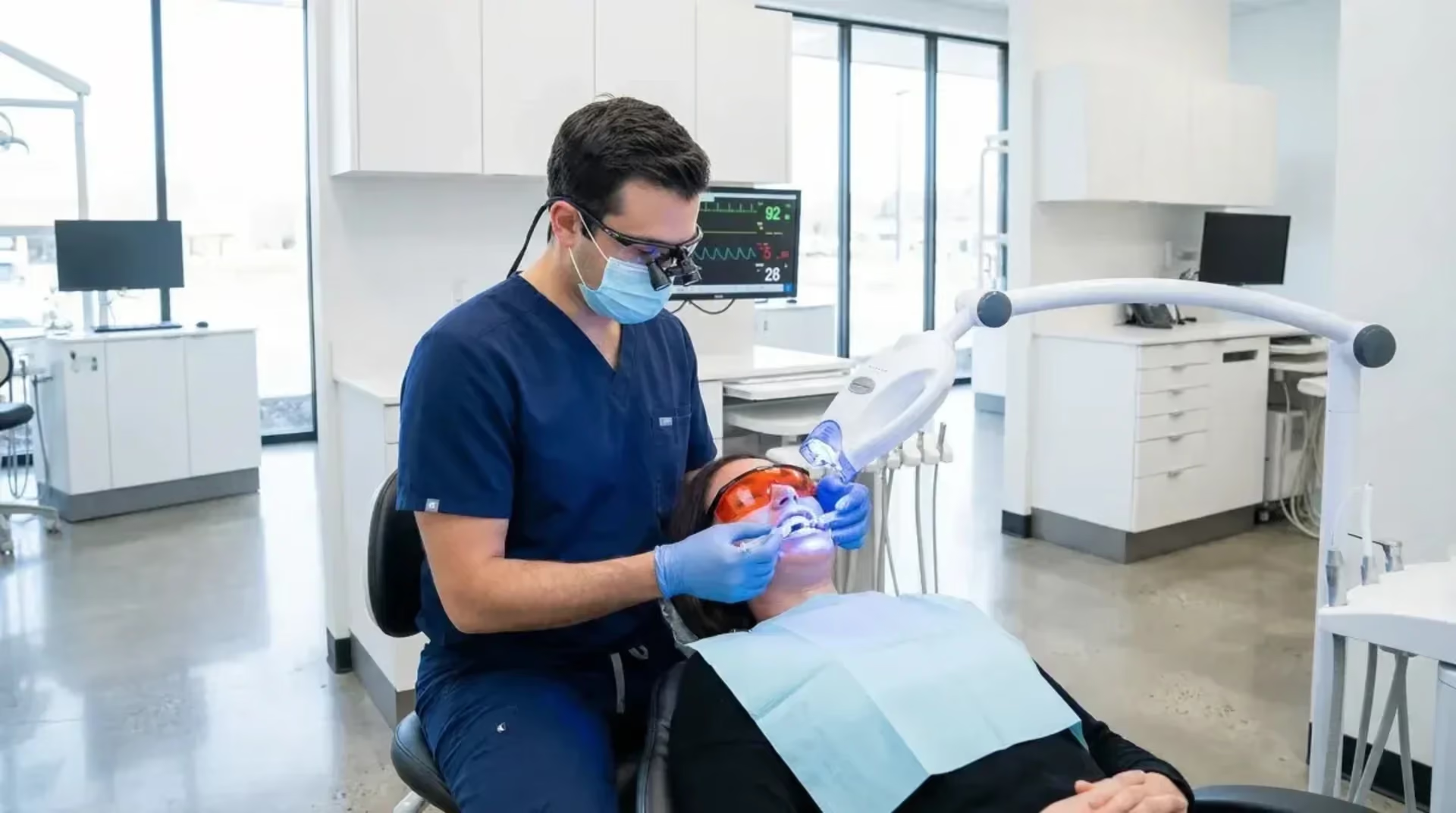
The root-treated tooth is whitened internally through its existing opening. The root filling is covered, the bleaching agent is placed in the crown and the tooth is temporarily sealed. Achieving the intended whitening takes several days.*
How long does internal bleaching last?
A Graz follow-up published in 1999 reported satisfactory results in 79 percent after five years. This historical finding is not a personal five-year prognosis.* If the tooth darkens, first assess the cause.
What are the disadvantages of internal bleaching?
The tooth may darken again. Rarely, resorption occurs at the root near the tooth neck, associated with high peroxide concentrations of 30 to 35 %.* Treatment therefore avoids heat and seals off the root filling.
How many appointments does internal bleaching need?
This becomes clear during treatment: after each dressing, colour is checked and agent replaced if needed. The tooth remains temporarily sealed between visits and finally receives a tight tooth-coloured filling.
When may internal bleaching be suitable?
One tooth may appear darker than its neighbours after injury or root canal treatment. Internal bleaching can change colour from within a suitable root-treated tooth. The bleaching agent is placed inside the crown area rather than across the entire arch.
Internal bleaching may suit a single root-treated tooth with lasting darkening after canal treatment that can continue changing. Following injury, blood components can enter dentinal tubules; breakdown of red blood cells releases iron. Tissue remnants or root-treatment materials may also discolour teeth. Unlike external bleaching, the agent enters the opened tooth and acts on dentine from within, making overlying enamel appear lighter. The procedure section explains the agents discussed.
Non-vital means tissue inside the tooth is no longer alive, not automatically that root canal treatment has been properly completed. Clarify cause and treatment status before cosmetic whitening.
An inadequate root filling or another problem needing treatment takes priority. X-rays assess the root filling; examination includes gums and possible inflammation. A dark tooth is not selected by colour alone. Priv.Doz.Dr.Dr. K. Yerit assesses suitability after examination. Read about investigating causes at YERIT under causes of tooth discolouration.
Root canal treatment is endodontics, treating the tooth interior and canals. Internal bleaching may subsequently serve an aesthetic purpose, aiming to match neighbouring teeth more closely without automatically requiring a full crown for colour alone.
For context: Kahler 2022; Austria’s health portal.
How does whitening from within work?
After examination, access feasibility and suitability are assessed. A barrier separates the root filling from the agent, an important protective step.
Bleaching chemically changes colour-producing compounds in dentine. Agent is placed directly in the intended tooth area.
Which agents are used for internal bleaching?
Literature chiefly discusses hydrogen peroxide, carbamide peroxide and sodium perborate. Carbamide peroxide breaks down into hydrogen peroxide and urea, releasing the active agent more slowly. Sodium perborate was historically the standard walking-bleach dressing. This list describes historical and international literature, not our current product offer. Study protocols cannot be applied to current product classification and permitted Austrian use without assessment. We clarify suitable methods after examination.
More agent does not automatically mean a better result. A study of 50 non-vital front teeth found both an internal dressing and in-office treatment improved colour. Differences appeared only at some measurement points, with one month of observation (Bersezio et al., 2024). Ingredient names are information, not a recipe: agent inside an opened tooth belongs in dental hands.
Walking bleach leaves the agent temporarily inside beneath a provisional seal. Progress is checked and application adjusted or repeated if needed. A suitable tight final seal completes treatment.
This is not equivalent to extensive crown preparation. Nevertheless, saying no tooth structure or filling material is removed would go too far: access and final restoration belong in individual planning.
Appointments and spacing depend on method and progress. No fixed session number or minutes can generally be promised.
For context: Kahler 2022; Bersezio 2024.
Internal bleaching results and durability
A systematic review shows that internal bleaching can lighten discoloured root-treated teeth while describing methodological limits and the need for longer follow-up. The aim is a closer colour match, not a guaranteed exact match.
Colour may darken again. Repetition is not automatically the next step; it needs reassessment. Long-term durability and a repeat interval cannot be reliably generalised.
The YERIT guide to internal bleaching explains evidence and method differences.
For context: Frank 2022; Kahler 2022.
Which risks and alternatives belong in consultation?
Possible damage around the external tooth neck, called external cervical resorption, is a concern. Factors including previous trauma and the method complicate general risk estimates. No reliable percentage applies to every tooth.
Careful sealing and appropriate method selection therefore matter. Internal bleaching belongs in professional dental care, not home use.
If whitening is unsuitable or insufficient, other aesthetic or restorative options may be discussed. Composite bonding, veneers or crowns depend on remaining structure and tooth prognosis. An imperfect shade does not automatically require a crown or extraction. A severely damaged tooth first needs assessment of whether and how it can be retained. Medication and possible oral-hygiene preparation are also discussed beforehand.
For context: Kahler 2022.
Costs and appointment preparation
Costs depend on findings, planned applications and access restoration. Necessary root-filling treatment is separate. The personal plan should distinguish these steps; internal whitening costs follow them rather than a general number.
The price page lists indicative average Vienna market prices, not a personal offer for your tooth. The whitening costs page helps clarify scope.
Bring information about root treatment and previous injury. The onset of colour change and any symptoms matter too. The teeth whitening in Vienna overview puts single-tooth whitening into wider context.
Walking bleach temporarily seals the tooth between applications. Care and checks follow the agreed method. Mention symptoms or problems with the seal.
YOUR OPTIONS
TREATMENT OPTIONS COMPARED
We will discuss payment terms with you prior to treatment.
The indicative market prices in our price overview provide an initial guide. We will discuss which services are planned for you and the costs involved based on your examination findings and individual cost plan.
Advanced Dental Aesthetics & Implantology
Priv.Doz.Dr.Dr. K. Yerit
“Aesthetics is not a coincidence, but the result of precise planning and deep passion.”
Before recommending a veneer or crown, we first try more tooth-preserving internal bleaching where the tooth is suitable.
View profile →Scientific references
Institute for Implantology and Digital Dentistry Vienna
American Dental Association (ADA)
Deutsche Gesellschaft für Zahnerhaltung (DGZ)
Österreichische Gesellschaft für Ästhetische Zahnheilkunde
European Academy of Esthetic Dentistry (EAED)
Yerit Practice – Dentist Vienna
Frequently asked questions
Frequently asked questions
Do you have a specific question about your diagnosis? Book a consultation appointment directly →
Questions about your treatment?
Discuss what matters to you and what the next steps look like with us.
Book your appointment nowYour orientation
Understand your options for a lighter shade.
Understanding what’s involved
Clarify treatment scope and appointments from personal findings.
In everyday life
Walking bleach temporarily seals the tooth between applications. Care and checks follow the agreed method. Mention symptoms or problems with the seal.
Who this information is for
For individual discoloured root-treated teeth after assessing tooth condition, root filling and achievable shade.
Important limitations
An inadequate root filling or another problem needing treatment must be assessed first. Sealing and risks belong in individual planning.
Our approach
Studies support possible whitening of root-treated teeth. Methodological limits and limited long-term data do not permit a fixed durability promise.
SCIENTIFIC STUDIES
Studies support possible whitening of root-treated teeth. Methodological limits and limited long-term data do not permit a fixed durability promise.
Aidos M et al. (2024). Comparison of in-office and at-home bleaching techniques: An umbrella review
A review of 28 systematic reviews, nine analysed quantitatively, found no statistically established difference in colour or sensitivity between the in-office and home methods compared. The quality and protocols of the included reviews vary. Non-significance does not prove equivalence. Sensitivity is possible with both methods, but does not necessarily occur in every person.
38371984
de Geus JL et al. (2025). At-home vs In-office Bleaching: An Updated Systematic Review and Meta-analysis
The updated review found lower sensitivity intensity with home whitening, but no clear difference in its occurrence. Shade scales and instrumental colour measurement produced different comparative results. The qualitative review included 32 studies. The certainty of evidence was low. No general promise of individual suitability, equivalence or freedom from pain follows.
40485133
Jiang NW et al. (2024). Correlation between patient satisfaction and color changes after tooth bleaching
In a study involving 63 people, satisfaction after the whitening procedure studied was associated with the measured colour change. The regression model used derived thresholds in the ΔE00 measure that differed by tooth type. These are sample- and model-specific findings for a particular protocol, not a generally applicable minimum whitening level or satisfaction guarantee. ΔE00 should not be treated as interchangeable with other colour-difference measures without clarification.
38303586
Bersezio C et al. (2024). Comparative efficacy of In-office and walking bleach techniques in whitening of non-vital teeth
In 50 non-vital front teeth, both in-office and walking bleach methods improved colour. The in-office method studied showed advantages on the whiteness index at certain measurement points. Specific procedures on non-vital teeth were investigated, with follow-up of up to one month. This does not establish long-term superiority, applicability to every vital dentition or a commitment to a local treatment protocol.
39704843
Kahler B (2022). Present status and future directions - Managing discoloured teeth
The narrative review describes whitening options for discoloured teeth, protective sealing during internal bleaching and the risk of external cervical resorption. Causes and risk depend on several factors, including previous injuries and the method used. It provides no universal frequency, duration of effect or barrier-thickness requirement in millimetres.
35188275
Nunes GP et al. (2025). Protective role of calcium-based agents in dental bleaching gels
The review included 50 laboratory studies and six clinical studies. In the systems investigated, calcium-based additives showed smaller changes to dental hard tissue and less clinical sensitivity, with comparable whitening. Laboratory findings on dental hard tissue and clinical symptoms are different outcomes. Further clinical studies of formulations and protocols are called for. This is neither a blanket protection guarantee nor a statement about a specific practice product.
40072631
Reitzer 2019 — Fallbericht zur kombinierten inneren und äußeren Aufhellung
A clinical case report describes a modified combination of internal and external whitening of a non-vital tooth. The whitening agent is sealed inside the access cavity rather than leaving the opening exposed during treatment. This is a single case, not a comparison of effectiveness or safety. The legal statement in the historical article is not adopted here as a current general EU rule. A study protocol is not an instruction for use or a statement of regulatory approval.
31559399
Öffentliches Gesundheitsportal Österreichs: Zahnverfärbungen
Composite fillings and porcelain crowns are not whitened by bleaching. Temporary sensitivity and gum irritation may occur afterwards; overly frequent and intensive whitening can damage teeth, so it should take place only with dental guidance and supervision (gesundheit.gv.at, accessed 02.11.2026).
Glockner K et al. (1999). Five-year follow-up of internal bleaching. Braz Dent J
In a follow-up study in Graz, the result of internal bleaching remained successful after five years in 79 % of all cases, and in 91 % when the palatal access opening was small (pubmed.ncbi.nlm.nih.gov, accessed 03.11.2026)
10863397
More topics in this area
Deepen your knowledge – find all information regarding the treatment process, costs, and results.
Kärntner Straße 9
100 meters from Stephansplatz, Innere Stadt.

Partnerships & Memberships & References