
General Anaesthesia at the Dentist: Information About External Treatment
Smile4Life does not provide general anaesthesia at its practice. Understand questions about suitability, the anaesthetic team, location and aftercare before external treatment.
Enable treatment
Assess suitability
Understand the procedure
Plan recovery
General Anaesthesia at the Dentist Vienna
vollnarkose-zahnarzt-wien
4.9★
Doctify rating
25+
Years of experience
Personal
In-practice consultation
1010 Vienna
Kärntner Straße 9
At a glance
What is general anaesthesia for dental treatment, and when is it considered?
You are unconscious during treatment. Smile4Life does not provide general anaesthesia at its practice; clarify location and the responsible anaesthetic team with the specific provider.
It may be suitable when necessary treatment is otherwise impossible, for example extensive procedures, several wisdom teeth or certain conditions. Austria’s health portal describes insufficient evidence for dental anxiety; it remains an exception in that context.*
How long does dental surgery under general anaesthesia take?
Dental treatment time depends on the procedure. Preparation, induction and recovery-room monitoring make the overall stay considerably longer. Hoarseness or sore throat from the breathing tube usually resolve within 24 hours.*
What are the alternatives to general anaesthesia for dental treatment?
Depending on procedure and anxiety: adequate local anaesthesia, shorter appointments with agreed breaks, nitrous oxide or conscious sedation. These methods differ in effects and requirements; location follows the method and team. For clinically significant anxiety, Austria’s health portal prioritises cognitive behavioural therapy combined with dental treatment.*
When general anaesthesia for dental treatment in Vienna may be suitable
General anaesthesia may be considered when necessary dental care cannot appropriately be provided with local anaesthesia and other support. Severe anxiety, particular support needs or treatment scope may matter, but no single characteristic determines the decision.
Tooth number alone is insufficient. General anaesthesia is neither necessary for every large treatment nor excluded for a small one. Individual assessment with dental and anaesthetic teams is decisive.
How it differs from conscious sedation
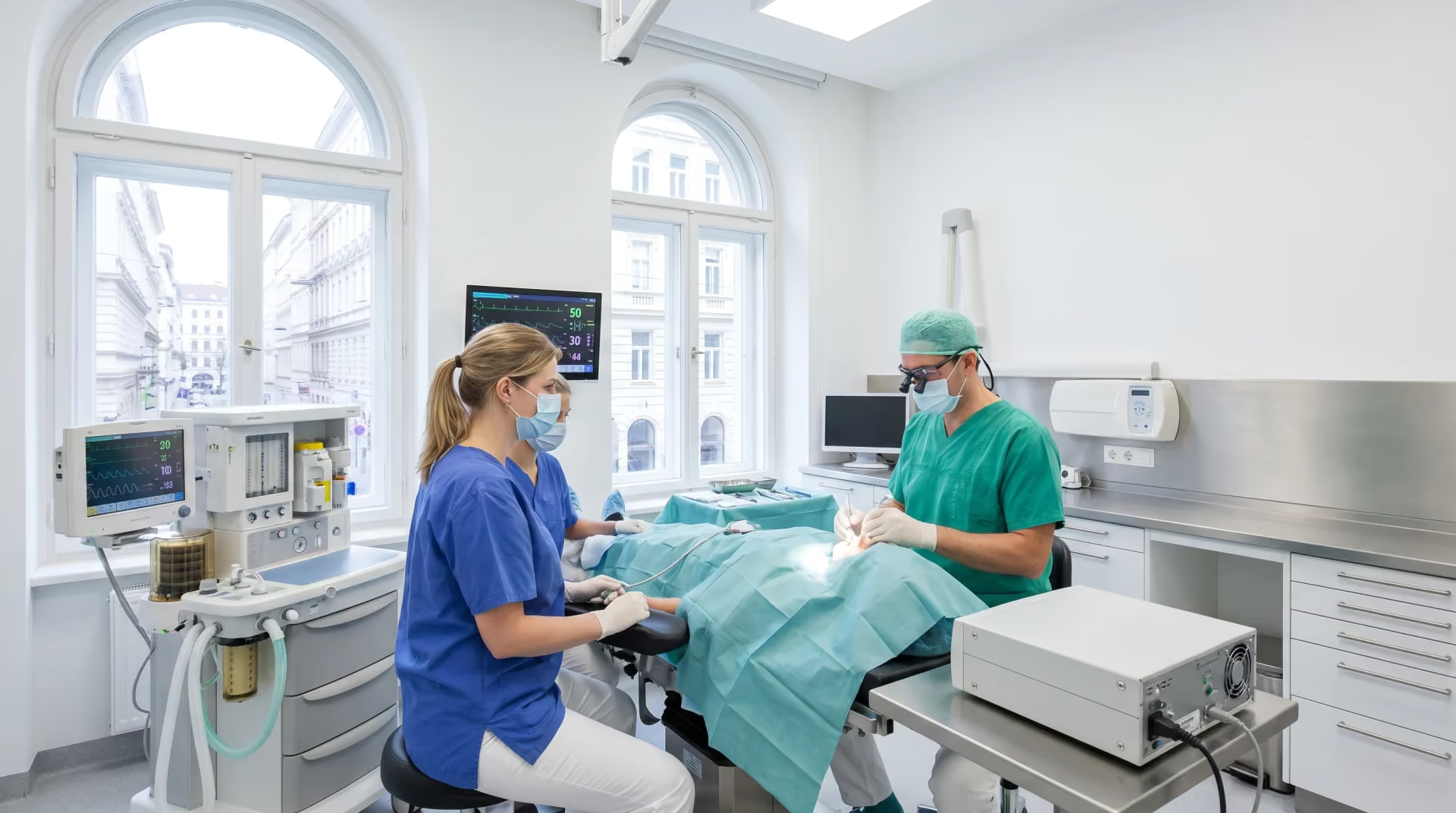
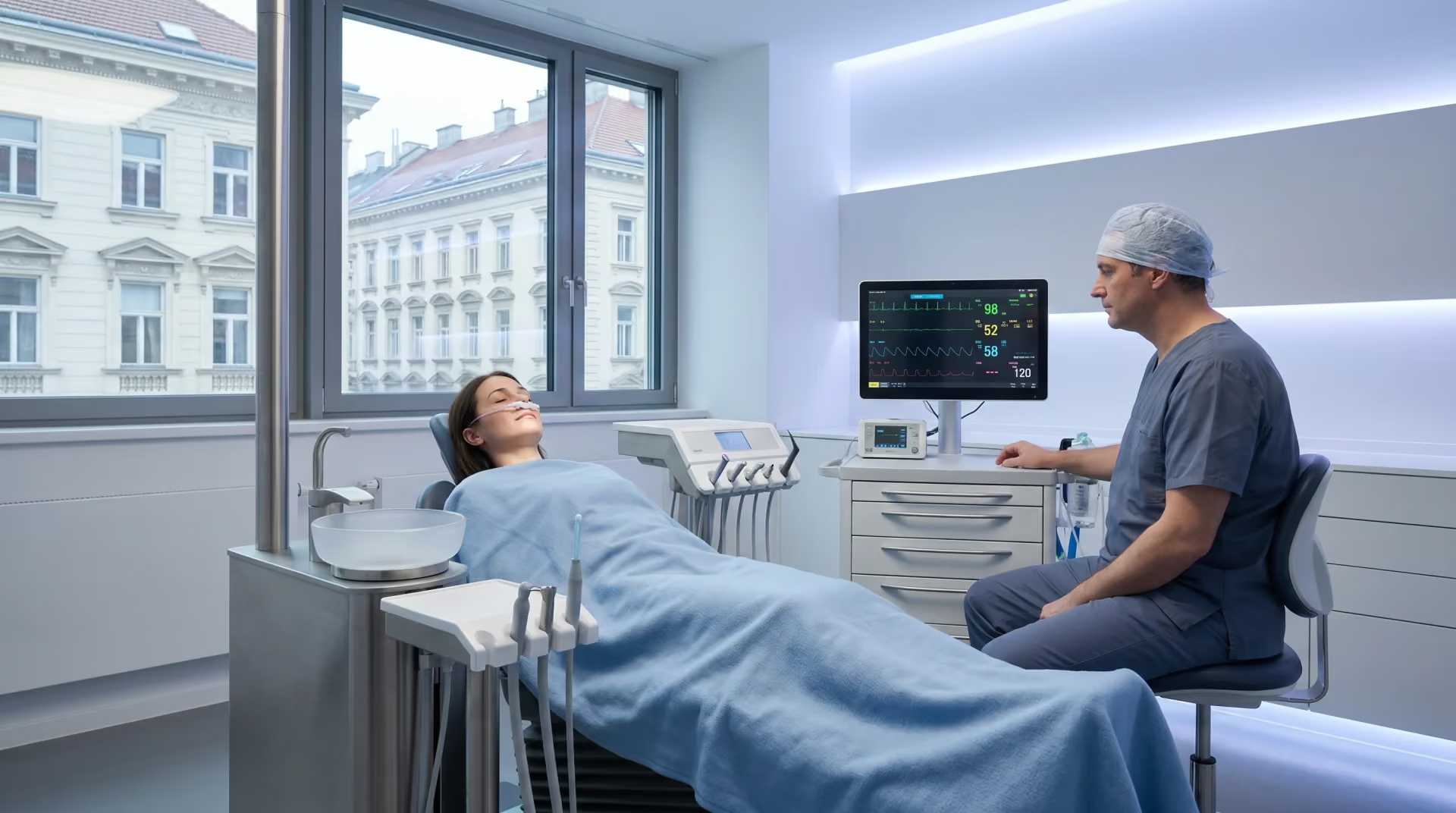
Under general anaesthesia, you are unconscious and usually do not perceive treatment. Pain control forms part of it. Breathing and circulation are monitored, with breathing supported as required or according to the method.
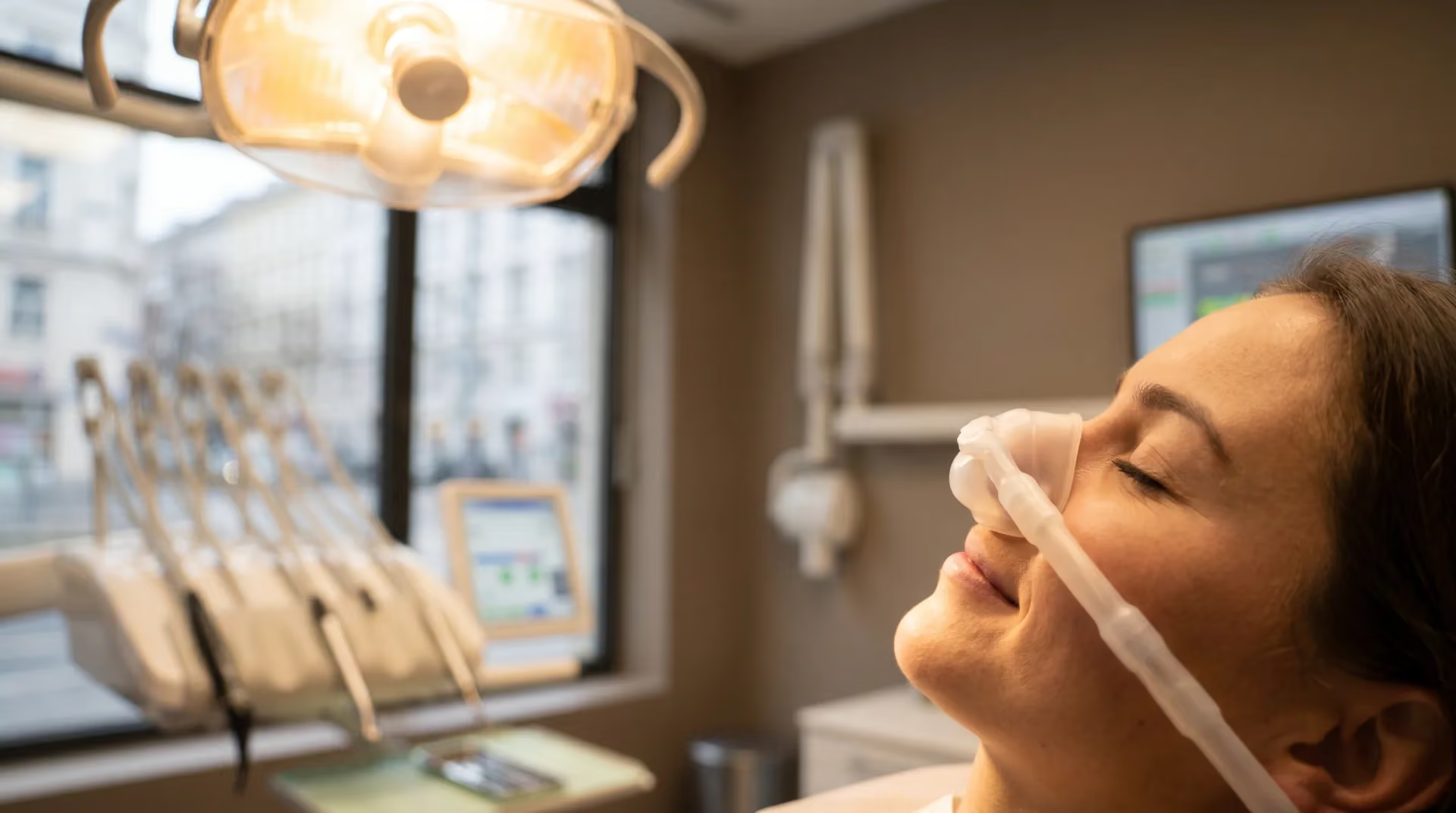
With conscious sedation, often called Dämmerschlaf, responsiveness to speech is generally retained. It differs from general anaesthesia in effects and requirements; location depends on the method and responsible team. Local anaesthesia may also be used during dental surgery under general anaesthesia to reduce subsequent symptoms. This does not make the methods equivalent. For mild to moderate tension, nitrous oxide at the dentist may also be an option; ÖGKiZ points to a professional ÖZÄK warning based on the 2017 OSR statement.
Preparation: questions for the assessment
Your health, dental treatment and anaesthetic method are discussed beforehand. Tell the team about medication, allergies, conditions, previous anaesthetic problems and possible pregnancy. You can also mention fear of intravenous access.
You receive specific instructions on when to stop eating or drinking and how to manage medication. Follow them and ask if unclear. General timing information on a website cannot replace your individual instructions.
Clarifying the treatment location
Smile4Life does not perform general anaesthesia at its practice. If considered, clarify location, the responsible anaesthetic team, monitoring and aftercare with the specific treatment team.
Procedure and recovery
After preparation, anaesthesia is induced and monitored during dental treatment. Care continues as you wake. Discharge depends on your condition and procedure. Several treatment steps cannot always be completed in one appointment.
For outpatient treatment, organise the journey home and required care afterwards. Do not drive yourself after anaesthesia. Obtain written instructions on restrictions involving work, machinery, alcohol, important decisions and sole care of others.
Putting risks into context
Nausea, tiredness, hoarseness or sore throat may occur afterwards. More serious complications, including breathing problems or allergic reactions, are possible. Your personal risk is explained during informed consent.
Anaesthesia aims to enable treatment, but does not automatically remove fear of later dental visits. A plan for the next check is therefore useful. Support and alternatives are explained under dentist for anxious patients in Vienna. The YERIT guide to general anaesthesia explains the detailed procedure and suitability.
What does dental treatment under general anaesthesia cost?
The cost plan should distinguish dental treatment from anaesthesia and care. Scope and organisational requirements may vary. Our price page gives dental market guides, not an individual anaesthesia offer, and contains no separate anaesthesia guide price.
Medical necessity matters for health insurance. Smile4Life is a private practice. You pay our dental invoice initially and may apply for reimbursement from your insurer, such as ÖGK. Where available, reimbursement follows the applicable insurance tariff, not a fixed proportion of our invoice. This explanation does not promise external anaesthesia cover; clarify that invoice and reimbursement with the actual provider and insurer.
Ask your insurer beforehand whether prior approval is required and what it covers. Obtain confirmation in writing. Neither blanket cover nor a general refusal can be promised here. Through contact, you can request records of our dental services. The responsible provider supplies external anaesthesia documentation.
Sources for context
These sources explain general methods; they do not establish a particular service at a Vienna practice.
Plan accompaniment and care after outpatient treatment. Follow the responsible anaesthetic team’s written instructions.
YOUR OPTIONS
TREATMENT OPTIONS COMPARED
We will discuss payment terms with you prior to treatment.
The indicative market prices in our price overview provide an initial guide. We will discuss which services are planned for you and the costs involved based on your examination findings and individual cost plan.
Advanced Dental Aesthetics & Implantology
Priv.Doz.Dr.Dr. K. Yerit
“Aesthetics is not a coincidence, but the result of precise planning and deep passion.”
General anaesthesia is a medical decision, not a convenience service. We first assess whether treatment is possible without it; if not, it takes place in hospital, not at the practice.
View profile →Scientific references
Institute for Implantology and Digital Dentistry Vienna
Österreichische Gesellschaft für Anästhesiologie, Reanimation und Intensivmedizin (ÖGARI)
Cochrane Oral Health
Medizinische Universität Wien — Universitätszahnklinik
Österreichische Zahnärztekammer (ÖZÄK)
Yerit Practice – Dentist Vienna
Frequently asked questions
Frequently asked questions
Do you have a specific question about your diagnosis? Book a consultation appointment directly →
Questions about your treatment?
Discuss what matters to you and what the next steps look like with us.
Book your appointment nowYour orientation
A clearly explained plan helps you decide.
Understanding what’s involved
Preparation and recovery are discussed according to treatment.
In everyday life
Plan accompaniment and care after outpatient treatment. Follow the responsible anaesthetic team’s written instructions.
Who this information is for
General anaesthesia may be considered when necessary treatment cannot otherwise be provided appropriately. Health, anxiety, support needs and scope are assessed together.
Important limitations
Suitability requires individual assessment. Previous anaesthetic problems, medication and conditions belong in informed consent; a website cannot make that decision.
Our approach
SCIENTIFIC STUDIES
Silveira ER et al. (2021). Estimated prevalence of dental fear in adults: A systematic review and meta-analysis
The international review shows that dental anxiety is common among adults. Definitions and results vary, and most included studies had a high risk of bias. The findings are not a measurement of prevalence in Vienna.
33711405
Sun IG et al. (2024). Global prevalence of early childhood dental fear and anxiety: A systematic review and meta-analysis
Among children aged two to six, the pooled prevalence of dental fear and anxiety is 30 %. Children with no previous dental experience and those with experience of tooth decay are more often affected (Journal of Dentistry, 2024).
38246307
Hoffmann B et al. (2022). Management strategies for adult patients with dental anxiety in the dental clinic: a systematic review
The review describes different ways of supporting adults with dental anxiety. Behavioural support and medication serve different purposes; this does not establish a fixed sequence for all patients.
35735746
Piccialli F et al. (2025). Efficacy and Safety of Nitrous Oxide Inhalation Sedation Compared to Other Sedative Agents in Dental Procedures
For the outcomes investigated, the review found no statistically clear differences between nitrous oxide and the comparator agents. This establishes neither general superiority nor equivalence; safety was not assessed systematically.
40428887
Rosa A et al. (2024). Different Uses of Conscious Sedation for Managing Dental Anxiety During Third-Molar Extraction
A systematic review of 18 randomised studies involving 2,081 patients reports inconsistent and partly contradictory findings on conscious sedation for wisdom tooth removal. The authors attribute this to a lack of standardised outcomes and call for more comparable studies (Journal of Craniofacial Surgery, 2024).
39207162
Unnikrishnan G et al. (2024). Effectiveness of behavioural therapy and inhalational sedation in reducing dental anxiety
The meta-analysis included 940 children and adults from different study designs. Behavioural approaches reduced anxiety scores measured before dental treatment more than inhalation sedation; the results were markedly heterogeneous. The authors rated the evidence as high for randomised studies and moderate for observational studies. This concerns anxiety scales, not a promise of the same effect for every person, pain-free care or general treatment success (Unnikrishnan et al., PMID 39506128).
39506128
Zahnbehandlungsangst – Öffentliches Gesundheitsportal Österreichs
For dental phobia, experts recommend combining dental treatment and psychotherapy, with cognitive behavioural therapy as the first approach. In acute situations, benzodiazepines may be considered, followed by nitrous oxide as a second option and general anaesthesia in exceptional cases (gesundheit.gv.at, accessed 03.11.2026).
More topics in this area
Deepen your knowledge – find all information regarding the treatment process, costs, and results.

Partnerships & Memberships & References




