
Composite Bonding: Treatment Procedure in Vienna
From initial discussion to aftercare: understand the steps and include your shape and colour wishes in planning.
Discuss wishes
Agree shape and colour
Understand the steps
Know your care routine
Composite Bonding Procedure Vienna
composite-bonding-ablauf-wien
4.9★
Doctify rating
25+
Years of experience
Personal
In-practice consultation
1010 Vienna
Kärntner Straße 9
At a glance
How does composite bonding work?
After examination and planning, the surface is prepared. Composite is shaped directly, hardened with a suitable light and finished. Shape, bite and surface are checked.
Does bonding require tooth reduction?
This depends on the tooth and planned correction. Small additions often preserve substantial natural structure. Necessary preparation is assessed for each tooth.
How many appointments are needed, and is anaesthesia necessary?
A small correction may be possible in one treatment visit. Scope, pretreatment and sensitivity determine whether extra visits or local anaesthesia are appropriate. Raise questions before starting.
The procedure at a glance
From planning and colour matching through direct composite build-up to polishing and subsequent care.
How does planning begin?
First clarify what you want to change and whether direct composite is suitable. A small gap, broken corner and larger shape change need different planning. Tooth condition and bite matter too: the addition should suit loading, not only appearance.
Mention symptoms, grinding and a wish for lighter teeth. Necessary prior treatment is included in the sequence. The composite bonding overview for Vienna explains possibilities and limits.
Agreeing shape and colour
Before bonding, the desired contour and a shade fitting the surroundings are selected. For gaps, consider the resulting tooth width. For edges, consider loading when biting.
The usefulness of photographs, a model or digital planning depends on scope. Necessary records are discussed beforehand. Mention future whitening early so shade matching can account for it.
Preparing the tooth and building composite
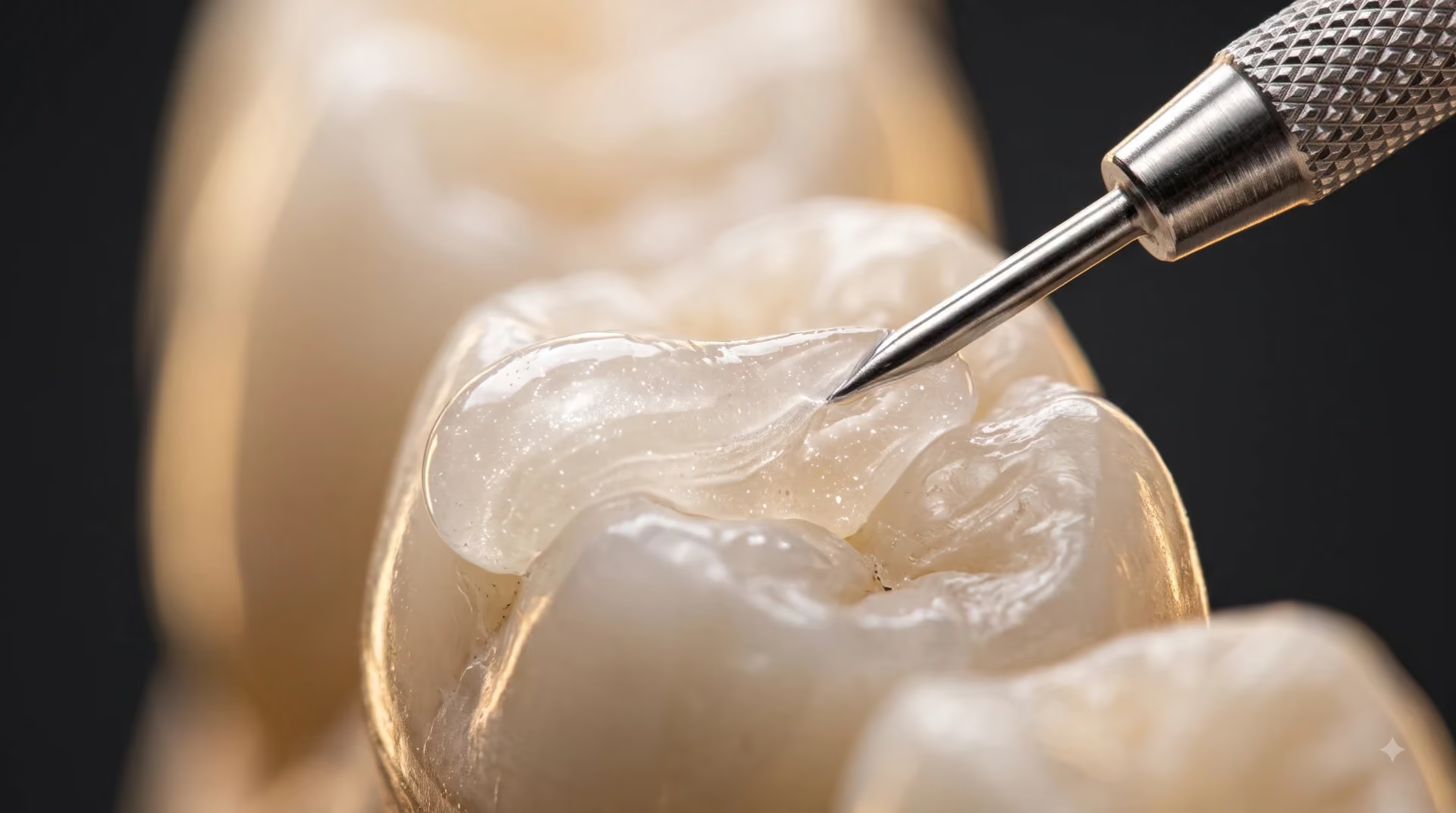
The surface is prepared for bonding and protected from saliva. Adhesives and light curing follow the material system. Tooth-coloured composite is then applied directly and shaped. Small additions may preserve substantial natural structure. Preparation and the amount involved cannot be defined equally for every case.
The material hardens under a suitable light, then contours and surface are finished and polished. The bite is checked. This explains the general method; your personal plan determines the steps.
How many appointments are needed? Is anaesthesia necessary?
This depends on scope and necessary pretreatment. Ask about expected time and appointment numbers. No fixed promise applies to all cases.
Local anaesthesia is decided according to need. Mention sensitivity and worries beforehand. After anaesthesia, wait until feeling returns before eating and follow your personal instructions.
What matters afterwards?
Have a bite that feels unusually high or a sharp edge checked. Persistent or increasing symptoms also warrant contacting the dentist.
Brush regularly and clean between teeth. Avoid nail biting or using teeth to open packaging. Composite may change over time; checks establish whether polishing or repair would help.
Questions before your appointment
Clarify expected outcomes, limits and recommended care. Also discuss follow-up timing and handling of possible adjustments.
The composite bonding cost explanation helps with financial questions. Read the YERIT explanation of composite bonding for clinical background.
Correction scope determines preparation and appointments.
YOUR OPTIONS
TREATMENT OPTIONS COMPARED
We will discuss payment terms with you prior to treatment.
The indicative market prices in our price overview provide an initial guide. We will discuss which services are planned for you and the costs involved based on your examination findings and individual cost plan.
Advanced Dental Aesthetics & Implantology
Priv.Doz.Dr.Dr. K. Yerit
“Aesthetics is not a coincidence, but the result of precise planning and deep passion.”
The procedure follows tooth condition and correction scope. We discuss appropriate preparation and aftercare according to the findings.
View profile →Scientific references
Institute for Implantology and Digital Dentistry Vienna
Deutsche Gesellschaft für Ästhetische Zahnmedizin (DGÄZ)
American Academy of Cosmetic Dentistry (AACD)
European Academy of Esthetic Dentistry (EAED)
Academy of Dental Materials
Yerit Practice – Dentist Vienna
Frequently asked questions
Frequently asked questions
Do you have a specific question about your diagnosis? Book a consultation appointment directly →
Questions about your treatment?
Discuss what matters to you and what the next steps look like with us.
Book your appointment nowYour orientation
Understanding what’s involved
In everyday life
Who this information is for
Important limitations
Our approach
SCIENTIFIC STUDIES
Spencer P et al. (2019). Threats to adhesive/dentin interfacial integrity and next generation bio-enabled multifunctional adhesives
A review article shows that composite fillings fail markedly more often than amalgam fillings at the bonded interface between tooth and restoration; next-generation bioactive adhesives are intended to address this specifically (Journal of Biomedical Materials Research Part B, 2019).
30895695
Ayub JM & Blatz MB (2024). What's Trending in Resin-Based Restorations
A specialist article shows that the long-term clinical success of direct composite restorations depends critically on the choice of restorative material, curing light and matrix technique (Compendium of Continuing Education in Dentistry, 2024).
38289628
Bilen H & Türkün LS (2025). 6-year clinical performance of prefabricated and clear template-formed resin composite veneers
A six-year study began with 74 front-tooth restorations in 21 people and compared direct composite veneers with prefabricated veneers. 15 people attended the six-year review. Both methods remained clinically successful in this follow-up group; observations for direct composite veneers included loss of gloss and marginal staining, and repolishing was described. The small study group does not establish a fixed polishing interval for every bonding correction.
41125803
Mendonça TS et al. (2025). Clinical performance of posterior resin composite restorations bonded with universal adhesive system
A 26-month study of 138 composite fillings demonstrates acceptable clinical performance regardless of the adhesive application method chosen, with differences limited to minor marginal staining (Journal of Applied Oral Science, 2025).
41259555
Raucci Neto W et al. (2025). Effectiveness of the Beautibond Xtreme adhesive system in class I and II restorations: one-year results
A randomised one-year study involving 152 teeth shows better clinical performance of the adhesive when used with total-etch or selective enamel etching than with the self-etch technique (Journal of Applied Oral Science, 2025).
41092140
Mališauskienė A et al. (2026). Efficient diastema closure – the modified Mylar pull technique
A specialist article describes a modified direct-bonding technique for closing gaps that applies composite specifically to the proximal surfaces, creating a natural appearance without a visible buccal veneer layer (The International Journal of Esthetic Dentistry, 2026).
42145245
More topics in this area
Deepen your knowledge – find all information regarding the treatment process, costs, and results.



Partnerships & Memberships & References




